
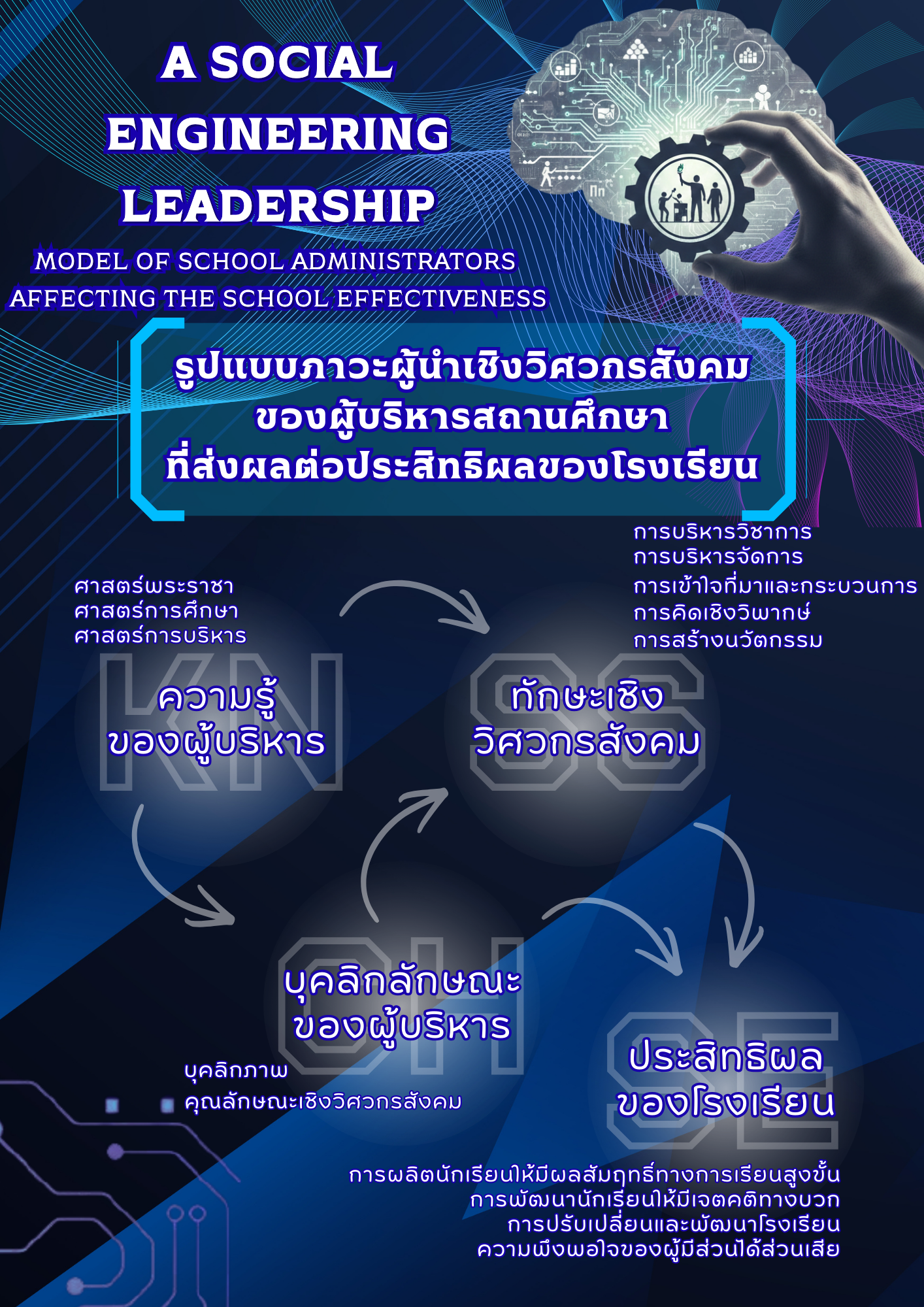
รูปแบบภาวะผู้นำเชิงวิศวกรสังคมของผู้บริหารสถานศึกษาที่ส่งผลต่อประสิทธิผลของโรงเรียน (A social engineering leadership model of school administrators affecting school effectiveness)
Article Sidebar
Main Article Content
Abstract
ท่ามกลางความท้าทายของการปฏิรูปการศึกษาในศตวรรษที่ 21 สถานศึกษาจำเป็นต้องมีนวัตกรรมการบริหารที่สามารถแก้ไขปัญหาเชิงโครงสร้างและสร้างการเปลี่ยนแปลงอย่างยั่งยืน ภาวะผู้นำเชิงวิศวกรสังคมจึงเป็นสมรรถนะสำคัญที่จะช่วยขับเคลื่อนประสิทธิผลของสถานศึกษาให้เท่าทันต่อการเปลี่ยนแปลง การวิจัยนี้มีวัตถุประสงค์เพื่อ 1) ศึกษาสภาพจริงและสภาพที่คาดหวังของภาวะผู้นำเชิงวิศวกรสังคมของผู้บริหารสถานศึกษาที่ส่งผลต่อประสิทธิผลของโรงเรียน 2) พัฒนารูปแบบภาวะผู้นำเชิงวิศวกรสังคม และ 3) ตรวจสอบความสอดคล้องของแบบจำลองโครงสร้างความสัมพันธ์เชิงสาเหตุที่สร้างขึ้นกับข้อมูลเชิงประจักษ์ ประชากร คือ ผู้บริหารสถานศึกษาและครูในโรงเรียนสังกัดสำนักงานเขตพื้นที่การศึกษาประถมศึกษาสุราษฎร์ธานี เขต 2 จำนวน 1,847 คน กลุ่มตัวอย่าง จำนวน 327 คน เครื่องมือที่ใช้ ได้แก่ แบบสอบถาม (มีค่าความเชื่อมั่นทั้งฉบับเท่ากับ 0.98) และแบบสัมภาษณ์ การวิเคราะห์ข้อมูลใช้สถิติเชิงพรรณนา และสถิติเชิงอนุมาน ได้แก่ การวิเคราะห์องค์ประกอบเชิงยืนยัน (CFA) การวิเคราะห์โมเดลสมการเชิงโครงสร้าง (SEM) และการวิเคราะห์เส้นทาง (path analysis) โดยใช้โปรแกรม Mplus ผลการวิจัยพบว่า 1) ค่าเฉลี่ยของภาวะผู้นำเชิงวิศวกรสังคมและประสิทธิผลของโรงเรียนในสภาพที่คาดหวังสูงกว่าสภาพจริงอย่างมีนัยสำคัญทางสถิติที่ระดับ 0.001 2) รูปแบบความสัมพันธ์เชิงสาเหตุที่พัฒนาขึ้นมีองค์ประกอบ 4 ด้าน 14 ตัวบ่งชี้ มีความถูกต้อง เหมาะสม เชื่อถือได้และมีประสิทธิภาพ 3) แบบจำลองมีความสอดคล้องกับข้อมูลเชิงประจักษ์ โดยมีดัชนีความสอดคล้อง χ²/df = 2.43, RMSEA = 0.070, CFI = 0.971, TLI = 0.963, SRMR = 0.024 และสามารถอธิบายความแปรปรวนของประสิทธิผลของโรงเรียนได้ร้อยละ 88 ซึ่งผลการวิจัยสามารถนำไปใช้เป็นแนวทางในการพัฒนาภาวะผู้นำของผู้บริหารสถานศึกษาเพื่อยกระดับประสิทธิผลของโรงเรียนในอนาคต
Amid the challenges of educational reform in the 21st-century, educational institutions require administrative innovations capable of addressing structural problems and fostering sustainable change. Social engineering leadership has therefore emerged as a critical competency for driving school effectiveness in response to these transformations. This research aimed to: 1) examine the actual and expected conditions of social engineering leadership among school administrators affecting school effectiveness; 2) develop a social engineering leadership model; and 3) validate the consistency of the proposed structural causal model with empirical data. The population consisted of 1,847 school administrators and teachers under the jurisdiction of the Surat Thani Primary Educational Service Area Office 2, with a sample of 327 participants. The research instruments included a questionnaire (with an overall reliable coefficient of 0.98) and an interview form. Data were analyzed using descriptive statistics and inferential statistics, including Confirmatory Factor Analysis (CFA), Structural Equation Modeling (SEM), and path analysis, conducted using Mplus. The findings revealed that: 1) the mean scores for social engineering leadership and school effectiveness in the expected condition were significantly higher than those in the actual condition at the 0.001 level; 2) the developed causal model comprised four components and fourteen indicators, demonstrating validity, appropriateness, reliability, and effectiveness; and 3) the structural model showed a good fit with the empirical data (χ²/df = 2.43, RMSEA = 0.070, CFI = 0.971, TLI = 0.963, SRMR = 0.024) and explained 88% of the variance in school effectiveness. The findings may serve as a guideline for enhancing school administrators’ leadership to improve school effectiveness in the future.
Downloads
Article Details

This work is licensed under a Creative Commons Attribution-NonCommercial-NoDerivatives 4.0 International License.
References
Bass, B. M., & Avolio, B. J. (1994). Improving organizational effectiveness through transformational leadership. Sage.
Burns, J. M. (1978). Leadership. Harper & Row.
Chawakitphaiboon, W., Yafu, S., & Potipitak, P. (2023). Relationship between creative leadership and academic operation of schools under the Chainat Primary Educational Service Area Office (ความสัมพันธ์ระหว่างภาวะผู้นำเชิงสร้างสรรค์กับการดำเนินงานวิชาการของโรงเรียน สังกัดสำนักงานเขตพื้นที่การศึกษาประถมศึกษาชัยนาท). The Journal of Research and Academics, 6(1), 161–176. https://doi.org/10.14456/jra.2023.12
Eisner, E. W. (1976). Educational connoisseurship and criticism: Their form and functions in educational evaluation. The Journal of Aesthetic Education, 10(3/4), 135–150. https://doi.org/10.2307/3332067
Fongsri, P. (2015). Educational research (วิจัยทางการศึกษา) (9th ed.). Dan Sutta Printing.
Fullan, M. (2001). Leading in a culture of change. Jossey-Bass.
Hoy, W. K., & Miskel, C. G. (2001). Educational administration: Theory, research, and practice (6th ed.). McGraw-Hill.
Issaro, N. (2021). Student development handbook for national development (คู่มือพัฒนานักศึกษาเพื่อการพัฒนาประเทศ). Amarin.
Jomtraikhup, R. (2020). A causal relationship model of selected factors affecting effectiveness of secondary schools in the northeastern region (โมเดลความสัมพันธ์เชิงสาเหตุของปัจจัยคัดสรรที่ส่งผลต่อประสิทธิผลของโรงเรียนมัธยมศึกษาในภาคตะวันออกเฉียงเหนือ) [Doctoral dissertation, Sakon Nakhon Rajabhat University]. Sakon Nakhon Rajabhat University e-Thesis. https://gsmis.snru.ac.th/e-thesis/thesis_detail?r=60632250106
Kamphaeng, K. (2020). A leadership model of school administrators affecting the effectiveness of primary schools in Khon Kaen province: A competing model of innovative leadership and digital leadership (โมเดลภาวะผู้นำของผู้บริหารสถานศึกษาที่ส่งผลต่อประสิทธิผลของโรงเรียนประถมศึกษาในจังหวัดขอนแก่น : โมเดลแข่งขันภาวะผู้นำเชิงนวัตกรรมและภาวะผู้นำแบบดิจิทัล) [Unpublished master’s thesis]. Khon Kaen University.
Krejcie, R. V., & Morgan, D. W. (1970). Determining sample size for research activities. Educational and Psychological Measurement, 30(3), 607–610. https://doi.org/10.1177/001316447003000308
Leithwood, K., Day, C., Sammons, P., Harris, A., & Hopkins, D. (2006). Seven strong claims about successful school leadership. National College for School Leadership.
Ministerial Regulation on the Decentralization of Administration and Educational Management B.E. 2550. (2007, August 24). Royal Thai Government Gazette. No. 124 Section 60 A. pp. 1–10.
Office of the Education Council. (2002). National Education Act B.E. 2542 (1999) and amendments (Second National Education Act B.E. 2545 (2002)) (พระราชบัญญัติการศึกษาแห่งชาติ พ.ศ. 2542 และที่แก้ไขเพิ่มเติม (ฉบับที่ 2) พ.ศ. 2545). Office of the Education Council, Ministry of Education.
Pradu, Y., Charoensuk, B., & Pechrpuang, S. (2021). The characteristics of the school administrators that affect the effectiveness of the school as perceived by school administrators and teachers under Surat Thani Primary Educational Service Area Office 3 (คุณลักษณะของผู้บริหารสถานศึกษาที่ส่งผลต่อประสิทธิผลของสถานศึกษาตามการรับรู้ของผู้บริหารและครูสังกัดสำนักงานเขตพื้นที่การศึกษาประถมศึกษา สุราษฎร์ธานี เขต 3). Journal of Social Sciences in Measurement Evaluation Statistics and Research, 2(1), 47–56. https://so03.tci-thaijo.org/index.php/mesr/article/view/253448
Saengmookda, S. (2022). Development of critical thinking skills of basic education administrators (การพัฒนาทักษะการคิดเชิงวิพากษ์ของผู้บริหารสถานศึกษาขั้นพื้นฐาน). MBU Education Journal, 10(2), 240–252. https://so04.tci-thaijo.org/index.php/edj/article/view/260813
Surat Thani Primary Educational Service Area Office 2. (2023). Annual performance report for fiscal year 2023 (รายงานผลการดำเนินงาน ประจำปีงบประมาณ พ.ศ. 2566). Surat Thani Primary Educational Service Area Office 2.
Suratthani Rajabhat University. (2023). Social engineering handbook: From policy to concrete integrated practical implementation, Suratthani Rajabhat University model (คู่มือวิศวกรสังคม : จากนโยบายสู่การบูรณาการขับเคลื่อนภาคปฏิบัติอย่างเป็นรูปธรรม ตามแบบฉบับมหาวิทยาลัยราชภัฏสุราษฎร์ธานี). Special Policy Unit, Student Development Division, Suratthani Rajabhat University.
Tansukrueng, J., Chatruprachewin, C., & Chaowachai, S. (2023). An administrative model based on the King’s philosophy to improve the quality of students in schools under Primary Educational Service Area Office (รูปแบบการบริหารตามศาสตร์พระราชาเพื่อพัฒนาคุณภาพผู้เรียนในสถานศึกษา สังกัดสำนักงานเขตพื้นที่การศึกษาประถมศึกษา). Journal of MCU Peace Studies, 11(2), 412–426. https://so03.tci-thaijo.org/index.php/journal-peace/article/view/264804
Wiratchai, N. (2005). Research trends in the knowledge-based society (แนวโน้มการวิจัยในยุคสังคมความรู้). Journal of Educational Administration, Khon Kaen University, 1(2), 9–18.
Wonganuttaroj, P. (2010). Academic administration (การบริหารงานวิชาการ). Bangkok Media Support Center.
Wongkam, R., & Pranpa, M. (2025). Administrative skills of school administrators in the 21st century of administrators in Nawawattana group schools under the jurisdiction of the Pathum Thani Primary Educational Service Area Office 2 (ทักษะการบริหารของผู้บริหารสถานศึกษาในศตวรรษที่ 21 ของผู้บริหารในโรงเรียนกลุ่มนววัฒนา สังกัดสำนักงานเขตพื้นที่การศึกษาประถมศึกษาปทุมธานี เขต 2). Journal of Educational Innovation and Research, 9(1), 1–16. https://so03.tci-thaijo.org/index.php/jeir/article/view/275893
