การพัฒนาพื้นที่การท่องเที่ยวเชิงวัฒนธรรมชุมชนอย่างยั่งยืน ตำบลงิ้วราย อำเภอนครชัยศรี จังหวัดนครปฐม (Sustainable development of community cultural tourism in Ngiw Rai, Nakhon Chai Sri, Nakhon Pathom)
Article Sidebar
Main Article Content
Abstract
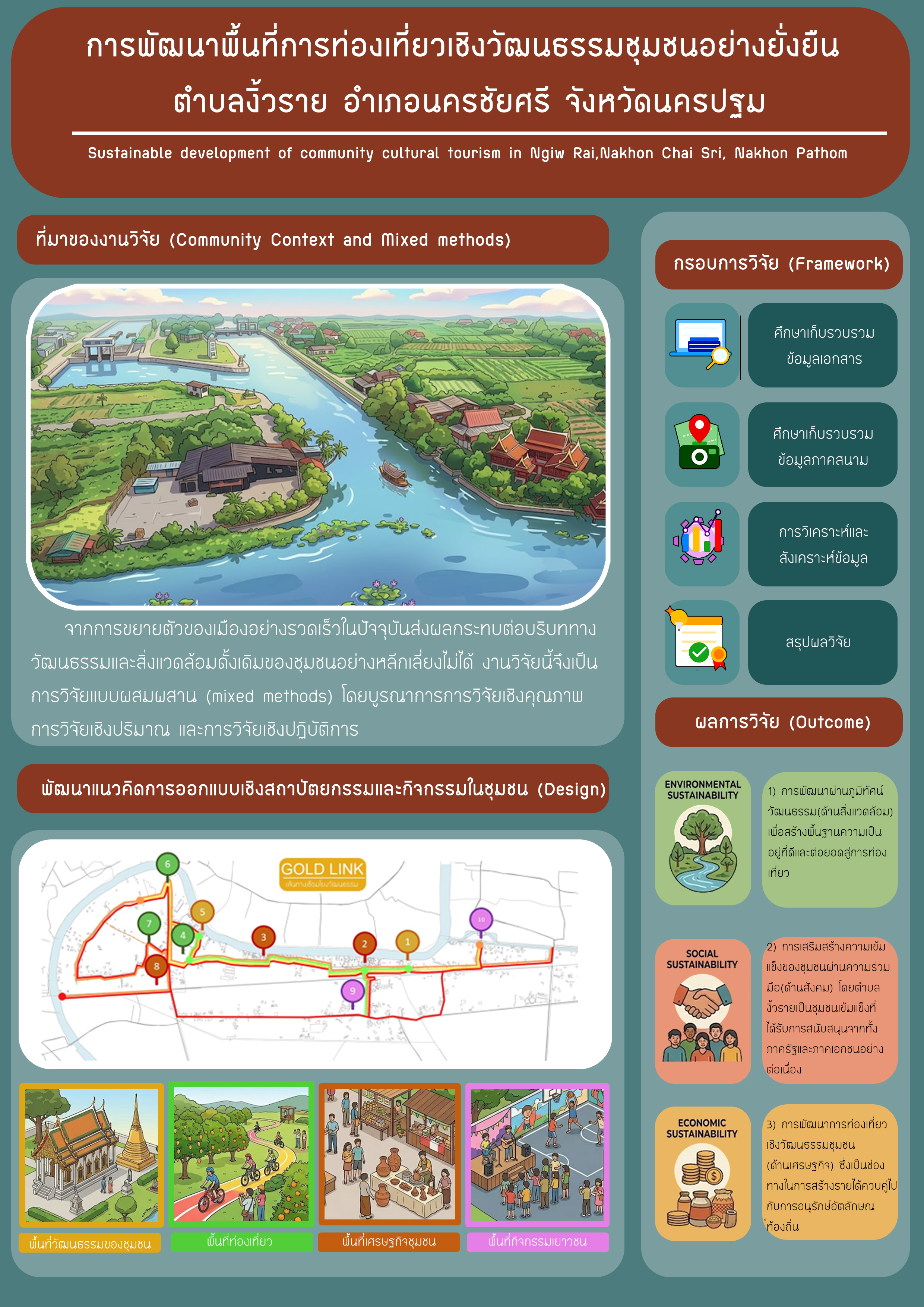
จากการขยายตัวของเมืองอย่างรวดเร็วในปัจจุบันส่งผลกระทบต่อบริบททางวัฒนธรรมและสิ่งแวดล้อมดั้งเดิมของชุมชนอย่างหลีกเลี่ยงไม่ได้ งานวิจัยนี้จึงเป็นการวิจัยแบบผสมผสาน (mixed methods) โดยบูรณาการการวิจัยเชิงคุณภาพ การวิจัยเชิงปริมาณ และการวิจัยเชิงปฏิบัติการ มีวัตถุประสงค์เพื่อ 1) ศึกษาและทำความเข้าใจบริบทของชุมชนโดยรอบพื้นที่ในหลากหลายมิติ ทั้งด้านวิถีชีวิต สังคม เศรษฐกิจ วัฒนธรรม สถาปัตยกรรม รวมถึงการสร้างกระบวนการมีส่วนร่วมเพื่อสะท้อนความต้องการที่มีต่อพื้นที่สร้างสรรค์ 2) ออกแบบด้านสถาปัตยกรรมและภูมิสถาปัตยกรรมให้สอดคล้องกับข้อมูลที่ได้จากกระบวนการมีส่วนร่วมกับชุมชน และ 3) สร้างความรู้สึกเป็นเจ้าของพื้นที่ร่วมกันในกลุ่มเยาวชน คนในพื้นที่ และหน่วยงานท้องถิ่น ซึ่งนำไปสู่การบริหารจัดการและดูแลพื้นที่อย่างยั่งยืน งานวิจัยบูรณาการแนวคิดเรื่องวัฒนธรรมชุมชน การออกแบบแบบมีส่วนร่วม การท่องเที่ยวยั่งยืน และภูมิทัศน์วัฒนธรรม ผ่านกระบวนการทำงานร่วมกัน (co-creation) และการสร้างสรรค์พื้นที่ (placemaking) เพื่อส่งเสริมบทบาทของชุมชนในการออกแบบภูมิทัศน์วัฒนธรรมและพัฒนากิจกรรมสร้างสรรค์อีกทั้งเตรียมพร้อมการขยายตัวของเมืองที่จะทำลายบริบททางวัฒนธรรมและสิ่งแวดล้อม วิธีดำเนินการวิจัย ประกอบด้วย การเก็บรวบรวมข้อมูลจากการสัมภาษณ์ และเวทีเสวนาร่วมกับคนในชุมชน เพื่อนำมาวิเคราะห์และพัฒนาแนวคิดการออกแบบเชิงสถาปัตยกรรมและกิจกรรมที่สะท้อนอัตลักษณ์ชุมชน ผลการวิจัยพบว่า แนวทางการพัฒนาสามารถจำแนกออกเป็น 3 ด้านหลัก ได้แก่ 1) การพัฒนาผ่านภูมิทัศน์วัฒนธรรม (ด้านสิ่งแวดล้อม) เพื่อสร้างพื้นฐานความเป็นอยู่ที่ดีและต่อยอดสู่การท่องเที่ยว 2) การเสริมสร้างความเข้มแข็งของชุมชนผ่านความร่วมมือ (ด้านสังคม) โดยตำบลงิ้วรายเป็นชุมชนเข้มแข็งที่ได้รับการสนับสนุนจากทั้งภาครัฐและภาคเอกชนอย่างต่อเนื่องและ 3) การพัฒนาการท่องเที่ยวเชิงวัฒนธรรมชุมชน (ด้านเศรษฐกิจ) ซึ่งเป็นช่องทางในการสร้างรายได้ควบคู่ไปกับการอนุรักษ์อัตลักษณ์ท้องถิ่น ผลลัพธ์จากงานวิจัยนี้สามารถนำไปใช้เป็นแนวทางเชิงปฏิบัติสำหรับหน่วยงานท้องถิ่นในการพัฒนาพื้นที่สาธารณะของชุมชน ตลอดจนการสร้างกระบวนการมีส่วนร่วมเพื่อการอนุรักษ์และพัฒนาเมืองอย่างยั่งยืน
Rapid urban expansion inevitably impacts the traditional cultural and environmental contexts of local communities. Consequently, this research adopts a mixed-methods approach, integrating qualitative, quantitative, and action research. The objectives are three-fold: 1) to understand multifaceted community contexts—encompassing lifestyle, social, economic, cultural, and architectural dimensions—while establishing participatory processes to reflect needs for creative spaces; 2) to design architecture and landscapes aligned with community engagement data; and 3) to foster a collective sense of ownership among youth, residents, and local authorities, leading to sustainable area management. The study integrates community culture, participatory design, sustainable tourism, and cultural landscapes through co-creation and placemaking. These approaches aim to empower the community in cultural landscape design and creative activity development, while preparing for the effects of urban expansion that threaten cultural and environmental contexts. The methodology involves data collection through interviews and community forums to analyze and develop architectural design concepts and activities that reflect community identity. The findings reveal three primary development dimensions: 1) cultural landscape development (environmental) to improve well-being and promote tourism; 2) strengthening community through collaboration (social), highlighting Ngiw Rai as a resilient community continuously supported by public and private sectors; and 3) community-based cultural tourism development (economic) to generate income, while preserving local identity. The outcomes provide practical guidelines for local authorities in public space planning and development, serving as a model for participatory processes in sustainable urban conservation and development.
Downloads
Article Details

This work is licensed under a Creative Commons Attribution-NonCommercial-NoDerivatives 4.0 International License.
References
Boon-ying, P. (2023). Theory and principle of community development (เอกสารประกอบการสอนวิชาทฤษฎีและหลักการพัฒนาชุมชน) [Unpublished manuscript]. Faculty of Humanities and Social Sciences, Nakhon Si Thammarat Rajabhat University.
Chittangwatthana, B. (2005). Sustainable tourism development (การพัฒนาการท่องเที่ยวแบบยั่งยืน). Tourism Authority of Thailand Academic Center.
Chumruksa, C., Niramol, K., & Suwanmanee, S. (2019). Cultural landscapes of Khao Pu’s community learning center on the way of life, water and forest (ภูมิทัศน์วัฒนธรรมศูนย์การเรียนรู้ชุมชนวิถี คน น้ำ ป่า เขาปู่). Journal of Education Thaksin University, 19(1), 115–133. https://so02.tci-thaijo.org/index.php/eduthu/article/view/191434
Global Sustainable Tourism Council. (2019). GSTC criteria for tourist attractions version 2.0 (เกณฑ์ GSTC สำหรับแหล่งท่องเที่ยว Version 2.0). https://www.gstc.org/wp-content/uploads/GSTC-Criteria-for-Destinations-2.0-Thai.pdf
Kirdsiri, K. (2008). Community and cultural landscape (ชุมชนกับภูมิทัศน์วัฒนธรรม). Southeast Asia Publishing House.
Klawijan, U. (2017). Guidelines for success of community-based tourism management (แนวทางสู่ความสำเร็จของการจัดการการท่องเที่ยวโดยชุมชน). SAU Journal of Social Sciences & Humanities, 1(2), 70–79. https://so05.tci-thaijo.org/index.php/saujournalssh/article/view/172274
Namburi, S. (2019). Participation theory in public administration (ทฤษฎีการมีส่วนร่วมในงานรัฐประศาสนศาสตร์). The Journal of Research and Academics, 2(1), 183–197. https://so06.tci-thaijo.org/index.php/jra/article/view/179213
Office of the National Culture Commission, Ministry of Culture, & Faculty of Architecture, Silpakorn University. (2006). Guidelines for cultural landscape management (แนวทางการจัดการภูมิทัศน์วัฒนธรรม). Amarin Printing and Publishing.
Padthaisong, S. (2002). Community culture: Conditions for community strength (วัฒนธรรมชุมชน : เงื่อนไขความเข้มแข็งชุมชน/หมู่บ้าน). Journal of Behavioral Science, 8(1), 11–20. https://so06.tci-thaijo.org/index.php/BSRI/article/view/1989
Phaetlakfa, C. (2013). Participation of urban community in developing arts and culture learning center: Cast study, Lad Prao community (การมีส่วนร่วมของชุมชนเมืองในการพัฒนาแหล่งเรียนรู้ศิลปวัฒนธรรม : กรณีศึกษาชุมชนลาดพร้าว). Institute of Culture and Arts Journal, 14(2), 1–23. https://so02.tci-thaijo.org/index.php/jica/article/view/15165
Piamkum, K., & Chubchuwong, M. (2022). An analysis of creative tourism activities affecting the satisfaction and loyalty of Thai tourists: A case study of Ban Laem sub-district community, Suphan Buri (การวิเคราะห์ประสบการณ์จากการเข้าร่วมกิจกรรมท่องเที่ยวเชิงสร้างสรรค์ที่ส่งผลต่อความพึงพอใจและความภักดีของนักท่องเที่ยวชาวไทย กรณีศึกษา ชุมชนตำบลบ้านแหลม จังหวัดสุพรรณบุรี). Journal of Social Sciences and Humanities Association of Private Higher Education Institutions of Thailand, 28(2), 77–90. https://so06.tci-thaijo.org/index.php/apheit-ss/article/view/258777
Polnyotee, M., Noonium, S., & Sakulwanichcharoen, S. (2022). Sustainable community-based tourism development guideline: A case study of Tai Dam community at Ban Na Pa Nard, Chiang Khan district, Loei province (แนวทางการพัฒนาการท่องเที่ยวโดยชุมชนอย่างยั่งยืน กรณีศึกษา ชุมชนไทดำ บ้านนาป่าหนาด อำเภอเชียงคาน จังหวัดเลย). Journal of International and Thai Tourism, 18(1), 1–25. https://so02.tci-thaijo.org/index.php/jitt/article/view/254270
Rattanathaworn, T. (2015). A study of spatial morphology of urban communities in agricultural areas in the Nakhon Chai Si river basin Nakhon Pathom province (การศึกษาสัณฐานเชิงพื้นที่ของชุมชนเมืองในพื้นที่เกษตรกรรมบริเวณลุ่มแม่น้ำนครชัยศรี จังหวัดนครปฐม) [Unpublished manuscript]. Faculty of Architecture and Design, Rajamangala University of Technology Rattanakosin.
Singhapat, S. (2017). Creative cultural tourism: Additional revenue activities for Phutai’s Ban Phon community in Kalasin province (ท่องเที่ยวเชิงสร้างสรรค์ทางวัฒนธรรม : กิจกรรมสร้างรายได้เพิ่มแก่ชุมชนผู้ไทบ้านโพน จังหวัดกาฬสินธุ์). Burapha Journal of Political Economy, 5(1), 53–67. https://so01.tci-thaijo.org/index.php/pegbuu/article/view/199190
Teerarat, S., & Pooripakdee, S. (2021). Perceptions of 2nd tier city’s attractiveness in Thailand that affect corporate meetings and incentive travel business’s preferences (การรับรู้ในเสน่ห์เมืองรองของประเทศไทยที่ส่งผลต่อความพึงพอใจในธุรกิจการประชุมองค์กรและการท่องเที่ยวเพื่อเป็นรางวัล). Journal of Yala Rajabhat University, 16(3), 337–347. https://so04.tci-thaijo.org/index.php/yru_human/article/view/241849
Thai Health Working Group. (2011). Thai health 2011: HIA: A mechanism for healthy public policy. Institute for Population and Social Research, Mahidol University, Thai Health Promotion Foundation, and The National Health Commission Office. https://www.hiso.or.th/thaihealthstat/report/thaihealth.php?y=2011&l=eng
Thupthong, S. (2019). Guidelines for promotion Ban Ronghuad earthenware learning center according to philosophy of the sufficiency economy (แนวทางส่งเสริมแหล่งเรียนรู้เครื่องปั้นดินเผาบ้านโรงหวดตามแนวคิดปรัชญาของเศรษฐกิจพอเพียง) [Master’s thesis, Silpakorn University]. DSpace at Silpakorn University. http://ithesis-ir.su.ac.th/dspace/handle/123456789/2719
United Nations Thailand. (n.d.). Our work on the sustainable development goals in Thailand (งานของเราเกี่ยวกับเป้าหมายการพัฒนาที่ยั่งยืนในประเทศไทย). https://thailand.un.org/th/sdgs
