
นวัตกรรมจัดการเรียนรู้บูรณาการเชิงพื้นที่เพื่อส่งเสริมสมรรถนะนักเรียน (An innovative area-based integrated learning management approach to enhance student competencies)
Article Sidebar
Main Article Content
Abstract
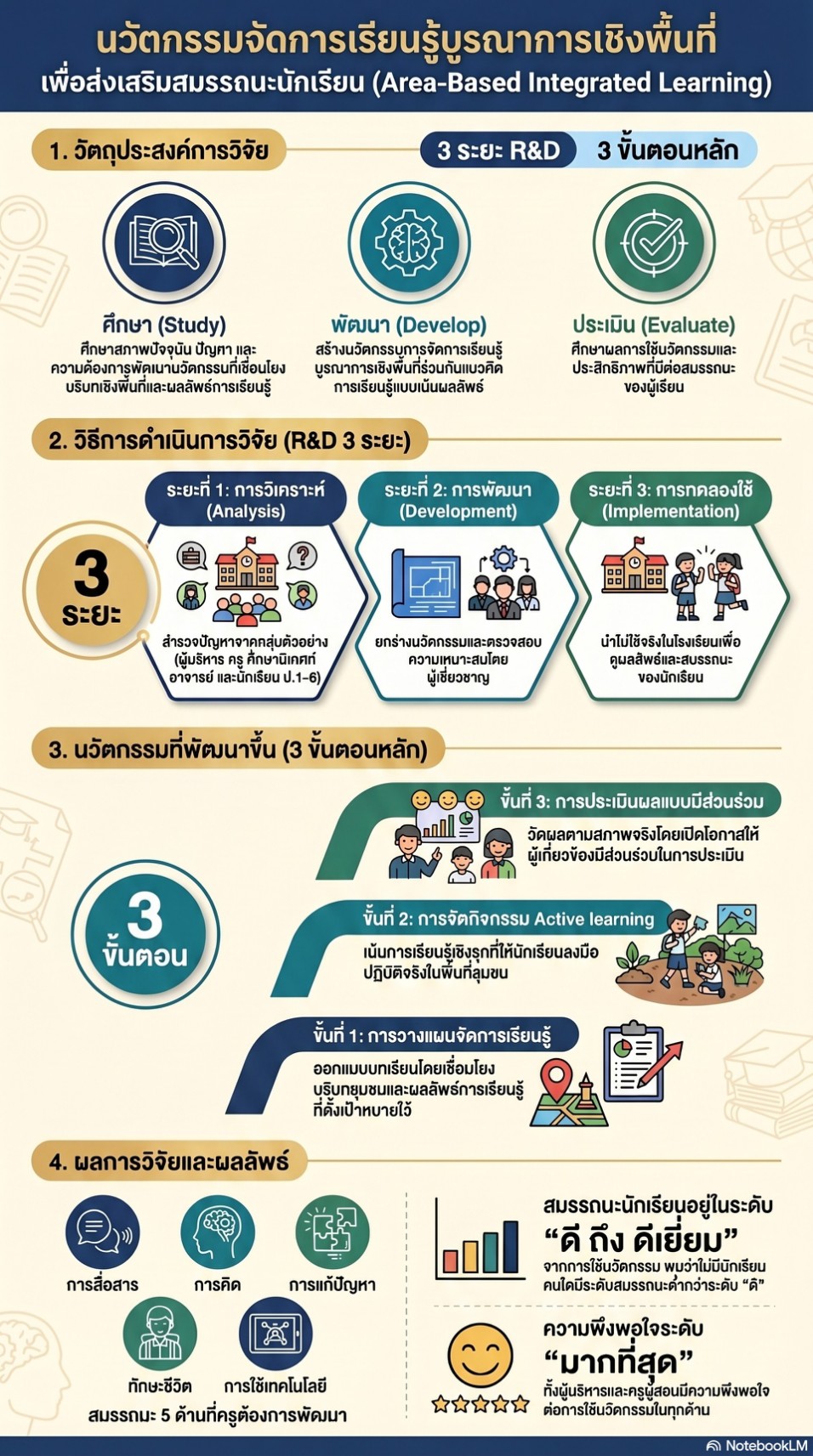
Rapid changes in society and technology require elementary education to develop learners’ competencies aligned with real-life contexts and clearly defined learning outcomes. However, the integration of area-based contexts with outcome-based learning remains insufficiently articulated at the procedural level. The purposes of this research were to: 1) examine the current conditions, problems, and needs for developing an integrated learning management innovation that incorporates area-based contexts together with an outcome-based learning approach; 2) develop the innovation; and 3) investigate the results of its implementation. The study employed a research and development (R&D) design conducted in three phases. The sample consisted of school administrators, teachers, educational supervisors, university lecturers, and students in Grades 1–6. The research instruments included interview forms, evaluation forms, and focus group discussion records. Data were analyzed using descriptive statistics and content analysis. The findings revealed that schools attempted to promote students’ competencies through active learning activities; however, the process of integrating community context and applying learning outcomes remained unclear. Teachers expressed a need to develop students’ competencies in five key areas: communication, thinking, problem-solving, life skills, and technology. The developed innovation comprised three main stages: learning management planning, active learning-based activities, and participatory assessment, all grounded in community context. The implementation results indicated that teachers were able to effectively implement integrated learning management. Students demonstrated competencies at good to excellent levels, with no students performing below the good level. Teachers and administrators reported the highest level of satisfaction in all aspects. These findings offer a clear procedural framework for integrating area-based contexts with outcome-based learning and can serve as a model for teacher development, curriculum design, and instructional practices in primary education, particularly in special or remote areas, to effectively enhance student competencies.
Downloads
Article Details

This work is licensed under a Creative Commons Attribution-NonCommercial-NoDerivatives 4.0 International License.
References
Angganapattarakajorn, V. (2009). Integrational instruction (การจัดการเรียนรู้แบบบูรณาการ). Journal of Education, 20(3), 1–12.
Banhuaysom School. (2024). Learning management plan for primary education (แผนการจัดการเรียนรู้ ระดับประถมศึกษา). Banhuaysom School.
Banks, J. A. (2016). Cultural diversity and education: Foundations, curriculum, and teaching (6th ed.). Routledge.
Catts, R., & Lau, J. (2008). Towards information literacy indicators: Conceptual framework paper. UNESCO. http://unesdoc.unesco.org/images/0015/001587/158723e.pdf
Equitable Education Fund (EEF). (2023, March 14). Area-based education: Addressing pain points and closing gaps (การจัดการศึกษาเชิงพื้นที่ (area-based education) แก้จุดเจ็บ เย็บจุดขาด). https://www.eef.or.th/article-area-based-education-140323
Gay, G. (2000). Culturally responsive teaching: Theory, research, and practice. Teachers College Press.
Gronlund, N. E. (1991). How to write and use instructional objectives (5th ed.). Macmillan.
Hanwong, U. (2022). The development of a science learning management model for students in the highlands of the northern region (การพัฒนารูปแบบการจัดการเรียนรู้วิทยาศาสตร์สำหรับนักเรียนบนพื้นที่สูงภาคเหนือ). Silpakorn University Journal, 42(4), 98–111.
Jaitieng, A. (2010). Principles of teaching (หลักการสอน) (5th ed.). Odeon Store.
Jetsadawiroj, S. (2003). Integrated teaching and learning (การจัดการเรียนการสอนแบบบูรณาการ). Book Point.
Joint Committee on Standards for Educational Evaluation. (1981). Standards for evaluations of educational programs, projects, and materials. McGraw-Hill.
Khammanee, T. (2019). The science of teaching: Knowledge for effective learning management (ศาสตร์การสอน : องค์ความรู้เพื่อการจัดกระบวนการเรียนรู้ที่มีประสิทธิภาพ) (23rd ed.). Chulalongkorn University Press.
Ladson-Billings, G. (2021). Culturally relevant pedagogy: Asking a different question. Teachers College Press.
Macayan, J. V. (2017). Implementing Outcome-Based Education (OBE) framework: Implications for assessment of students’ performance. Educational Measurement and Evaluation Review, 8(1), 1–10.
Office of the Basic Education Commission (OBEC), Ministry of Education. (2021). (draft) Handbook for using the basic education core curriculum framework for grade cluster 1 ((ร่าง) คู่มือการใช้กรอบหลักสูตรการศึกษาขั้นพื้นฐาน พุทธศักราช... สำหรับช่วงชั้นที่ 1) https://cbethailand.com/wp-content/uploads/2021/11/รวมเล่ม-คู่มือการใช้กรอบหลักสูตรฯ-ชช.1.pdf
Organisation for Economic Co-operation and Development (OECD). (2019). OECD skills strategy 2019: Skills to shape a better future. OECD Publishing. https://doi.org/10.1787/9789264313835-en
Piaget, J. (1977). The development of thought: Equilibration of cognitive structures. The Viking Press.
Raksutthi, S. (2001). Techniques for instructional management and lesson planning with a learner-centered approach (เทคนิควิธีการจัดการเรียนการสอนและเขียนแผนการสอน โดยยึดผู้เรียนเป็นสำคัญ). Phatthanasueksa.
Sinthapanon, S. (2015). Modern teachers’ instructional management for 21st-century learner skills (การจัดการเรียนรู้ของครูยุคใหม่ เพื่อพัฒนาทักษะของผู้เรียนในศตวรรษที่ 21). 9119 Technique Printing.
Smith, G. A. (2007). Place-based education: Breaking through the constraining regularities of public school. Environmental Education Research, 13(2), 189–207. https://doi.org/10.1080/13504620701285180
Sobel, D. (2004). Place-based education: Connecting classrooms & communities. The Orion Society.
Spady, W. G. (1994). Outcome-based education: Critical issues and answers. American Association of School Administrators.
Trilling, B., & Fadel, C. (2009). 21st century skills: Learning for life in our times. Jossey-Bass.
Viphoouparakhot, V. (2021). Area based education management of participatory management of basic education school administrators (การจัดการศึกษาเชิงพื้นที่ในการบริหารแบบมีส่วนร่วมของผู้บริหารสถานศึกษาขั้นพื้นฐาน). Panyapiwat Journal, 13(3), 320–332. https://so05.tci-thaijo.org/index.php/pimjournal/article/view/242784
Watzlawick, P. (Ed.). (1984). The invented reality: How do we know what we believe we know? (contributions to constructivism). W. W. Norton & Company.
Wei, R. C., Darling-Hammond, L., Andree, A., Richardson, N., & Orphanos, S. (2009). Professional learning in the learning profession: A status report on teacher development in the U.S. and abroad. National Staff Development Council.
Wongyai, W., & Patphol, M. (2019). Creative integration (การบูรณาการเชิงสร้างสรรค์). Innovative Leaders Center in Curriculum and Learning.
