
ผู้มีอิทธิพลในสื่อสังคมออนไลน์กับรายได้ที่มาก่อนกาล (Social media influencers and premature income)
Article Sidebar
Main Article Content
Abstract
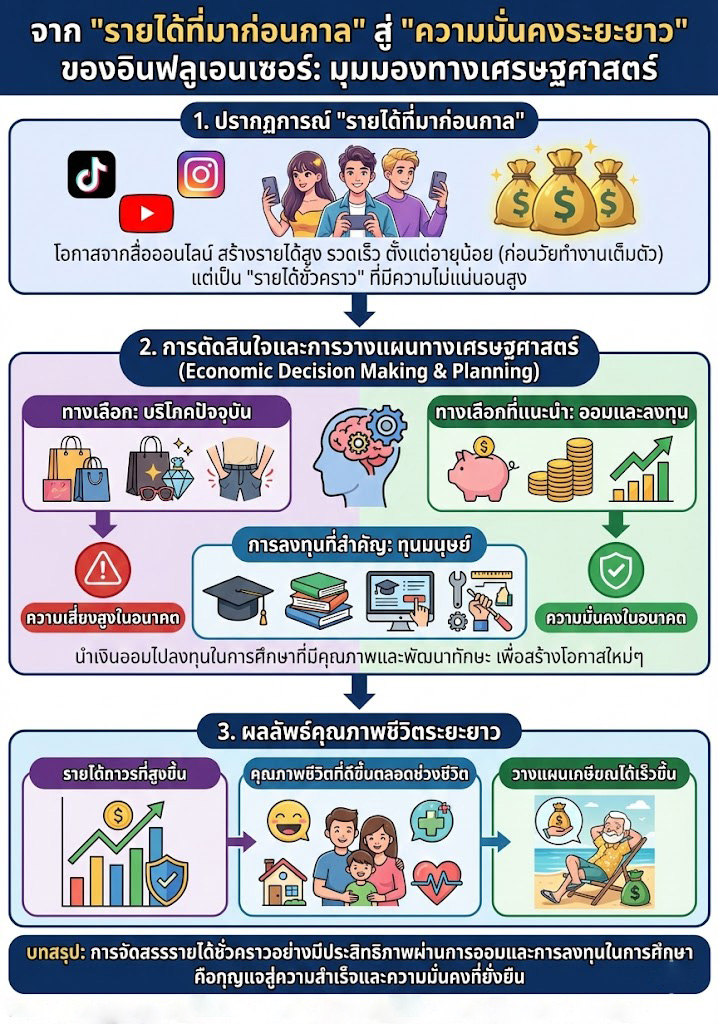
ในปัจจุบันสื่อสังคมออนไลน์ส่งผลให้การรับรู้ข้อมูลของคนในสังคมเปลี่ยนไป อินฟลูเอนเซอร์กลายเป็นบุคคลที่มีอิทธิพลต่อการตัดสินใจเลือกใช้หรือบริโภคสินค้าของกลุ่มผู้ติดตามมากขึ้น และเป็นช่องทางหารายได้ค่อนข้างสูงในเวลารวดเร็วโดยไม่ได้จำกัดแค่คนในวัยทำงานเท่านั้น แต่ยังรวมถึงกลุ่มคนอายุน้อยที่สามารถสร้างรายได้ตั้งแต่ก่อนเข้าสู่ตลาดแรงงาน แตกต่างจากกรณีพื้นฐานของบุคคลทั่วไปที่มักจะเริ่มมีรายได้เมื่อเข้าสู่วัยทำงานอย่างเต็มตัว นำมาซึ่งประเด็นคำถามที่น่าสนใจว่า รายได้ที่เกิดขึ้นจากกระแสความนิยมนี้ จะนำมาซึ่งพฤติกรรมการบริโภคและโอกาสในการยกระดับคุณภาพชีวิตของเหล่าอินฟลูเอนเซอร์ในระยะยาวได้อย่างไร โดยบทความนี้ได้นำเสนอมุมมองจากทฤษฎีทางด้านเศรษฐศาสตร์ในการวางแผนการบริโภคในแต่ละช่วงเวลา ซึ่งหากอินฟลูเอนเซอร์เลือกบริโภคในปัจจุบันน้อยกว่ารายได้ในปัจจุบัน พวกเขาจะอยู่ในฐานะของผู้ให้กู้หรือมีเงินเก็บออม ทำให้สามารถบริโภคในอนาคตได้มากขึ้น ซึ่งสอดคล้องกับสภาพเศรษฐกิจและสังคมในปัจจุบันที่เต็มไปด้วยความเสี่ยงและความไม่แน่นอน นอกจากนี้ยังสามารถยกระดับการบริโภคโดยรวมตลอดชีวิตให้สูงขึ้นได้ หรือแม้แต่การวางแผนเกษียณในอนาคตให้เร็วขึ้นได้จากการเก็บสะสมเงินออมที่มากพอ หรือนำไปลงทุนต่อยอดเพื่อให้ได้รับผลตอบแทนในระยะยาว โดยเฉพาะอย่างยิ่งการลงทุนเพื่อการยกระดับการศึกษาที่มีคุณภาพให้แก่ตนเองเพื่อสร้างโอกาสในการมีรายได้ถาวรที่สูงกว่ากลุ่มคนทั่วไป เมื่อนั้นบุคคลเหล่านี้ก็จะสามารถยกระดับคุณภาพชีวิตของตนเองในระยะยาวได้จากรายได้ที่เกิดขึ้นเพียงชั่วคราวนี้
In recent years, social media has significantly transformed the way individuals perceive and access information. Social media influencers have emerged as key figures shaping consumer decisions and consumption behavior among their followers. Becoming an influencer has also developed into a highly lucrative source of income within a short period, not only for working-age individuals but also for younger individuals who are able to generate income before formally entering the labor market. This differs from the conventional pattern in which individuals typically begin earning income only after entering full-time employment. This phenomenon raises an important question regarding how income generated from popularity-driven activities influences consumption behavior and contributes to the long-term improvement of influencers’ quality of life. This article examines the issue through economic theories of intertemporal consumption planning. If influencers choose to consume less than their current income, they assume the role of savers or lenders, allowing for greater consumption in the future. Such behavior is consistent with contemporary economic and social conditions characterized by uncertainty and risk. Moreover, appropriate consumption and savings planning can increase overall lifetime consumption and potentially enable earlier retirement through sufficient savings accumulation or long-term investment returns. In particular, investment in quality education may enhance opportunities for securing stable and higher long-term income compared with the general population. In this way, influencers may transform temporary income gains into sustainable long-term improvements in their quality of life.
Downloads
Article Details

This work is licensed under a Creative Commons Attribution-NonCommercial-NoDerivatives 4.0 International License.
References
Andres, R., Rossi, M., & Tremblay, M. (2023). YouTube ‘Adpocalypse’: The Youtubers’ journey from ad-based to patron-based revenues (ZEW Discussion Papers No. 23-059). ZEW - Leibniz-Zentrum für Europäische Wirtschaftsforschung. https://hdl.handle.net/10419/283579
Bangkok Biz News. (2024, September 14). Revealing Thai influencers’ income per post, from micro to macro (เปิดรายได้อินฟลูเอนเซอร์ไทยต่อการโพสต์ ตั้งแต่ไมโคร-แม็คโคร อู้ฟู่!). https://www.bangkokbiznews.com/business/business/1144712#google_vignette
Barari, M. M., Eisend, M., & Jain, S. P. (2025). A meta-analysis of the effectiveness of social media influencers: Mechanisms and moderation. Journal of the Academy of Marketing Science, 1–21. https://doi.org/10.1007/s11747-025-01107-3
Criddle, C. (2024, March 25). Upstart agencies tap into influencers. Financial Times. https://www.ft.com/content/7dbc592a-1027-4e89-80ce-f12ca479a2c1
DataReportal. (2025, March 3). Digital 2025: Thailand. https://datareportal.com/reports/digital-2025-thailand
Deaton, A. (2005). Franco Modigliani and the life-cycle theory of consumption. BNL Quarterly Review, Banca Nazionale del Lavoro, 58(233–234), 91–107.
Digimusketeers. (2024, April 11). Get to know 8 types of influencers that brands should use for the right group (รู้จักอินฟลูเอนเซอร์ 8 ประเภท แบรนด์ควรใช้ให้ถูกกลุ่ม). https://digimusketeers.co.th/blogs/online-marketing/อินฟลูเอนเซอร์-2
El Sanyoura, L., & Anderson, A. (2022). Quantifying the creator economy: A large-scale analysis of patreon. Proceedings of the International AAAI Conference on Web and Social Media, 16(1), 829–840. https://doi.org/10.1609/icwsm.v16i1.19338
Friedman, M. (1957). The permanent income hypothesis. In A theory of the consumption function (pp. 20–37). Princeton University Press.
InsightERA. (2023, November 7). Summary of statistics of social media users via popular platforms in Thailand (สรุปสถิติผู้ใช้งาน Social media ผ่าน Platform ยอดนิยมในไทย). https://www.insightera.co.th/social-madia-statshot-2023/
Keynes, J. M. (2018). The general theory of employment, interest, and money. Palgrave Macmillan.
Libai, B., Rosario, A. B., Beichert, M., Donkers, B., Haenlein, M., Hofstetter, R., Kannan, P. K., van der Lans, R., Lans, A., Li, H. A., Mayzlin, D., Muller, E., Shapira, D., Yang, J., & Zhang, L. (2025). Influencer marketing unlocked: Understanding the value chains driving the creator economy. Journal of the Academy of Marketing Science, 53(1), 4–28. https://doi.org/10.1007/s11747-024-01073-2
Liu, X., & Zheng, X. (2024). The persuasive power of social media influencers in brand credibility and purchase intention. Humanities and Social Sciences Communications, 11, Article 15. https://doi.org/10.1057/s41599-023-02512-1
Meegle. (2024, December 10). Influencer marketing in niche markets. https://www.meegle.com/en_us/topics/influencer-economy/influencer-marketing-in-niche-markets
Motive Influence. (2022, April 4). Which social media platform is suitable for people of what age? (Social media แพลตฟอร์มไหนเหมาะกับคนอายุเท่าไหร่?). https://www.motiveinfluence.com/blog/marketing/Social-Media-แพลตฟอร์มไหนเหมาะกับ-คนอายุเท่าไหร่/338
National Science Museum Thailand. (2021, December 13). Influencer (อินฟลูเอนเซอร์). https://www.nsm.or.th/nsm/th/node/5593
Office of the National Economic and Social Development Council. (2023). Influencer: When everyone in society is a mass media (Influencer: เมื่อทุกคนในสังคมล้วนเป็นสื่อ). https://www.nesdc.go.th/wordpress/wp-content/uploads/2025/06/2566_article_q4_001.pdf
Pei, A., Bart, Y., Pauwels, K., & Chan, K. (2023). Black-white pay gap in influencer marketing (Northeastern U. D’Amore-McKim School of Business Research Paper No. 4156872). SSRN. http://dx.doi.org/10.2139/ssrn.4156872
Tantivasadakarn, C. (2011). Microeconomics: Theory and applications (เศรษฐศาสตร์จุลภาค: ทฤษฎีและการประยุกต์). Thammasat University Press.
Tumtook. (2025, January 11). How many types of influencers are there? What are the levels of influencers? (Influencer มีกี่ประเภท? อินฟลูเอนเซอร์มีระดับอะไรบ้าง). https://www.tumtook.com/content/sme/influencer-ประเภท-ระดับ-01012025
Venciute, D., Mackeviciene, I., Kuslys, M., & Correia, R. F. (2023). The role of influencer–follower congruence in the relationship between influencer marketing and purchase behaviour. Journal of Retailing and Consumer Services, 75, Article 103506. https://doi.org/10.1016/j.jretconser.2023.103506
Wisesight. (2022, August 23). How many types of influencer tiers are there? How can they be measured using ZOCIAL EYE? (Influencer tier มีกี่ประเภท ใช้ ZOCIAL EYE วัดผลได้อย่างไรบ้าง). https://wisesight.com/th/news/influencer-tier/
Xu, X. (2023). Influencer marketing with social platforms: Increasing brand awareness and user engagement. Journal of Education, Humanities and Social Sciences, 19, 228–234. https://doi.org/10.54097/ehss.v19i.11039
