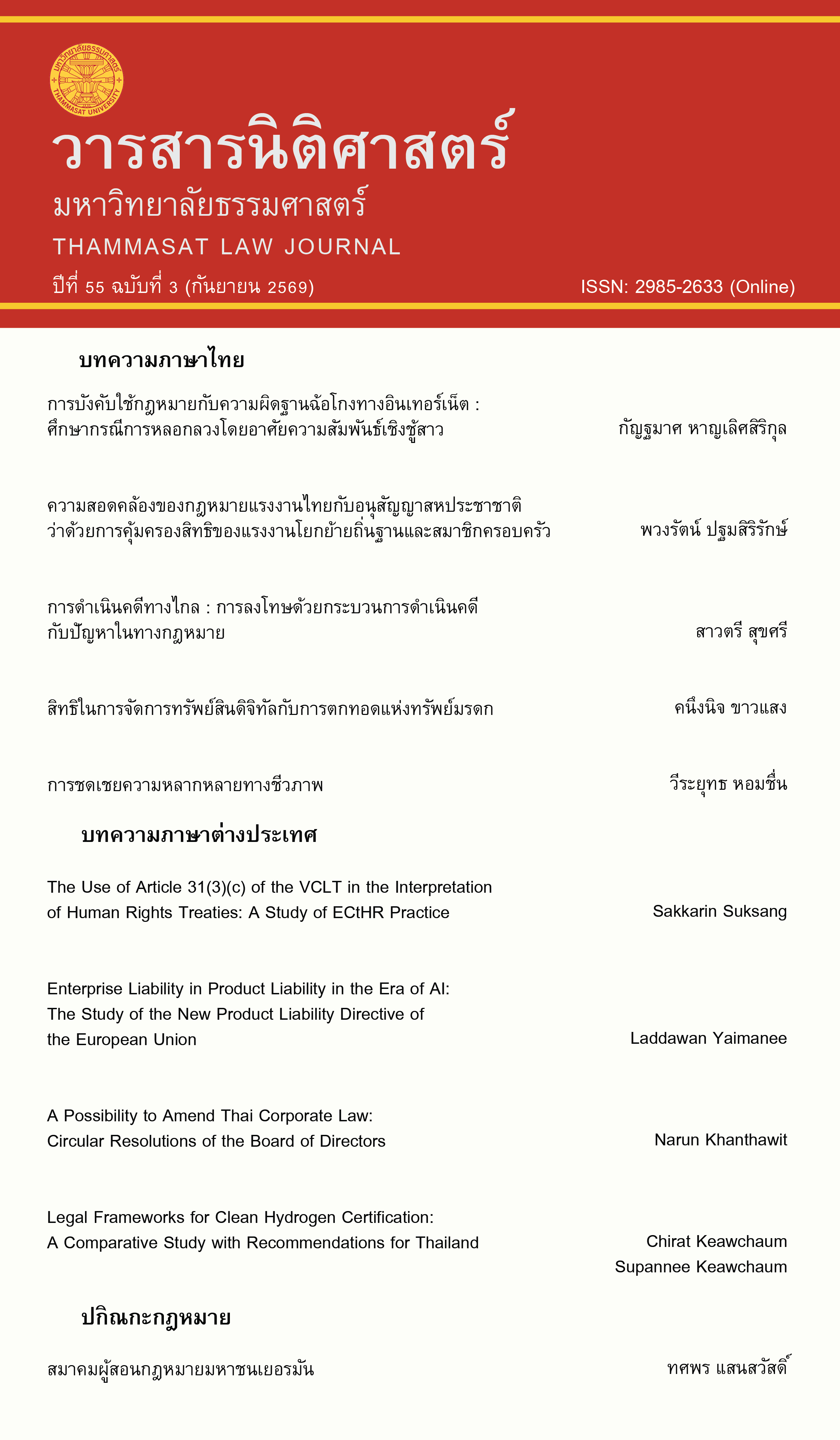
Legal Frameworks for Clean Hydrogen Certification: A Comparative Study with Recommendations for Thailand
Keywords:
Clean Hydrogen Certification, Subsidy, Legal Certainty, Comparative Law, Legal GapAbstract
Clean hydrogen is globally recognized as essential for decarbonization, yet its environmental value is not inherent; it is a legal status requiring robust certification. This article addresses Thailand’s subsidy paradox, where ambitious climate goals and Board of Investment (BOI) incentives for clean hydrogen are rendered functionally inoperable. This paralysis stems from a critical legal gap: the absence of a national definition, standard, and verification system for clean hydrogen, which creates severe legal uncertainty for investors. The research argues that certification is a foundational legal prerequisite for any subsidy regime. Employing a functional-structural comparative legal methodology, the study analyzes six key jurisdictions (the United States, Canada, the European Union, South Korea, Australia, and Japan) to identify international best practices. Findings reveal an alignment on technical criteria (e.g., Well-to-Gate greenhouse gas assessment scope, tiered thresholds up to 4.0 kgCO2e/kgH2), but finds Thailand’s current legal framework (BOI, ERC, TISI) incompatible for implementation due to critical jurisdictional and institutional constraints. The article concludes that the enactment of a new law is essential, recommending the enactment of a sui generis Hydrogen Certification Act. This new legal framework should adopt a pragmatic hybrid model, blending South Korea’s tiered, technology-neutral, Well-to-Gate criteria with Australia’s flexible, unbundled certificate (PGO/REGO) structure. This approach provides legal certainty while avoiding the prohibitive complexity of the EU model.
References
Andrzej Graczyk, Paweł Brusiło and Alicja Małgorzata Graczyk, ‘Hydrogen as a Renewable Fuel of Non-Biological Origins in the European Union—The Emerging Market and Regulatory Framework’ (2025) 18 Energies 617 <https://doi.org/10.3390/en18030617> accessed 30 October 2025.
Anthony Velazquez Abad and Paul E. Dodds, ‘Green hydrogen characterisation initiatives: Definitions, standards, guarantees of origin, and challenges’ (2020) 138 Energy Policy 111300 < https://doi.org/10.1016/j.enpol.2020.111300> accessed 30 October 2025.
Daniel Goodwin and others, ‘Expert views on the legitimacy of renewable hydrogen certification schemes’ (2025) 121 Energy Research & Social Science 103970 <https://doi.org/10.1016/j.erss.2025.103970> accessed 30 October 2025.
Donna M. Attanasio and Meghan Briggs, ‘Hydrogen Regulation in the United States Hydrogen Regulation in the United States: Will Government Financial Incentives Outweigh Regulatory Hurdles?’ in Ruven Fleming (ed) The Cambridge Handbook of Hydrogen and the Law (CUP 2024) <https://doi.org/10.1017/9781009459259> accessed 30 October 2025.
Erlend Hordvei and others, ‘From Policy to Practice: The Cost of Europe's Green Hydrogen Ambitions.’ arXiv e-prints (2024): arXiv-2406 <https://arxiv.org/abs/2406.07149> accessed 30 October 2025.
Francisca Gallegos, ‘Bridging the Gap: Certification Schemes for Sustainable Hydrogen in Global Trade’ (2024) 21(3-4) Journal for European Environmental & Planning Law 239 <https://doi.org/10.1163/18760104-21030005> accessed 30 October 2018.
Francisca Gallegos, ‘The Art of Certifying Hydrogen: A New Era in International Trade’ (2024) 22 Oil, Gas and Energy Law 1 <https://erepo.uef.fi/handle/123456789/33286> accessed 30 October 2018.
Fred Gale and others, ‘Renewable hydrogen standards, certifications, and labels: A State-of-the-Art Review from a Sustainability Systems Governance Perspective’ (2024) 59 International Journal of Hydrogen Energy 654 < https://doi.org/10.1016/j.ijhydene.2024.02.038> accessed 30 October 2025.
Gabriela Gonçalves Dias Ponzi and others, ‘The hydrogen life cycle assessment methodology: an overlooked puzzle piece in harmonizing hydrogen certification and trade’ (2024) 26 Clean Technol Environ Policy 2573 <https://doi.org/10.1007/s10098-024-02752-y> accessed 30 October 2025.
Ibrar Ahmad, Jamil Afzal, and Siraj Ahmad, ‘International and Comparative Law Perspectives of Hydrogen Economy’ in Ibrar Ahmad, Jamil Afzal, and Siraj Ahmad (eds) Legal Framework of Green Hydrogen Production and Hydrogen Economy for Sustainable Development. (SCOPUA Books 2025) < https://doi.org/10.64060/978-627-7898-00-7-3 > accessed 30 October 2025
Ibrar Ahmad, Jamil Afzal, and Siraj Ahmad, ‘Regulatory Analysis of Energy Law and Hydrogen Economy’ in Ahmad, Ibrar, Jamil Afzal, and Siraj Ahmad (eds) Legal Framework of Green Hydrogen Production and Hydrogen Economy for Sustainable Development. (SCOPUA Books 2025) <https://doi.org/10.64060/978-627-7898-00-7-4> accessed 30 October 2025.
Jae-Eun Shin, ‘Hydrogen Technology Development and Policy Status by Value Chain in South Korea’ (2022) 15 Energies 8983 < https://doi.org/10.3390/en15238983> accessed 30 October 2025.
John Chandler and John Paterson, ‘Selling sunshine Emerging challenges in the certification of hydrogen’ (2025) 43 Journal of Energy & Natural Resources Law 47 <https://doi.org/10.1080/02646811.2024.2344363> accessed 30 October 2025.
Jonathan Schmid and others, ‘Is it green? Designing a blockchain-based certification system for the EU hydrogen market’ (2024) 7 Frontiers in Blockchain 1408743 <https://doi.org/10.3389/fbloc.2024.1408743> accessed 30 October 2025.
Judith Resnik and Dennis Curtis, Representing Justice: Invention, Controversy, and Rights in City-States and Democratic Courtrooms (Yale University Press 2011).
Kyeong-Mi Kim and Dongwoo Kim, ‘Life Cycle Assessment of Greenhouse Gas Emissions in Hydrogen Production via Water Electrolysis in South Korea’ (2024) 16 Sustainability 11010 <https://doi.org/10.3390/su162411010> accessed 30 October 2025.
Lee V. White and others, ‘Implications for cost-competitiveness of misalignment in hydrogen certification’ Energy Policy 204 (2025) 114661 < https://doi.org/10.1016/j.enpol.2025.114661> accessed 30 October 2025.
Lee V. White and others, ‘Towards emissions certification systems for international trade in hydrogen: The policy challenge of defining boundaries for emissions accounting’ (2021) 215 Energy 119139 <https://doi.org/10.1016/j.energy.2020.119139> accessed 30 October 2025
Leigh Hancher and Simina Suciu, ‘Hydrogen Regulation in Europe: The EU’s ‘Hydrogen and Decarbonised Gas Market’ – Best Practice or Missed Opportunity?’ in Ruven Fleming (ed) The Cambridge Handbook of Hydrogen and the Law (CUP 2024) <https://doi.org/10.1017/9781009459259> accessed 30 October 2025.
Mark Van Hoecke, Methodology of Comparative Legal Research (Hart Publishing 2015).
Maximilian Kuhn and Peter Koop, Standardizing Hydrogen Certification: Enhance Traceability, Transparency, and Market Access (H2Global Stiftung Policy Brief 2023).
Piti Eiamchamroonlarp, ‘Hydrogen Regulation in Southeast Asia: Steam Reforming from Biofuels as an Alternative to Electrolysis?’ in Ruven Fleming (ed) The Cambridge Handbook of Hydrogen and the Law (CUP 2024) <https://doi.org/10.1017/9781009459259> accessed 30 October 2025.
Ralf Michaels, 'The Functional Method of Comparative Law' in Mathias Reimann and Reinhard Zimmermann (eds), The Oxford Handbook of Comparative Law (Oxford University Press 2006) <https://doi.org/10.1093/oxfordhb/9780198810230.013.11> accessed 30 October 2025.
Ruven Fleming, ‘Introduction’ in Ruven Fleming (ed) The Cambridge Handbook of Hydrogen and the Law (CUP 2024) <https://doi.org/10.1017/9781009459259> accessed 30 October 2025.
Shahrouz Nayebossadri, Michael Walsh and Michael Smailes, ‘An Overview of the Green Hydrogen Value Chain Technologies and Their Challenges for a Net-Zero Future’ (2025) 6(2) Hydrogen 26 <https://doi.org/10.3390/hydrogen6020026> accessed 30 October 2018.
Stefan Bube and others, ‘Sustainability regulations for PtX projects: Scope and impact analysis’ (2025) 9 Joule 101966 <https://doi.org/10.1016/j.joule.2025.101966> accessed 30 October 2025.
Wenting Cheng and Sora Lee, ‘How Green Are the National Hydrogen Strategies?’ (2022) 14 Sustainability 1930 <https://doi.org/10.3390/su14031930> accessed 30 October 2018.
Yuma Osaki and Llewelyn Hughes, ‘Japan: Putting Hydrogen at the Core of Its Decarbonisation Strategy’ in Rainer Quitzow and Yana Zabanova (eds) The Geopolitics of Hydrogen (Springer 2025) 105-120 < https://doi.org/10.1007/978-3-031-84022-7_5> accessed 30 October 2025.
Yunji Kim and others, ‘An Analysis of Greenhouse Gas Emissions in Electrolysis for Certifying Clean Hydrogen’ (2024) 17 Energies 3698 <https://doi.org/10.3390/en17153698> accessed 30 October 2025.
Downloads
Published
Issue
Section
License
Copyright (c) 2026 Thammasat Law Journal

This work is licensed under a Creative Commons Attribution-NonCommercial-NoDerivatives 4.0 International License.
The manuscripts published in the Law Journal is the copyright of the Law Journal, Thammasat University
Any article or opinion appeared in the Law Journal will solely be under the responsibility of the author The Faculty of Law, Thammasat University and the editors do not need to reach in agreement or hold any responsibility.

