
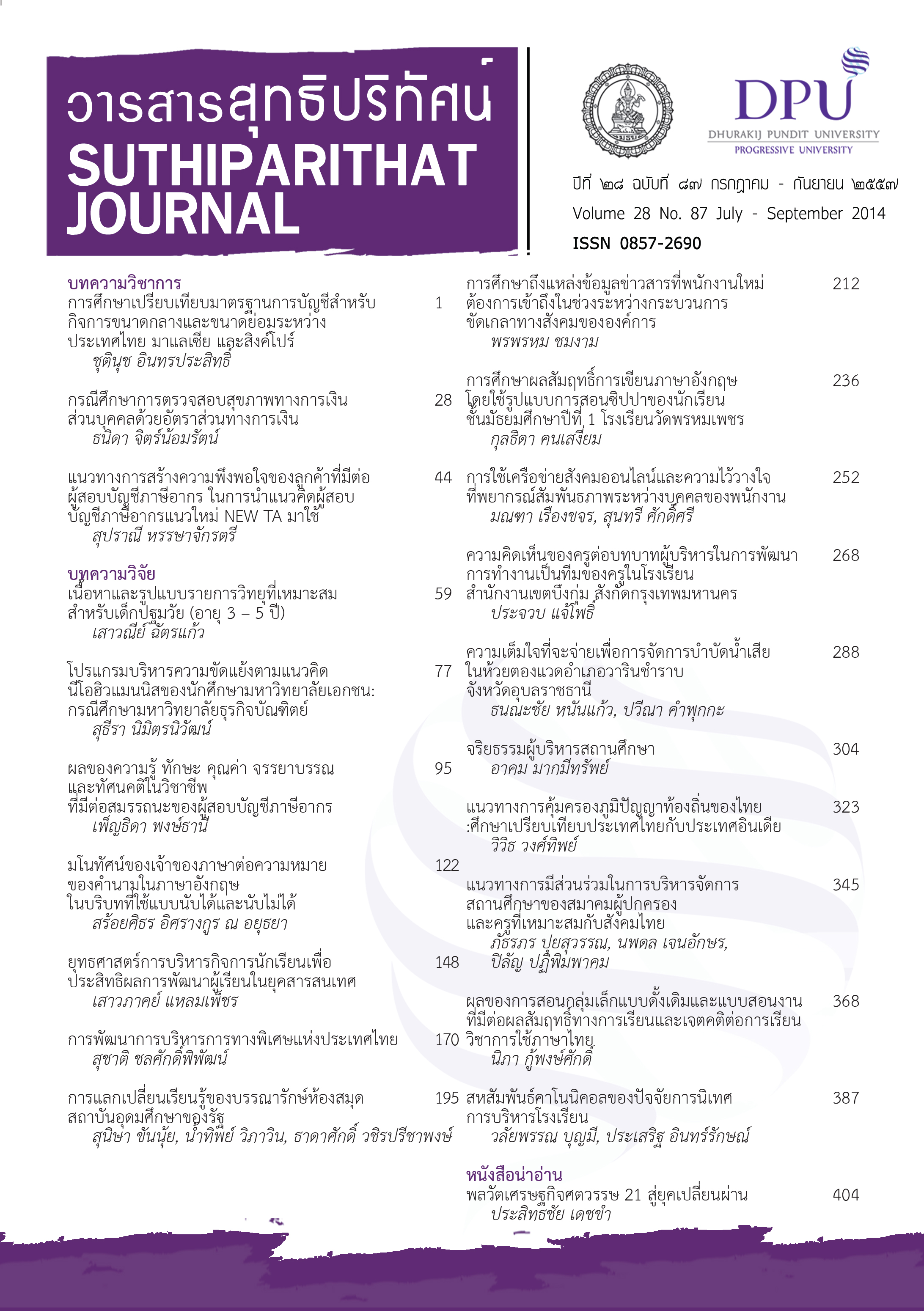
Content and Format of Preschool Radio Program (3 – 5 Years of Age)
Keywords:
content, format, preschool radio program, developmentAbstract
This research is to study the appropriate content and format of preschool radio programs (3 – 5 years of age). Qualitative research and in – depth interview with key informants including medical professionals, instructors, parents and media pertaining to preschoolers are the instruments of this study. The result shows that the content of preschool radio program should serve all dimensions: physical, emotional, social and intellectual developments. Almost all informants mainly concern social development and urge radio program to boost sharing, discipline, honesty, forgiveness, and proper manner for preschoolers. For physical, emotional and intellectual developments, radio program should concentrate on preschoolers’ self control, imagination, creativity, well – rounded knowledge, language and mathematical skills, reading habit and physical movement as well as parenting consultation. The format of preschool radio program should be variety that consists of short tales (5 – 10 minutes), music, children participation and games. The short tales might be run by one main character, instill moral value and ask receivers to recall it at the end of stories. For music, it could be with lyrics or being instrumental music that support preschoolers’ knowledge, language and mathematical skills and moral value.
Downloads
References
ประกาศ สำนักงาน กสทช. เรื่องผลการเลือกหมายเลขลำดับการให้บริการโทรทัศน์ในระบบดิจิตอลประเภทบริการธุรกิจระดับชาติ. สืบค้นเมื่อ 25 มีนาคม 2557, จาก http://www.nbtc.go.th/
มติคณะรัฐมนตรี เรื่อง แนวทางและมาตรการการใช้สื่อของรัฐเพื่อการศึกษาและการเรียนรู้ของเด็กเยาวชนและครอบครัว. สืบค้นเมื่อ 15 มีนาคม 2557, จาก http://www.eppo.go.th/
เสาวณีย์ ฉัตรแก้ว และคณะ. (2550). การสำรวจโครงการพัฒนารายการวิทยุเพื่อเด็กเยาวชนและครอบครัว. กรุงเทพฯ: สำนักงานกองทุนสนับสนุนการสร้างเสริมสุขภาพ.
อุษา บิ้กกิ้นส์. (2556). ปัจจัยที่มีผลต่อพฤติกรรมเมาแล้วขับและการเปิดรับสื่อของผู้ขับขี่รถจักรยานยนต์ในเขตกรุงเทพมหานคร. วารสารสุทธิปริทัศน์, 27 (82)
Bickham, David., Wright, John. & Huston, Aletha. (2001). Attention, Comprehension, and Educational Influences of Television, in Handbook of Children and the Media, Singer Dorothy & Singer Jerome. CA: Sage Publications.
Canton, Joanne. (2001). The Media and Children’s Fears, Anxieties, and Perceptions of Danger. In Handbook of Children and the Media, Singer, Dorothy and Singer, Jerome. CA: Sage Publications.
Dainton, Marianne & Zelley, Elaine D. (2005). Applying Communication Theory for Professional Life: A Practical Introduction. USA: Sage Publications.
Fisch, Shalom M. (2009). Educational Television and Interactive Media for Children: Effects on Academic Knowledge, Skills, and Attitudes. In Media Effects: Advances in Theory and Research, Bryant, Jennings & Oliver, Mary Beth. UK: Routledge.
Harris, Richard Jackson. (2004). A Cognitive Psychology of Mass Communication. USA : LEA’s communication series.
Hogan, Margorie J.. (2001). Parents and Others Adults. In Handbook of Children and the Media, Singer, Dorothy and Singer, Jerome. CA: Sage Publications.
Naigales, Letitia R. & Mayeux, Lara. (2001). Television as Incidental Language Teacher. In Handbook of Children and the Media, Singer, Dorothy and Singer, Jerome. CA: Sage Publications.
Strasburger, Victor C. & Wilson, Barbara J. (2002). Children, Adolescents, and the Media. USA: Sage Publications.
Downloads
Published
How to Cite
Issue
Section
License
Content and information of the article published at Suthiparithat Journal are based on the sole opinions and responsibility of author(s) only. Neither the editorial board involve in......



