
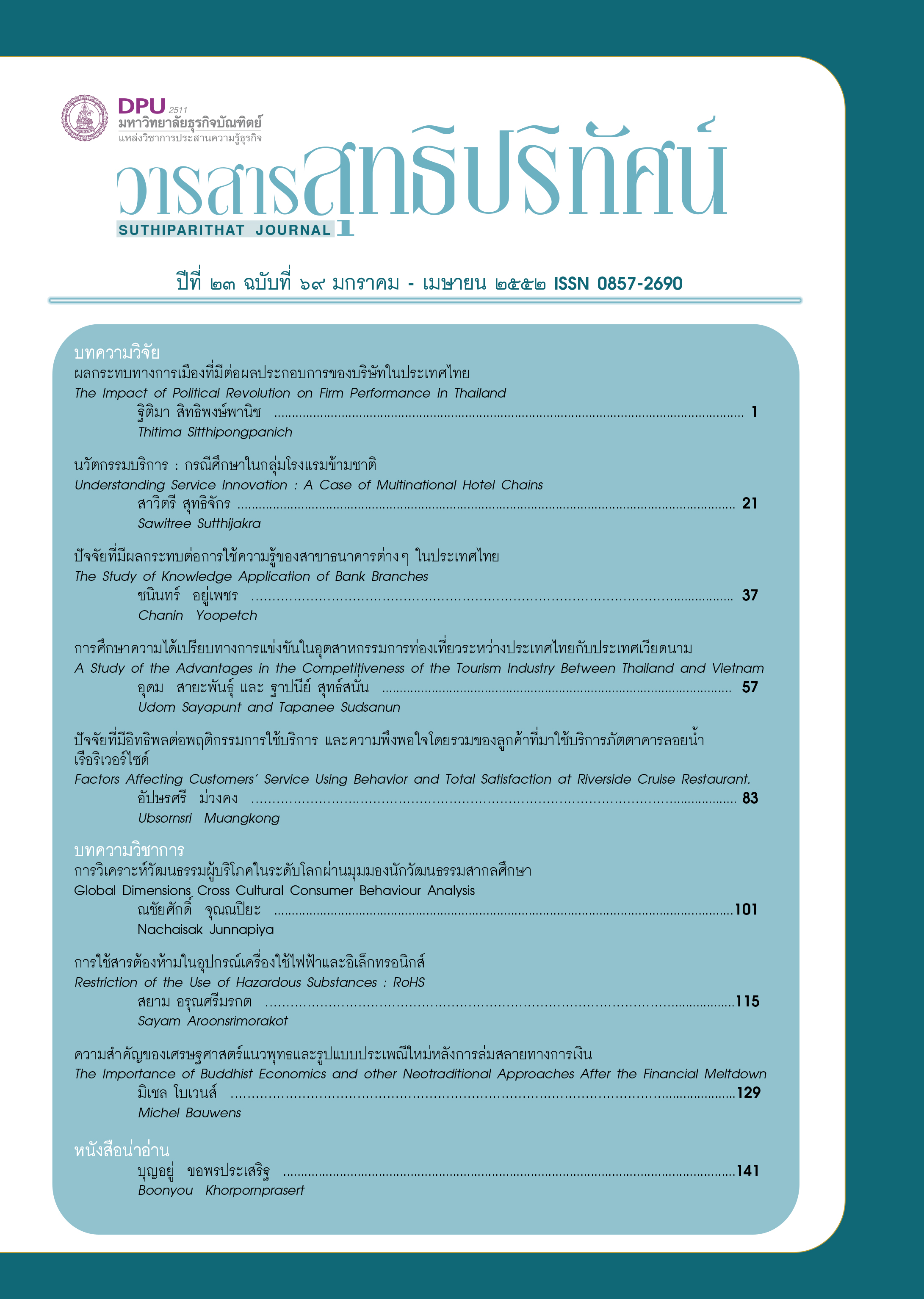
A STUDY OF THE ADVANTAGES IN THE COMPETITIVENESS OF THE TOURISM INDUSTRY BETWEEN THAILAND AND VIETNAM
Keywords:
CompetitivenessAbstract
The research on: A Study of the advantages in the Competitiveness of the Tourism Industry between Thailand and Vietnam” can be summarized that the tour operators had the overall opinion on the competitiveness in tourism industry that Thailand was better than Vietnam. When headlines were considered, it was found that the tour operators had the opinion towards competitiveness in tourism industry that Thailand was better than Vietnam on the beauty of the tourist attractions of the nature type, historic sites, world’s heritage, security service at the tourist attractions. Also was better in the hotel room quality, price of the hotels compared with the room quality, security service of the hotels. As well as providing information on the tourist attractions and hotels, development of the traveling roads, development of the train service, ports, and modernization of the airports, electricity, tap water, telephone, the Internet quality, food quality and hygiene for the tourists. However, it found the operators to have opinion on the competitiveness in the tourism of Thailand was better than Vietnam in the convenience to enter the country, quality of the memorabilia, conservation of the environment, promotion of investment in the tourism, price of fuel, and control of urban air pollution.
While the study on the competitiveness in the tourism industry of Thailand and Vietnam, using the Travel & Tourism Competitiveness Index (TCCI) found Thailand had better overall capabilities than Vietnam upon the consideration on the individual basis as follows:
1. Establishment of the structure in the tourism supervision found Thailand had better capability in the competitiveness on the overall supervision than Vietnam, including the policy, rule, and regulation on the environment, health, and hygiene. While on prioritization of tourism found Vietnam had better implementation than Thailand on safety and security service.
2. On the economic conditions and infrastructures found Thailand had better competitive capabilities in business environment and infrastructures than Vietnam, as well as the infrastructures on the air and land transportation, tourism, communications and telecommunications. But it found Vietnam had a cheaper price in this industry.
3 . On the human resources in tourism, culture, and natural resources found Thailand to be more competitive than Vietnam in all these stances, including human resources, and openness to tourism.
Downloads
References
การท่องเที่ยวแห่งประเทศไทย (2539) 36 ปี การท่องเที่ยวแห่งประเทศไทย กรุงเทพฯ : โรงพิมพ์ดอกเบี้ย
ฉลองศรี พิมลสมพงศ์ (2531) การวางแผนและพัฒนาตลาดการท่องเที่ยว กรุงเทพฯ : สำนักพิมพ์มหาวิทยาลัยเกษตรศาสตร์.
ธนาคารเพื่อการส่งออกและนำเข้าแห่งประเทศไทย (2548) อุตสาหกรรมท่องเที่ยว…เสน่ห์ที่ซ่อนเร้นของเวียดนาม สืบค้นเมื่อ 13 กุมภาพันธ์ 2551 จาก http://www.exim.go.th
ประชาชาติ (2551) ททท. ชวนร่วมงาน “เทศกาลเที่ยวเมืองไทย” สืบค้นเมื่อ 16 กุมภาพันธ์ 2551 จาก http://www.matichon.co.th/prachachat/news_title.php?id=3305
ผู้จัดการออนไลน์ (2549) เวียดปักธงสนามบิน $8 พันล้าน แข่งสุวรรณภูมิ สืบค้นเมื่อ 16 กุมภาพันธ์ 2551 จาก http://www.manager.co.th/IndoChina/ViewNews.aspx?NewsID=9490000156521
พจนานุกรมฉบับราชบัณฑิตยสถาน (2525) พิมพ์ครั้งที่ 4. กรุงเทพฯ : อักษรเจริญทัศน์
วิกิพีเดีย (2551) ประเทศไทย สืบค้นเมื่อ 16 กุมภาพันธ์ 2551 จาก http://th.wikipedia.org
วิกิพีเดีย (2551) ประเทศเวียดนาม สืบค้นเมื่อ 16 กุมภาพันธ์ 2551 จาก http://th.wikipedia.org
สำนักงานคณะกรรมการส่งเสริมการลงทุน (2551) ข้อมูลการลงทุนในประเทศสืบค้นเมื่อ 4 มีนาคม 2551 จาก http://www.boi.go.th/thai/clmv/2008_vietnam/Index_Vietnam.htm
สำนักงานคณะกรรมการพัฒนาการเศรษฐกิจและสังคมแห่งชาติ (2549) แผนพัฒนาเศรษฐกิจและสังคมแห่งชาติฉบับที่ 10 (พ.ศ. 2550 – 2554) สืบค้นเมื่อ 22 กุมภาพันธ์ 2551 จาก from http://www.nesdb.go.th
Buckley, R. (1994) A framework for ecotourism Annals of Tourism Research 21 (3). 661–9.
Central Intelligence Agency (2007) Thailand สืบค้นเมื่อ 16 กุมภาพันธ์ 2551 จาก https://www.cia.gov
Central Intelligence Agency (2007) Vietnam สืบค้นเมื่อ 16 กุมภาพันธ์ 2551 จาก https://www.cia.gov
Crotts, J. (1996) Theoretical perspectives on tourist criminal victimisation Journal of Tourism Studies 7 (1). pp. 2–9
Crouch, G.I and Ritchie, J.R.B. (1999) Tourism, competitiveness, and societal prosperity Journal of Business Research, 44. pp. 137–52
Dunn, R. and Iso-Ahala, S. (1991) Sightseeing tourists’ motivations and satisfactio. Annals of Tourism Research 18 (2). pp. 226–37
Dwyer, L., Forsyth, P. and Rao, P. (2 0 0 2 ) Destination price competitiveness: Exchange rate changes vs inflation rates Journal of Travel Research 40 (February). pp. 340–48
Dwyer, L., Forsyth, P. and Spurr, R. (2 0 0 3 ) Inter-industry effects of tourism growth: Some Implications for destinations managers Tourism Economics
Go, F. and Govers, R. (2000) Integrated quality management for tourist destinations: A European perspective on achieving competitiveness Tourism Management 21 (1). pp. 79–88.
Laura, W. (2007) New Report Forecasts that Per Head Tourist Expenditure in Vietnam Will Reach US$ 976.26 by 2011 สืบค้นเมื่อ 7 กุมภาพันธ์ 2551 จาก http://www.investors.com
Michael E. Porter (1998) The Competitive Advantage of Nations. New York: The Free Press
Mo, C., Handy, D. and Havitz, M. (1993) Testing an international tourist role typology Annals of Tourism Research 20 (2). pp. 319–35
Murphy P., Pritchard, M. and Smith, B. (2000) The destination product and its impact on traveler perceptions Tourism Management 21 (1). pp. 43–52
The World Bank. (2008) Transport in Thailand สืบค้นเมื่อ 7 กุมภาพันธ์ 2551 จาก http://web.worldbank.org
The World Bank. (2008) Transport in Vietnam สืบค้นเมื่อ 7 กุมภาพันธ์ 2551 จาก http://web.worldbank.org
Vietnam National Administration of Tourism (2008) Tourist Statistics สืบค้นเมื่อ 7 กุมภาพันธ์ 2551 จาก http://www.vietnamtourism.com/e_pages/news/index.asp?loai=1&chucnang=07
World Economic Forum. (2008) The Travel & Tourism Competitiveness Report 2008 สืบค้นเมื่อ 8 มีนาคม 2551 จาก www.weforum.org/en/initiatives/gcp/TravelandTourismReport
Downloads
Published
How to Cite
Issue
Section
License
Content and information of the article published at Suthiparithat Journal are based on the sole opinions and responsibility of author(s) only. Neither the editorial board involve in......



