
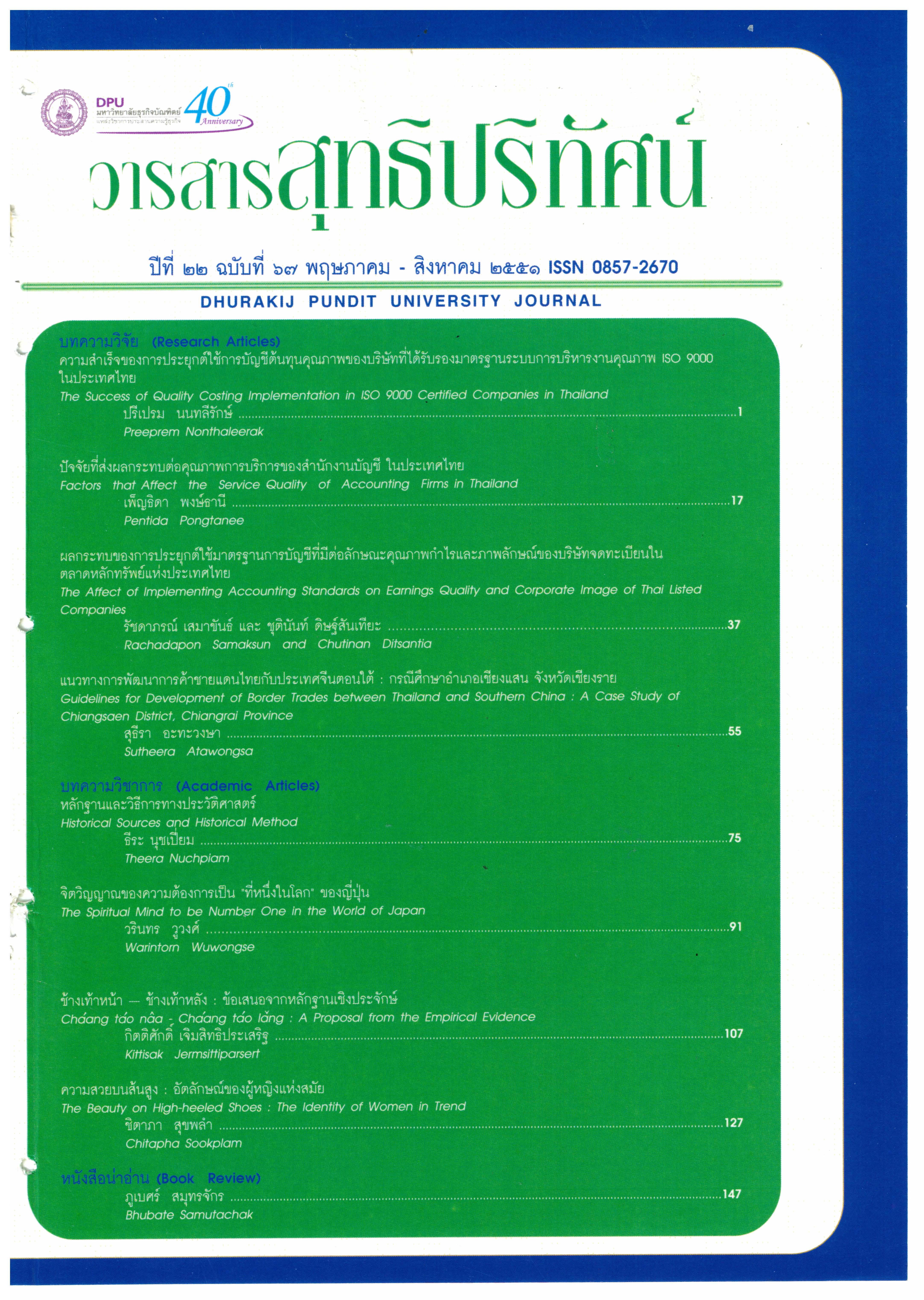
THE SUCCESS OF QUALITY COSTING IMPLEMENTATION IN ISO 9000 CERTIFIED COMPANIES IN THAILAND
Keywords:
Quality cost accounting, Cost of Quality, Quality Management SystemAbstract
Quality management has long been established as an important management strategy of business for achieving competitive advantage. Cost of quality plays a vital role as financial measures in quality management system. Its process is to collect and report cost of quality to support the management in decision-making process. Recently, the managerial accounting profession has turned their interests to the usefulness of quality costing in providing relevant quality cost information for operation control. Thus, the aims of this paper are to study the critical success factors on the quality costing implementation as well as to study the obstacles and problems of the implementation. The survey research was carried out in the ISO 9000 certified companies in 7 strategic industries in Thailand. The results reveal that three factors, which are i) the readiness in adopting and implementing the quality management system; ii) the appropriateness of resources allocation in quality management activities; and iii) the supporting in physical facilities and operation for quality management program, show significant positive relationship with the success of implementing quality costing. In addition, the study provides practitioners’ opinions on problems and obstacles when implementing quality costing and areas of future research are discussed.
Downloads
References
Aaker, A., Kumar, V. and Say, S. (2001), Marketing research, John Wiley and Son, New York.
Atkinson, A., Balakrishnan, R., Booth, P., Cote, J., et al. (1997), “New Directions in Management Accounting research” Journal of Management Accounting Research, Vol. 9, pp.79-106
Blocher, E., Stout, D., Cokins, G. and Chen, K., (1999) Cost Management – A Strategic Emphasis, 4th Edition. McGraw-Hill, New York, USA
Brewer, C. (2004), “Six Sigma help a company create a culture of accountability”, Journal of Organizational Excellence, Vol.23, No. 3, 2004, pp.45-60.
Caulcutt, R. (2001), “Why is Six Sigma so successful?” Journal of Applied Statistics. 28 (3/4) 301-306
Chaidamrong,N. (2003), “The development of an economic quality cost model”, TQM & Business Excellence, Vol. 14, No.9, 2003, pp. 999-1014.
Coronado, R. B., Antony, J. (2002) “Critical success factors for the successful implementation of six sigma projects in organizations”, The TQM Magazine, Vol 14 (2), pp. 92-99.
Crom, S. (2000), “Implementing Six Sigma in Europe”, Quality Progress, Vol. 33 (10) pp. 73-76.
Carnell, M. (2004), “The Six Sigma Mambo”, Quality Progress, Vol. 37 (1), pp. 87-89
Dales and Plunkett (1990) Managing Quality , Phillip Alan.
Deming, W. E. (1986), Out of the crisis: Quality, Productivity and Competitive Position: Cambridge University Press.
Easton, G. and Jarrell, S. (1998) , “The Effects of Total Quality Management on Corporate Performance: An Empirical Investigation”, Journal of Business, Vol 71, no. 2, pp.253-306.
Feigenbaum, A.V. (1961) Total Quality Control, McGraw-Hill, New York, USA
Garrison, R. and Noreen, E. (1997), Managerial Accounting, 8th Edition, Chicago, IL, USA
Horngren, C., Foster, G. and Datar, S(1996), Cost Accounting – A Managerial Emphasis, 9th Edition, Englewood Cliffs, NJ., Prentice Hall.
Juran, J.M. (1951), Quality Control Handbook, 1st edition, McGraw-Hill, New York
Lee, F., Lee, C. and Lee, A (2000), Statistics for Business and Financial Economics, 2nd Ed., World Scientific, Singapore.
Maica, A and Jacobs, F., (2006), “Assessing the Impact of Benchmarking Antecedents on Quality Improvement and its Financial Consequences”, Journal of Management Accounting Research, Vol. 18, pp.97-123.
Mehrtens, Gragg and Mills (2001), “A model of Internet adoption by SME”, Information & Management, Vol. 39, Iss. 3
Nonthaleerak and Hendry (2006), “Six Sigma: Literature review and key future research areas”, International Journal of Six Sigma and Competitive Advantages (IJSSCA), Vol 2 No. 2,
Nunnually, C. (1978), Psychometric theory, McGraw-Hill, New York
Plunkett, JJ., and Dale, B.G. (1987), “A review of the literature on quality-related costs”, International Journal of Quality and reliability Management, Vol. 4, No. 1, p.40.
Schiffauerova, A. and Thomson, V. (2006), “A review of research on cost of quality model and best practices” International Journal of Quality and Reliability Management, Vol. 23, No. 4.
Sjoblom, L. (1998), “Financial Information and Quality management – Is there a Role for Accountants?” Accounting Horizons, Vol. 23, No. 4, 1998, p.363-373
Yasin, M., Bayes, P., Czuchry, A. (2005), “The Changing Role of Accounting in Supporting the Quality and Customer Goals of Organizations: An Open System Perspective” International Journal of Management, Vol. 22, No. 3, p.323-331
Downloads
Published
How to Cite
Issue
Section
License
Content and information of the article published at Suthiparithat Journal are based on the sole opinions and responsibility of author(s) only. Neither the editorial board involve in......



