Supporting Request and Medical Efficacy of COVID-19 Patients: A Cross-sectional Survey from the Help Society Network
DOI:
https://doi.org/10.57260/csdj.2025.269034Keywords:
Assistance, COVID-19, Food, Medication, VolunteerAbstract
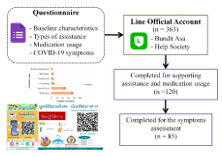
This study employs a cross-sectional survey to assess the support needs of COVID-19 patients within the Help Society network, considering the outbreak's extensive social consequences. Assistance‒including medication, food supplies, counseling, oxygen tanks, bed supplies, and patient transportation‒is dynamically allocated to respond to the varying intensity of COVID-19 waves. Data were collected from March to May 2023 via Google Forms and Line Official Accounts within the Help Society and the Volunteer Club at Sirindhornrajavidhayalaya Campus (Bundit Asa) from 120 respondents (average age: 39.27 years, SD = 11.69), and analyzed using nonparametric test. The results reveal that the most frequently requested forms of assistance were medication, food supplies, and counseling. Medication usage is catagorized into three types: herbal remedies (79.17%), contemporary pharmaceuticals (61.67%), and COVID-19-specific antiviral drugs (25%). Notably, there is a significant discrepancy between the medicines dispensed and actual medication utilization by patients (p <.001). Specifically, 64% adhered to the prescribed dosage, while 23% exceeded it, and 13% underutilized it. Furthermore, after five days of medication, participants reported substantial relief from thirteen symptoms (p < 0.05). This research highlights the complex relationship between pandemic response strategies and individual treatment adherence within the Help Society network, providing valuable insights for optimizing assistance during public health crises.
Downloads
References
Adhikari, S., & Shrestha, S. (2022). An experience as a medical support during the COVID-19 pandemic. Journal of the Nepal Medical Association, 60(251), 664-666. Retrieved from https://doi.org/10.31729/jnma.7554
Ang, L., Song, E., Lee, H. W., & Lee, M. S. (2020). Herbal medicine for the treatment of coronavirus disease 2019 (COVID-19): A systematic review and meta-analysis of randomized controlled trials. Journal of Clinical Medicine, 9(5), 1583. Retrieved from https://doi.org/10.3390/jcm9051583
Badreldin, H. A., & Atallah, B. (2021). Global drug shortages due to COVID-19: Impact on patient care and mitigation strategies. Research in Social & Administrative Pharmacy, 17(1), 1946-1949. Retrieved from https://doi.org/10.1016/j.sapharm.2020.05.017
Bosaeed, M., Alharbi, A., Mahmoud, E., Alrehily, S., Bahlaq, M., Gaifer, Z., Alturkistani, H., Alhagan, K., Alshahrani, S., Tolbah, A., Musattat, A., Alanazi, M., Jaha, R., Sultana, K., Alqahtani, H., Al Aamer, K., Jaser, S., Alsaedy, A., Ahmad, A., Abalkhail, M., AlJohani, S., Al Jeraisy, M., Almaziad, S., Albaalharith, N., Alabdulkareem, K., Alshowair, A., Alharbi, N. K., Alrabiah, F., Alshamrani, M., Aldibasi, O., & Alaskar, A. (2022). Efficacy of favipiravir in adults with mild COVID-19: A randomized, double-blind, multicentre, placebo-controlled clinical trial. Clinical microbiology and infection : the official publication of the European Society of Clinical Microbiology and Infectious Diseases, 28(4), 602-608. Retrieved from https://doi.org/10.1016/j.cmi.2021.12.026
Bureau of Information Office of the Permanent Secretary of MOPH. (2022). Ministry of Public Health reveals that infected with "COVID" will be treated according to symptoms. Mild symptoms are still recommended to isolate for 5 days, adhere to DMH 100%. Retrieved from https://pr.moph.go.th/index.php?url=pr/detail/2/04/179492/
Carlsen, H. B., Toubøl, J., & Brincker, B. (2021). On solidarity and volunteering during the COVID-19 crisis in Denmark: The impact of social networks and social media groups on the distribution of support. European Societies, 23(sup1), S122-S140. Retrieved from https://doi.org/10.1080/14616696.2020.1818270
Chaomuang, N., Dede, A. J. O., Saokaew, S., & Umnuaypornlert, A. (2022). Effects of home drug delivery on drug-related problems: Preliminary evidence for improved patient outcomes during the COVID-19 pandemic in Thailand. Journal of the American Pharmacists Association, 62(4), 1206-1213. Retrieved from https://doi.org/10.1016/j.japh.2022.01.015
Chaturabundit, N. (2022). Factors predicting severity of corona virus disease 2019 patients in Phang nga Province, Thailand. Weekly Epidemiological Surveillance Report, 53(27), 409-419. Retrieved from https://wesr-doe.moph.go.th/wesr_new/file/y65/H65272022-07-032022-07-09.pdf
Dabestani, A., DeAngelo, D., Chhay, S. R., Larson, B. J., & Ganio, M. C. (2020). Medication utilization in patients in New York hospitals during the COVID-19 pandemic. American Journal of Health-System Pharmacy, 77(22), 1885-1892. Retrieved from https://doi.org/10.1093/ajhp/zxaa251
Du, Z., Wang, Y., Bai, Y., Wang, L., Cowling, B. J., & Meyers, L. A. (2023). Estimate of COVID-19 deaths, China, December 2022-February 2023. Emerging Infectious Diseases, 29(10), 2121-2124. Retrieved from https://doi.org/10.3201/eid2910.230585
Enners, S., Gradl, G., Kieble, M., Böhm, M., Laufs, U., & Schulz, M. (2021). Utilization of drugs with reports on potential efficacy or harm on COVID-19 before, during, and after the first pandemic wave. Pharmacoepidemiology and Drug Safety, 30(11), 1493-1503. Retrieved from https://doi.org/10.1002/pds.5324
Fan, A. Y., Gu, S., Alemi, S. F., & Research Group for Evidence-based Chinese Medicine. (2020). Chinese herbal medicine for COVID-19: Current evidence with systematic review and meta-analysis. Journal of Integrative Medicine, 18(5), 385-394. Retrieved from https://doi.org/10.1016/j.joim.2020.07.008
Ghasemi, H., Darvishi, N., Salari, N., Hosseinian-Far, A., Akbari, H., & Mohammadi, M. (2022). Global prevalence of polypharmacy among the COVID-19 patients: A comprehensive systematic review and meta-analysis of observational studies. Tropical Medicine and Health, 50(1), 60. Retrieved from https://doi.org/10.1186/s41182-022-00456-x
Harrop, E., Goss, S., Farnell, D., Longo, M., Byrne, A., Barawi, K., Torrens-Burton, A., Nelson, A., Seddon, K., Machin, L., Sutton, E., Roulston, A., Finucane, A., Penny, A., Smith, K. V., Sivell, S., & Selman, L. E. (2021). Support needs and barriers to accessing support: Baseline results of a mixed-methods national survey of people bereaved during the COVID-19 pandemic. Palliative Medicine, 35(10), 1985-1997. Retrieved from https://doi.org/10.1177/02692163211043372
Iloanusi, S., Mgbere, O., & Essien, E. J. (2021). Polypharmacy among COVID-19 patients: A systematic review. Journal of the American Pharmacists Association, 61(5), e14-e25. Retrieved from https://doi.org/10.1016/j.japh.2021.05.006
Ioannidis J. P. A. (2021). Over- and under-estimation of COVID-19 deaths. European Journal of Epidemiology, 36(6), 581-588. Retrieved from https://doi.org/10.1007/s10654-021-00787-9
Itharat, A., Tiyao, V., Sutthibut, K., & Davies, N. M. (2021). Potential Thai herbal medicine for COVID-19. Asian Medical Journal and Alternative Medicine, 21, S58-S73. Retrieved from https://asianmedjam.com/index.php/amjam/article/view/253
Jamovi desktop (2022). Jamovi. Retrieved from https://www.jamovi.org/download.html
Jattamart, A., Nusawat, P., Saikatikorn, N., & Kwangsawad, A. (2023). Connecting integrated tourism networks post COVID-19 scenario with geoinformatics innovation in Prachuap Khiri Khan Province for Thai tourists. Rajabhat Chiang Mai Research Journal, 24(3), 47-64. Retrieved from https://doi.org/10.57260/rcmrj.2023.264429
Khanthong, P., Jayathavaj, V., & Jitjum, S. (2024). Drug use patterns in COVID-19 patients: A retrospective survey 2021–2022. Science, Engineering and Health Studies, 18, 24050001. Retrieved from https://doi.org/10.69598/sehs.18.24050001
Knearem, T., Jo, J., & Carroll, J. M. (2021). Local community support for tangible food aid during COVID-19. Proceeding of the Companion publication of the 2021 Conference on Computer Supported Cooperative Work and Social Computing,104-107. Retrieved from https://doi.org/10.1145/3462204.3481766
Liana, D., & Phanumartwiwath, A. (2022). Leveraging knowledge of Asian herbal medicine and its active compounds as COVID-19 treatment and prevention. Journal of Natural Medicines, 76(1), 20-37. Retrieved from https://doi.org/10.1007/s11418-021-01575-1
Mahase E. (2020). COVID-19: death rate is 0.66% and increases with age, study estimates. BMJ: British medical Journal (Online), 369. Retrieved from https://doi.org/10.1136/bmj.m1327
Mahikul, W., Chotsiri, P., Ploddi, K., & Pan-ngum, W. (2021). Evaluating the impact of intervention strategies on the first wave and predicting the second wave of COVID-19 in Thailand: A mathematical modeling study. Biology, 10(2), 80. Retrieved from https://doi.org/10.3390/biology10020080
Mao, G., Fernandes-Jesus, M., Ntontis, E., & Drury, J. (2021). What have we learned about COVID-19 volunteering in the UK? A rapid review of the literature. BMC public health, 21(1), 1470. Retrieved from https://doi.org/10.1186/s12889-021-11390-8
Miao, Q., Schwarz, S., & Schwarz, G. (2021). Responding to COVID-19: Community volunteerism and coproduction in China. World development, 137, 105128. Retrieved from https://doi.org/10.1016/j.worlddev.2020.105128
Mustafa, Z. U., Kow, C. S., Salman, M., Kanwal, M., Riaz, M. B., Parveen, S., & Hasan, S. S. (2022). Pattern of medication utilization in hospitalized patients with COVID-19 in three District Headquarters Hospitals in the Punjab province of Pakistan. Exploratory Research in Clinical and Social Pharmacy, 5, 100101. Retrieved from https://doi.org/10.1016/j.rcsop.2021.100101
Pangsapa, P. (2022). Vaccine policy failure: Explaining Thailand’s unsuccessful containment of COVID-19 in the third wave. Asian Journal of Law and Society. 10(1), 1-17. Retrieved from https://doi.org/10.1017/als.2022.17
Pariyattikitworawat, P. (2022). Buddhist creative innovation: Four requisites. Journal of Srilanchang Review, 8(2), 135-145. Retrieved from https://so06.tci-thaijo.org/index.php/jslc/article/view/260490/176427
Phuangprayong, K. (2021). The Situation of impact, support needs an adaptation of working age population during the COVID-19 pandemic: Empirical study in Bangkok. Suthiparithat Journal, 35(1), 266-286. Retrieved from https://so05.tci-thaijo.org/index.php/DPUSuthiparithatJournal/article/view/249546/169898
Prats-Uribe, A., Sena, A. G., Hui Lai, L. Y., Ahmed, W. U. R., Alghoul, H., Alser, O., Alshammari, T. M., Areia, C., Carter, W., Casajust, P., Dawoud, D., Golozar, A., Jonnagaddala, J., Mehta, P. P., Gong, M., Morales, D. R., Nyberg, F., Posada, J. D., Recalde, M., Roel, E., Shah, K., Shah, N. H., Schilling, L. M., Subbian, V., Vizcaya, D., Williams, A., Zhang, L., Zhang, Y., Zhu, H., Liu, L., Rijnbeek, P., Hripcsak, G., Lane, J. C. E., Burn, E., Reich, C., Suchard, M. A., Duarte-Salles, T., Kostka, K., Ryan, P., Prieto-Alhambra, D., & Prieto-Alhambra, D. (2020). Heterogeneity and temporal variation in the management of COVID-19: A multinational drug utilization study including 71,921 hospitalized patients from China, South Korea, Spain, and the United States of America. Retrieved from https://doi.org/10.1101/2020.09.15.20195545
Promsriya, U., & E-sor A. (2021). The little free pantry: New normal COVID-19 era case study of Yala city municipality. Journal of Yala Rajabhat University, 16(3), 376-385. Retrieved from https://so04.tci-thaijo.org/index.php/yru_human/article/view/248858/172577
Rajatanavin, N., Tuangratananon, T., Suphanchaimat, R., & Tangcharoensathien, V. (2021). Responding to the COVID-19 second wave in Thailand by diversifying and adapting lessons from the first wave. BMJ Global Health, 6(7), e006178. Retrieved from https://doi.org/10.1136/bmjgh-2021-006178
Salahuddin, M., Manzar, D., Unissa, A., Pandi-Perumal, S., & BaHammam, A. (2022). The global shortage of essential drugs during the COVID-19 pandemic: Evidence based on aggregated media and social media reports. Journal of Nature and Science of Medicine, 5(1),23. Retrieved from https://link.gale.com/apps/doc/A693303941/HRCA?u=anon~cac79661&sid=googleScholar&xid=e6981ae3
Salve, S., Raven, J., Das, P., Srinivasan, S., Khaled, A., Hayee, M., Olisenekwu, G., & Gooding, K. (2023). Community health workers and Covid-19: Cross-country evidence on their roles, experiences, challenges and adaptive strategies. PLOS global public health, 3(1), e0001447. Retrieved from https://doi.org/10.1371/journal.pgph.0001447
Sandar U, E., Laohasiriwong, W., & Sornlorm, K. (2023). Spatial autocorrelation and heterogenicity of demographic and healthcare factors in the five waves of COVID-19 epidemic in Thailand. Geospatial Health, 18(1), 10.4081/gh.2023.1183. Retrieved from https://doi.org/10.4081/gh.2023.1183
Sangprapai, W., Khanthong, P., Namboonlue, C., & Jetinai, K. (2023). Effects of an 8-week home telehealth multimodal exercise program on physical and mental health in Thai seniors during the COVID-19 pandemic. Journal of Exercise Physiology Online, 26(6), 39-51. Retrieved from https://www.asep.org/asep/asep/JEPonlineDECEMBER2023_Phaksachiphon%20Khanthong.pdf
Schwartz, I., Boesen, M. E., Cerchiaro, G., Doram, C., Edwards, B. D., Ganesh, A., Greenfield, J., Jamieson, S., Karnik, V., Kenney, C., Lim, R., Menon, B. K., Mponponsuo, K., Rathwell, S., Ryckborst, K. J., Stewart, B., Yaskina, M., Metz, L., Richer, L., & Hill, M. D. (2021). Assessing the efficacy and safety of hydroxychloroquine as outpatient treatment of COVID-19: A randomized controlled trial. Canadian Medical Association Open Access Journal, 9(2), E693-E702. Retrieved from https://doi.org/10.9778/cmajo.20210069
Shanker, K., Rangnekar, H., Wele, A., Soni, P., Gaikwad, P., Pal, A., Bawankule, D. U., & Chanda, D. (2023). A randomized controlled pilot study of add-on therapy of CIM-MEG19 (standardized Andrographis paniculata formulation) in mild to moderate COVID-19. Phytomedicine Plus : International Journal of Phytotherapy and Phytopharmacology, 3(1), 100398. Retrieved from https://doi.org/10.1016/j.phyplu.2022.100398
Sirois, C., Boiteau, V., Chiu, Y., Gilca, R., & Simard, M. (2022). Exploring the associations between polypharmacy and COVID-19-related hospitalisations and deaths: A population-based cohort study among older adults in Quebec, Canada. BMJ Open, 12(3), e060295. Retrieved from https://doi.org/10.1136/bmjopen-2021-060295
Slater, J., Riediger, N., Pilli, B., Mann, K., Derksen, H., Penner, A. L., & Perchotte, C. (2022). COVID-19: first wave impacts on the charitable food sector in Manitoba, Canada. Canadian Food Studies/La Revue canadienne des études sur l'alimentation, 9(3), 17-35. Retrieved from https://canadianfoodstudies.uwaterloo.ca/index.php/cfs/article/view/551
Stroever, S. J., Ostapenko, D., Scatena, R., Pusztai, D., Coritt, L., Frimpong, A. A., & Nee, P. (2021). Medication Use Among Patients With COVID-19 in a Large, National Dataset: Cerner Real-World Data™. Clinical therapeutics, 43(6), e173-e196. Retrieved from https://doi.org/10.1016/j.clinthera.2021.03.024
Sukphan, J., & Satjasomboon, S. (2023). Challenges of young female social entrepreneurs in post-COVID 19: A case study of Mueang Pon, Mae Hong Son, Thailand. Rajabhat Chiang Mai Research Journal, 24(3), 65-79. Retrieved from https://doi.org/10.57260/rcmrj.2023.264701
Sutdhivajano, P.S., Kitirattanamongkol, N., & Sopajorn, W. (2022). The role of Mahamakut Buddhist University in organizational management and social remedies in the outbreak of the COVID-19. Journal of MCU Buddhapanya Review, 7(3), 85-99. Retrieved from https://so03.tci-thaijo.org/index.php/jmbr/article/view/257146/175251
Thongthep, W., &Lukarang, W. (2021). COVID-19: Zen-Dai, Rao Tong Rod, and Issarachon: The power of volunteers to fight COVID-19 when government bureaucracy fails. Retrieved from https://www.bbc.com/thai/thailand-58096985
Walsh, J., & Lovichakorntikul, P. (2023). Food insecurity in Thailand during the coronavirus pandemic. Journal of Social and Development Sciences, 13(4(S)), 34-42. Retrieved from https://doi.org/10.22610/jsds.v13i4(S).3347
Wang S, Li Y, Yue, Y., Yuan, C., Kang, J. H., Chavarro, J. E., Bhupathiraju, S. N., & Roberts, A. L. (2023). Adherence to healthy lifestyle prior to infection and risk of post–COVID-19 condition. JAMA Internal Medicine, 183(3), 232-241. Retrieved from https://doi:10.1001/jamainternmed.2022.6555
Yang, W., Wu, Z., Mok, N. Y., & Ma, X. (2022, April). How to Save Lives with Microblogs? Lessons From the Usage of Weibo for Requests for Medical Assistance During COVID-19. Proceedings of the 2022 CHI Conference on Human Factors in Computing Systems, 1-18. Retrieved from https://doi.org/10.1145/3491102.3517591
Yingyong, T., & Ragkhanto, S. (2022). The use of Thai traditional medicine formulas with Buddhist psychology to treat the coronavirus (COVID-19). Journal of MCU Humanities Review, 8(1), 399-412. Retrieved from https://so03.tci-thaijo.org/index.php/human/article/view/257157/174435
Downloads
Published
How to Cite
Issue
Section
Categories
License
Copyright (c) 2025 Community and Social Development Journal

This work is licensed under a Creative Commons Attribution-NonCommercial-NoDerivatives 4.0 International License.