Development of Practical Teacher Competencies Through Social Engineer Process in a School Lunch Program
DOI:
https://doi.org/10.57260/csdj.2025.272628Keywords:
Service-learning, Social engineer, Safe agriculture, School lunch, CMRU Model, Practice teacher competenciesAbstract
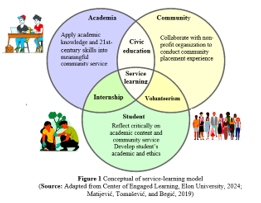
This study explores service-learning pedagogy in higher education, focusing on three components: university, community, and students. The research centers on improving safe and nutritious school lunches in Thai schools. Two main objectives were pursued: first, integrating service-learning with social engineer to examine the community food system, and second, identifying competencies of practical teachers after engaging in social engineer to enhance the school lunch supply chain's safety and nutrition. The study involved 30 practical teachers (ages 17-19) from the disciplines of elementary education and agriculture at Chiang Mai Rajabhat University (CMRU), spanning academic years 2021-2023. The research proceeded in three stages: 1) understanding community agriculture related to school lunches, 2) service delivery using social engineer tools to survey and improve the lunch supply chain, and 3) reflecting on teacher competencies in managing school lunches. Descriptive statistics were used for analysis. Results showed that the practical teachers gained knowledge of community food systems, safe agriculture, and food safety, achieving an average score of 80% in assessments. The study identified several issues in school lunch management, such as pesticide contamination, poor sanitation, improper food storage, and lack of alignment between lunch menus and seasonal vegetable availability. A fishbone diagram revealed five main risks in the supply chain: unsafe farming practices, uninspected food ingredients and water, poor food storage and transportation, improper cooking, and inadequate hygiene. These risks were addressed by creating a safer supply chain through social engineer. The study's outcomes highlighted teacher competencies in three areas: understanding community food systems, managing safe and nutritious lunches, and fostering social awareness. This service-learning project contributes to CMRU’s model, ensuring that graduates are equipped to manage safe and quality school lunches for elementary students.
Downloads
References
Anderson, L. W. & Krathwohl, D. R. (2001). A taxonomy for Learning, teaching, and assessing: A revision of Bloom’s taxonomy of educational objectives. New York: Addison Wesley Longman.
Bloom, B. S. (Ed.), Engelhart, M. D., Furst, E. J., Hill, W. H., & Krathwohl, D. R. (1956). Taxonomy of educational objectives: Handbook I: Cognitive domain. New York: David McKay.
Bundy, D. AP, Drake, L. J., & Burbano, C. (2012). School food, politics and child health. Public Health Nutrition, 16(6), 1012–1019. Retrieved from https://pubmed.ncbi.nlm.nih.gov/23116617/
Bureau of Nutrition. (2021). Guidelines for organizing midday meals for school-age children: Single-dish menu options. Nonthaburi: Department of Health, Ministry of Public Health, Thailand.
Burns, H., & Miller, W. (2012). The Learning Gardens Laboratory: teaching sustainability and developing sustainable food systems through unique partnerships. Journal of Agriculture, Food Systems, and Community Development, 2(3), 69–78. Retrieved from http://dx.doi.org/10.5304/jafscd.2012.023.003
Center of Engaged Learning, Elon University. (2024). Service-learning. Retrieved from
https://www.centerforengagedlearning.org/resources/service-learning/
Daugherty, J. (2015). Impact of service-learning experiences in culinary arts and
nutrition science. Journal of Public Scholarship in Higher Education, 5, 61-78. Retrieved from https://files.eric.ed.gov/fulltext/EJ1120328.pdf
DiBenedetto, C. A., Willis, V. C., & Bamck, K. (2018). Needs assessments for school-based agricultural education teacher: a review of literatures. Journal of Agricultural Education, 57(4), 52-71. Retrieved from https://files.eric.ed.gov/fulltext/EJ1200378.pdf
Forrestal, S., Potamites, E., Guthrie, J., & Paxton, N. (2021). Associations among food security, school meal participation, and students’ diet quality in the first school nutritionand meal cost study. Nutrients, 13(2), 307. Retrieved from https://doi.org/10.3390/nu13020307
Galli, F., Brunori, G., Di Iacovo, F., & Innocenti, S. (2014). Co-producing sustainability: involving parents and civil society in the governance of school meal services. a case study from Pisa, Italy. Sustainability, 6(4), 1643-1666. Retrieved from https://doi.org/10.3390/su6041643
Gregorová, A. B., Heinz ova, Z.& Chovancová, K. (2016). The impact of service-learning on students’ key competences. International Journal of Research on Service-Learning and Community Engagement, 4(1), 367-376. Retrieved from https://pdfs.semanticscholar.org/aefc/5bb8e733fc23a10c03cd85f0ce15ef12c1a0.pdf
Harder, W. C. (2009). Service-learning benefits gained by agricultural students in Costa Rica: A case study. Proceedings of the 25th Annual Meeting, InterContinental San Juan Resort, Puerto Rico. p. 237-146.
Kelemen, D. B., Cartmell, D. D., & Sitton, S. P. (2009). Learning Service: a case study in an agricultural communications course. Journal of Applied Communications, 93(3), 1-14. Retrieved from https://doi.org/10.4148/1051-0834.1195
Kolb, A. Y., & Kolb, D. A. (2005). Learning Styles and Learning Spaces: Enhancing Experiential Learning in Higher Education. Academy of Management Learning and Education, 4(2), 193–212. Retrieved from https://www.jstor.org/stable/40214287
Maneekosol, C., Boonraeng, S., Sridechakul, T., Suwannalert, P. & Panyoyai, N. (2021). The Kru Noi farming Project following The Royal Footsteps: The innovation of a student teacher development on the new theory of agriculture and sufficiency economy. Ganesha Journal, 17(1), 1-11. Retrieved from https://so01.tci-thaijo.org/index.php/pikanasan/article/view/243059
Matijević, A. S., Tomašević, T., & Begić, J. (2019). Community engagement and service-learning guidelines for higher education. Sweden: KIC - Knowledge Innovation Centre, The European Commission.
O' Neil, C. E., & Lima, M. (2013). Service-learning in agricultural instruction: a guide for implementing real-world, hands-on, community-based teaching and learning. NACTA Journal, 47(2), 36-41. Retrieved from https://www.jstor.org/stable/43766866
Phukamchanode, P. (2024). Concepts of social engineer. Retrieved from https://elfhs.ssru.ac.th/phusit_ph/pluginfile.php/42/block_html/content
Potchoo, J., Kaewchotima, N., & Taugsuphoom, N. (2022). Nutritional quality of lunch meals and plate waste in school lunch programme in Southern Thailand. Journal of Nutritional Science. 11, E35. Retrieved from http://dx.doi.org/10.1017/jns.2022.31
Resch, K., & Schrittesser, I. (2023). Using the Service-Learning approach to bridge the gap between theory and practice in teacher education. International Journal of Inclusive Education, 27(10), 1118-1132. Retrieved from https://doi.org/10.1080/13603116.2021.1882053
Rojas, A.,Valley, W., Mansfield, B., Orrego, E., Chapman, G. E., & Harlap, Y. (2011). Toward food system sustainability through school food system change: think&eatGreen@School and the making of a community-university research alliance. Sustainability, 3(5), 763-788. Retrieved from https://doi.org/10.3390/su3050763
Stavrianeas, S. (2018). Service-learning in a college nutrition class: examination of elementary school lunch partnerships. A Journal of Service-Learning and Civic Engagement, 9(1), 1-18. Retrieved from https://libjournal.uncg.edu/prt/article/view/1527
The Hang Seng University of Hong Kong. (2024). What is Service-Learning?. Retrieved from https://service-learning.hsu.edu.hk/what-is-service-learning/
World Economic Forum March. (2016). 21st-Century skills in fostering social and emotional learning through technology. World Economic Forum March.
Downloads
Published
How to Cite
Issue
Section
Categories
License
Copyright (c) 2025 Community and Social Development Journal

This work is licensed under a Creative Commons Attribution-NonCommercial-NoDerivatives 4.0 International License.