
Effectiveness of Peer Coaching and Academic Performance in Teaching Internship
DOI:
https://doi.org/10.57260/csdj.2025.275287Keywords:
Peer coaching, Teacher professional development, Correlational analysis, Academic performanceAbstract
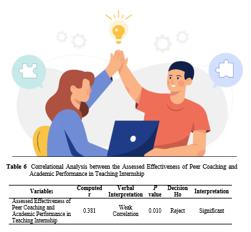
This study evaluates the effectiveness of peer coaching as a collaborative professional development practice for prospective teachers at a state university in the Philippines. Utilizing a descriptive-correlational design, the research explores the relationship between the effectiveness of peer coaching and the academic performance of fourth-year teaching interns. A sample of 137 students was selected from 212 total respondents, with data gathered through a validated 20-item researcher-made questionnaire and academic performance records. The findings reveal that peer coaching is highly effective in several key areas, including lesson planning, instructional delivery, feedback provision, and reflective practices. However, aspects such as systematic preparation and self-assessment showed slightly lower effectiveness. Overall, the academic performance of prospective teachers was predominantly high, with most rated as Superior. A weak but significant positive correlation (r = 0.381) was observed between peer coaching effectiveness and academic performance, suggesting that while peer coaching has a positive impact, the effect is modest. To maximize the benefits of peer coaching, recommendations include strengthening the components of systematic preparation and self-assessment, offering targeted training for peer coaches, and further enhancing reflective practices. Regular evaluations of peer coaching’s impact on academic performance are also suggested.
Downloads
References
Alonso, M. A., García, A., González-Ortiz-de-Zárate, M. Á., Gómez-Flechoso, López, M., & Castrillón, M. (2024). Effectiveness of a peer mentoring program on university dropout and academic performance. Psicología Educativa: Revista de los Psicólogos de la Educación, 3(1), 29-37. Retrieved from https://journals.copmadrid.org/psed/art/psed2024a5 DOI: https://doi.org/10.5093/psed2024a5
Atemeh, J., & Asoodar, M. (2024). Constructive peer-feedback to improve language and communication skills in medical education. Innovation in Language Learning and Teaching, 18(5), 387-401. Retrieved from https://www.tandfonline.com/doi/full/10.1080/17501229.2024.2311834 DOI: https://doi.org/10.1080/17501229.2024.2311834
Boulton, R. E. S., & Boaz, A. (2023). Peer coaching, implementation support, and organizational power. Journal of Interprofessional Care, 1, 1-10. Retrieved from https://www.tandfonline.com/doi/full/10.1080/13561820.2023.2205879 DOI: https://doi.org/10.1080/13561820.2023.2205879
Callo, E. M. E., & Ubayubay, R. M. (2024). Perceptions of peer coaching technique by the alternative learning system community implementer. International Journal of Research Publications, 144(1), 29-49. Retrieved from https://www.ijrp.org/paper-detail/6056 DOI: https://doi.org/10.47119/IJRP1001441320246138
Corrigan, P. W., Sheehan, L., Walley, G., Qin, S., Nieweglowski, K., & Maurer, K. (2020). Strengths and challenges of peer coaches for supported education in colleges and universities. Psychiatric Rehabilitation Journal, 43(3), 175–178. Retrieved from https://doi.org/10.1037/PRJ0000390 DOI: https://doi.org/10.1037/prj0000390
Cortellazzo, L., Bonesso, S., Gerli, F., & Lazreg, C. (2023). Peer coaching in a leadership development program: The role of developmental relationships. Proceedings of the 2023 International Conference on Human Resource Development, 16118. Retrieved from https://doi.org/10.4995/head23.2023.16118 DOI: https://doi.org/10.4995/HEAd23.2023.16118
Creswell, J. W. (2014). Research design: Qualitative, quantitative, and mixed methods approaches. (4th ed.). SAGE Publications.
Curran, V., Fleet, L., & Whitton, C. (2022). Fostering "Reflection-On-Practice" through a multisource feedback and peer coaching pilot program. Journal of Continuing Education in the Health Professions, 44(1), 64-70. Retrieved from https://doi.org/10.1097/CEH.0000000000000483
Ester, M. B., Monguillot, M., Soler, M., & Durán, D. (2024). Reciprocal peer observation: A mechanism to identify professional learning goals. Education Inquiry, 1-17. Retrieved from https://doi.org/10.1080/20004508.2024.2370116 DOI: https://doi.org/10.1080/20004508.2024.2370116
Fitriah, A., Ahlam, R., & Mapa, H. (2023). Unveiling the transformation: The impact of teaching internships in Thai schools on pre-service teachers' professional development. Journal of English Education, Literature and Linguistics, 3(2), 113-139. Retrieved from https://jurnal.iaih.ac.id/index.php/ETJaR/article/view/778 DOI: https://doi.org/10.55148/etjar.v3i2.778
Lanius, K. (2022). Fostering “reflection-on-practice” through a multisource feedback and peer coaching pilot program. Publish Ahead of Print, 44(1), 64-70. Retrieved from https://doi.org/10.1097/ceh.0000000000000483 DOI: https://doi.org/10.1097/CEH.0000000000000483
Lee, S. (2023). Reaching out: Cultivating a learning community to facilitate video-based peer coaching on teaching practice in the ‘extended’ and online classroom. International Journal of Mobile Learning and Organisation, 17(1/2), 32-32. Retrieved from https://doi.org/10.1504/ijmlo.2023.128346 DOI: https://doi.org/10.1504/IJMLO.2023.128346
Liew, W. Y. (2016). Peer coaching for improvement of teaching and learning. Journal of Interdisciplinary Research in Education (JIRE), 6(1), 64-70. Retrieved from https://pedagogyofconfidence.net/wp-content/uploads/2021/08/vol6_05.pdf
Li-Yu, C., Wei-Wei, Z., Wen-Zhe, H., & Rung-Jiun, C. (2023). Establishing a professional learning community for cultivating future design talents using a ‘peer coaching’ mechanism. Heliyon, 9(10), e20906. Retrieved from https://doi.org/10.1016/j.heliyon.2023.e20906 DOI: https://doi.org/10.1016/j.heliyon.2023.e20906
Terekhin, R., Argote, L., Feldman, E., Kayes, C. D., Klein, W., MurphyMarcinkus, M., MahmoudHeba, M., Scarola, D., Van Oosten, E. B., & Wasserman, I. (2023). Designing peer coaching groups to foster performance, learning, and well-being of the participants. Proceedings - Academy of Management. Retrieved from https://doi.org/10.5465/amproc.2023.10895symposium DOI: https://doi.org/10.5465/AMPROC.2023.10895symposium
Downloads
Published
How to Cite
Issue
Section
Categories
License
Copyright (c) 2025 Community and Social Development Journal

This work is licensed under a Creative Commons Attribution-NonCommercial-NoDerivatives 4.0 International License.