Household Debt and Income Inequality in Thailand: A Vector Autoregressive Analysis
DOI:
https://doi.org/10.57260/csdj.2025.275931Keywords:
Household debt, Income inequality, Vector autoregression modelAbstract
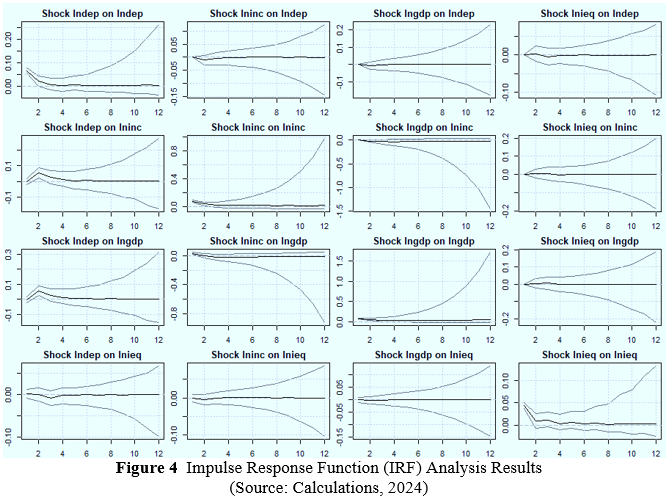
This study examines the dynamic relationships between household debt, income, GDP, and income inequality in Thailand, a nation grappling with rising household debt and persistent income disparities. Using a 19-year dataset, the research employs a Bayesian VAR (BVAR) model to explore the interdependencies among these variables and Impulse Response Function (IRF) analysis to evaluate their short-term and long-term adjustments to economic shocks. The findings reveal that household debt exhibits strong persistence and is positively influenced by income inequality, underscoring the role of disparities in driving debt accumulation. Conversely, income and GDP demonstrate resilience, with income positively influenced by GDP and negatively impacted by household debt, reflecting the burden of rising debt on income generation. GDP is shown to play a pivotal role in sustaining economic stability, while income inequality emerges as a persistent structural issue, amplified by household debt. The IRF analysis further reveals that a shock in household debt leads to a temporary decline in income and GDP, followed by stabilization in the medium term. However, income inequality responds positively to debt shocks, highlighting the disproportionate impact on low-income households and the long-term challenges of addressing inequality. The study's findings emphasize the need for targeted policies to manage household debt, promote equitable income distribution, and foster sustainable economic growth. Recommendations include debt restructuring programs, financial literacy campaigns, and progressive taxation to reduce disparities and enhance economic resilience.This research contributes to the understanding of the intricate relationships between debt, income, and inequality, offering insights for policymakers in Thailand and similar economies.
Downloads
References
Atkinson, A. B. (2015). Inequality: What can be done?. Cambridge: Harvard University Press. DOI: https://doi.org/10.4159/9780674287013
Bank of Thailand. (2021). Household Debt and Financial Stability Report. Bangkok: Bank of Thailand. Retrieved from https://www.bot.or.th
Bank of Thailand. (2022). Impact of COVID-19 on household debt vulnerability in Thailand. Bangkok: Bank of Thailand.
Bank of Thailand. (2022). Financial Stability Report 2022. Bangkok: Bank of Thailand. Retrieved from https://www.bot.or.th/content/dam/bot/documents/en/research-and-publications/reports/financial-stability-report/FSR2022e.pdf
Bank of Thailand. (2023). Monetary Policy Report: Quarter 4/2023. Bangkok: Bank of Thailand. Retrieved from https://www.bot.or.th/content/dam/bot/documents/en/our-roles/monetary-policy/mpc-publication/monetary-policy-report/mpr-box/MPR_2023_Q4_BOX4.pdf
Bertrand, M., & Morse, A. (2011). Information disclosure, cognitive biases, and payday borrowing. The Journal of Finance, 66(6), 1865–1893. Retrieved from https://doi.org/10.1111/j.1540-6261.2011.01698.x DOI: https://doi.org/10.1111/j.1540-6261.2011.01698.x
Corak, M. (2013). Income inequality, equality of opportunity, and intergenerational mobility. Journal of Economic Perspectives, 27(3), 79–102. Retrieved from https://doi.org/10.1257/jep.27.3.79 DOI: https://doi.org/10.1257/jep.27.3.79
Credit Suisse. (2018). Global Wealth Report 2018. Zurich: Credit Suisse Research Institute.
Dabla-Norris, E., Kochhar, K., Suphaphiphat, N., Ricka, F., & Tsounta, E. (2015). Causes and consequences of income inequality: A global perspective (IMF Staff Discussion Note No. 15/13). International Monetary Fund. https://www.imf.org/external/pubs/ft/sdn/2015/sdn1513.pdf DOI: https://doi.org/10.5089/9781513555188.006
Iacoviello, M. (2008). Household debt and income inequality: U.S. evidence. Journal of Monetary Economics, 55(3), 493–514. Retrieved from https://doi.org/10.1016/j.jmoneco.2008.03.001 DOI: https://doi.org/10.1016/j.jmoneco.2008.03.001
Jordà, Ò., Schularick, M., & Taylor, A. M. (2013). When credit bites back: Leverage, business cycles, and crises. Journal of Money, Credit and Banking, 45(s2), 3–28. Retrieved from https://doi.org/10.1111/jmcb.12069 DOI: https://doi.org/10.1111/jmcb.12069
Krueger, D., & Perri, F. (2006). Does income inequality lead to consumption inequality? Evidence and theory. Review of Economic Studies, 73(1), 163–193. Retrieved from https://doi.org/10.1111/j.1467-937X.2006.00373.x DOI: https://doi.org/10.1111/j.1467-937X.2006.00373.x
Lebarz, C. (2014). Credit and income inequality: Theoretical and empirical evidence. OECD Economics Department Working Paper.
Lusardi, A., & Mitchell, O. S. (2014). The economic importance of financial literacy: Theory and evidence. Journal of Economic Literature, 52(1), 5–44. Retrieved from https://doi.org/10.1257/jel.52.1.5 DOI: https://doi.org/10.1257/jel.52.1.5
Mian, A., & Sufi, A. (2014). House of debt: How they (and you) caused the Great Recession, and how we can prevent it from happening again. Chicago: University of Chicago Press. DOI: https://doi.org/10.7208/chicago/9780226277509.001.0001
Mingmaninakin, W. (2013). Macroeconomics (p.36–44). Bangkok, Thailand: Thammasat University Press.
National Economic and Social Development Council (NESDC). (2022). Thailand’s social and economic development report. Bangkok: NESDC.
OECD. (2019). Under pressure: The squeezed middle class. Paris: OECD Publishing. Retrieved from https://doi.org/10.1787/689afed1-en DOI: https://doi.org/10.1787/689afed1-en
Piketty, T. (2014). Capital in the twenty-first century. Cambridge: Harvard University Press. DOI: https://doi.org/10.4159/9780674369542
Pukahuta, P. (2012). The term factors and lags in impacts of monetary policy transmission mechanism of Thai economics. KKU Research Journal, 11(1), 56–65. Retrieved from https://rtt.kku.ac.th/ejournal/pa_upload_pdf/866193.pdf
Sriboonchitta, S. (2004). Econometrics (p.575–597). Chiang Mai, Thailand.
Stiglitz, J. E. (2012). The price of inequality: How today's divided society endangers our future. New York: W. W. Norton & Company.
Thai Bankers' Association. (2024). Household debt overview. Bangkok: Thai Bankers’ Association.
United Nations ESCAP. (2022). Reducing inequality for sustainable development in Asia and the Pacific. Bangkok: United Nations ESCAP. Retrieved from https://www.unescap.org
World Bank. (2020). Global economic prospects: Slow growth, policy challenges. Washington, DC: World Bank. Retrieved from https://www.worldbank.org/en/publication/global-economic-prospects
Downloads
Published
How to Cite
Issue
Section
License
Copyright (c) 2025 Community and Social Development Journal

This work is licensed under a Creative Commons Attribution-NonCommercial-NoDerivatives 4.0 International License.