Factors Affecting the Political Culture of First-Time Voters in the General Election of 2023 A.D. in Upper North of Thailand
DOI:
https://doi.org/10.57260/csdj.2025.278492Keywords:
Political culture, First-Time voters, General election 2023, Upper North of ThailandAbstract
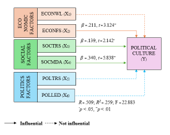
This article revisits the traditional political culture framework established by Gabriel Almond and Sidney Verba, which has been a cornerstone in the study of political culture for over five decades. By incorporating both traditional approaches and the political culture frameworks developed by Ronald Inglehart, Terry Clark, and Vincent Hoffmann-Martinot, which examines political culture in the context of economic and social changes, which are factors influencing the new political culture. Specifically, this study examines how economic, social, and political factors influence the political culture of first-time voters in the upper north of Thailand during the 2023 general election. The study sample size of 400 first-time voters from three provinces—Lamphun, Phrae, and Mae Hong Son. Quantitative research methods, including inferential statistics and multiple linear regression analysis, were employed to analyze the data.
The findings reveal that social factors related to social media significantly influenced the political culture of first-time voters ( = .340). Economic factors, specifically the family's financial status, also played a significant role (
= .211), as did social factors concerning social trust (
= .139). However, economic factors such as state welfare and political factors, including political trust and the leadership of political leaders, were found to have no impact on the political culture of first-time voters in the upper north of Thailand.
Future research should incorporate sociological and psychological dimensions to examine the motivations and obstacles influencing political participation among voters and its effects on political culture. Additionally, employing mixed-methods research for deeper analysis, including comparative studies of political generations, would help assess the impact of economic, social, and political factors on political culture.
Downloads
References
Almond, G. A., & Verba, S. (1963). The civic culture: Political attitudes and democracy in five nations. Princeton, NJ: Princeton University Press.
Boulianne, S. (2015). Social media use and participation: A meta-analysis of current research. Information, Communication & Society, 18(5), 524–538. Retrieved from https://doi.org/10.1080/1369118X.2015.1008542
Brehm, J., & Rahn, W. (1997). Individual-level evidence for the causes and consequences of social capital. American Journal of Political Science, 41(3), 999–1023. Retrieved from http://www.jstor.org/stable/2111684
Clark, T. N., & Martinot, V. (1998). The new political culture. New York, NY: Westview Press.
Chanley, V. A., Rudolph, T. J., & Rahn, W. M. (2000). The origins and consequences of public trust in government: A time series analysis. Public Opinion Quarterly, 64(3), 239-256. Retrieved from https://doi.org/10.1086/317987
Chandoevwit, W., & Suriyanrattakorn, S. (2022). Happiness economics. Lock-in Design Work Publishing.
Cramer, D. (1997). Fundamental statistics for social research: Step-by-step calculations and computer techniques using SPSS for Windows. New York, NY: Routledge.
Dalton, R. J. (2004). Democratic challenges, democratic choices: The erosion of political support in advanced industrial democracies. Oxford University Press.
Dalton, R. J., & Welzel, C. (Eds.). (2014). The civic culture transformed: From allegiant to assertive citizens. Cambridge University Press.
Department of Provincial Administration. (2022). Monthly population statistics by age group in Thailand. Retrived from https://stat.bora.dopa.go.th/new_stat/webPage/statByAgeMonth.php
Fukuyama, F. (1995). Trust: The social virtues and the creation of prosperity. New York: The Free Press.
Hetherington, M. J. (2005). Why Trust Matters: Declining Political Trust and the Demise of American Liberalism. Princeton University Press.
IBM Corp. Released (2023). IBM SPSS Statistics for Windows, Version 29.0.2.0 Armonk, NY: IBM Corp.
Inglehart, R. (1977). The silent revolution: Changing values and political styles. Princeton University Press.
Inglehart, R. (1988). Revisit political culture: The silent revolution. American Political Science Review, 82(4), 1203-1230. Retrieved from https://doi.org/10.2307/1962516
Inglehart, R. (1990). Culture shift in advanced industrial society. Princeton University Press.
Inglehart, R. (2005). Redefining culture perspective across the disciplines. Routledge.
Inglehart, R., & Welzel, C. (2005). Modernization, cultural change, and democracy: The human development sequence. Cambridge University Press.
Kanjanakij, C. (2002). Political trust and political participation in Thai local politics: A case study of Tambon Administration Organizations. (Doctoral dissertation, Faculty of Political Science, Chulalongkorn University).
Kline, R. B. (2016). Principles and practice of structural equation modeling (4th ed.). New York: The Guilford Press.
Lertchoosakul, K. (2021). Cold war (in) between white bows. Bangkok, Thailand: Matichon.
Levi, M., & Stoker, L. (2000). Political trust and trustworthiness. Annual Review of Political Science, 3(1), 475-507. Retrieved from https://doi.org/10.1146/annurev.polisci.3.1.475
Lipset, S. M. (1959). Some social requisites of democracy: Economic development and political legitimacy. American Political Science Review, 53(1), 69–105. Retrieved from https://www.jstor.org/stable/1951731
Mair, P. (2013). Ruling the Void: The Hollowing of Western Democracy. Verso Books.
Miller, A. H., Goldenberg, E. N., & Erbring, L. (1979). Type-set politics: Impact of newspapers on public confidence. The American Political Science Review, 73(1), 67-84. Retrieved from https://doi.org/10.2307/1954731
Mohammed, N. (2007). Leadership and political culture: A brief look at the Malaysian political landscape. Journal of Administrative Science, 4(2), 59–79. Retrieved from https://ir.uitm.edu.my/id/eprint/43150
Newton, K. (1997). Social trust and political involvement: A comparative analysis. European Journal of Political Research, 32(2), 157-175. Retrieved from https://doi.org/10.1111/1475-6765.00303
Newton, K. (2001). Trust, social capital, civil society, and democracy. International Political Science Review, 22(2), 201–214. Retrieved from http://www.jstor.org/stable/1601186
Newton, K. (2007). Social and political trust. In R. J. Dalton & H.-D. Klingemann (Eds.), The Oxford handbook of political behaviour (pp. 342-361). Oxford University Press.
Norman, G. (2010). Likert scales, levels of measurement and the "laws" of statistics. Advances in Health Sciences Education, 15(5), 625–632. Retrieved from https://doi.org/10.1007/s10459-010-9222-y
Norris, P. (Ed.). (1999). Critical citizens: Global support for democratic government. Oxford University Press.
Norris, P. (2011). Democratic Deficit: Critical Citizens Revisited. Cambridge University Press.
Pankaew, A. (2019). Attitudes toward Democracy and Politics of First-time Voters. King Prajadhipok’s Institute Journal, 17(2), 5–19. Retrieved from https://so06.tci-thaijo.org/index.php/kpi_journal/article/view/244023
Putnam, R. D. (1993). Making Democracy Work: Civic Traditions in Modern Italy. Princeton: Princeton University Press.
Putnam, R. D. (1995). Bowling alone: America's declining social capital. Journal of Democracy, 6(1), 65–78. Retrieved from https://doi.org/10.1353/jod.1995.0002
Putnam, R. D. (2000). Bowling Alone: The Collapse and Revival of American Community. New York: Simon & Schuster.
Putnam, R. D. (2001). Social capital: Measurement and consequences. Canadian Journal of Policy Research, 2(1), 41–51.
Pye, L. W. (1968). Political Culture. in International Encyclopedia of the Social Sciences. New York: Mac Millan and the Free Aress.
Rothstein, B. (1998). Just institutions matter: The moral and political logic of the universal welfare state. Cambridge University Press.
Rothstein, B., & Stolle, D. (2008). The state and social capital: An institutional theory of generalized trust. Comparative Politics, 40(4), 441-459. Retrieved from https://www.jstor.org/stable/20434095
Sathitniramai, A. (2023). Reviewing the landscape of Thai politics: The 2023 election results and Two Democracies. Naresuan University Journal of Social Sciences, 19(2), 261–266. Retrieved from https://doi.org/10.14456/jssnu.2023.23
Sathitniramai, A., Mookdawijit, Y., & Phawakhapan, N. (2013). Re-examining the political landscape of Thailand. Policy Advocacy Program, Public Policy Studies Institute, Chiang Mai University.
Sawadee, N. S., & Damjan, J. (2024). Voices of the new generation: Hopes, dreams, fears, and divides in Thai society. Friedrich Ebert Foundation.
Schoon, I., & Cheng, H. (2011). Determinants of political trust: A lifetime learning model. Developmental Psychology, 47(3), 619-631. Retrieved from https://doi.org/10.1037/a0021759
Seligson, M. A. (2002). The renaissance of political culture or renaissance of the ecological fallacy?. Comparative Politics, 34(3), 273-292. Retrieved from https://www.jstor.org/stable/4146954
Shirky, C. (2011). The political power of social media: Technology, the public sphere, and political change. Foreign Affairs, 90(1), 28-41. Retrieved from https://www.jstor.org/stable/25800379
Stiglitz, J. E. (2012). The price of inequality: How today's divided society endangers our future. W.W. Norton & Company.
Sukontharangsri, S. (1973). People, ideology, and leadership in Thai society. Thai Journal of Development administration NIDA, 13(4), 439-463.
Suksawas, W. (2021). Quantitative research in political science. (3rd ed.). Naresuan University Press.
Tufekci, Z., & Wilson, C. (2012). Social media and the decision to participate in political protest: Observations from Tahrir Square. Journal of Communication, 62(2), 363–379. Retrieved from https://doi.org/10.1111/j.1460-2466.2012.01629.x
Verba, S. (1965). Comparative political culture. In L. W. Pye & S. Verba (Eds.), Political culture and political development (pp. 512-534). Princeton University Press.
Verba, S., Schlozman, K. L., & Brady, H. E. (1995). Voice and Equality: Civic Voluntarism in American Politics. Harvard University Press.
Wongsatjachock, W. (2024). From a political to an ‘ideological’ machine: A case study of the 2023 general election, Phitsanulok province. Journal of Social Sciences Naresuan University, 20(1), 235–262. Retrieved from https://doi.org/10.69650/jssnu.2024.270939
Yamane, T. (1973). Statistics: An introductory analysis. Harper and Row.
Zmerli, S., & Newton, K. (2008). Social trust and attitudes toward democracy. Public Opinion Quarterly, 72(4), 706-724. Retrieved from https://doi.org/10.1093/poq/nfn042
Downloads
Published
How to Cite
Issue
Section
Categories
License
Copyright (c) 2025 Community and Social Development Journal

This work is licensed under a Creative Commons Attribution-NonCommercial-NoDerivatives 4.0 International License.