An Experimental Study on the Development of a Training Program for Psychological Traits and Skills to Enhance Socially Ethical Behaviors in Thai Youths
DOI:
https://doi.org/10.57260/csdj.2025.279203Keywords:
Experimental research, Social ethics, Thai youth, TrainingAbstract
This experimental research aimed to examine the effectiveness of Thai youths who underwent the different levels of training intensity. The sample had 120 Thai youths, who were randomly assigned to one of four groups without bias under a 2 × 2 factorial design, with two types of independent variables: 1) training in psychological traits, 2) training in socially ethical skills. Three phases were evaluated: before training, after training immediately, and three-month after training. Seven measurement tools were used by Likert-type rating scale with reliability coefficients from 0.810 to 0.860. The statistical method to test the hypotheses was Analysis of Covariance.
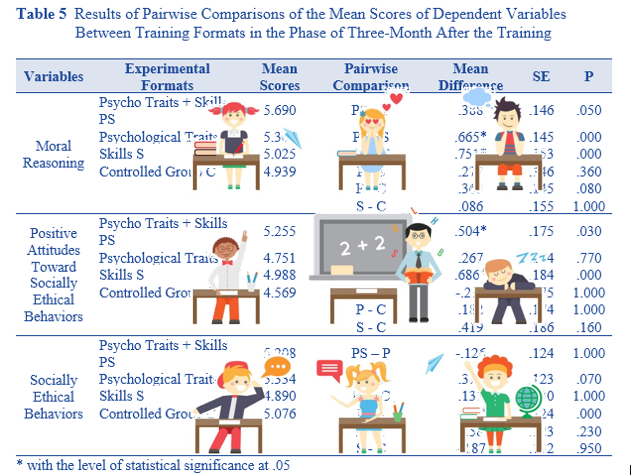
The findings revealed that 1) For the phase after training immediately, Thai youths who underwent the trainings in psychological traits and socially ethical skills had a higher mean score in moral reasoning compared to those who trained only the training in socially ethical skills or no any training. Additionally, they exhibited more positive attitudes toward socially ethical behaviors than those who did not train any training. Their socially ethical behaviors were higher than Thai youths who only underwent in socially ethical skills, 2) For the phase of three-month after training, Thai youths who underwent the trainings in psychological traits and socially ethical skills had a higher mean score in moral reasoning than those who trained only the training in socially ethical skills or no any training. Moreover, their positive attitudes toward socially ethical behaviors remained higher than Thai youths who only trained in psychological trait or no any training.
Downloads
References
Ajzen, I., & Fishbein, M. (1980). Understanding attitudes and predicting social behavior. Englewood Cliffs, NJ: Prentice-Hall.
Bhanthumnavin, D., & Bhanthumnavin, D. (2021). Academic innovative tales and the enhancement of psycho-moral strength in students. The Periodical of Behavioral Science, 27(1), 1–17. https://so06.tci-thaijo.org/index.php/BSRI/article/view/243371
Bhanthumnavin, D. (1996). The Tree of Ethics Theory: Research and Human Development. Bangkok: Chulalongkorn University.
Doyle, E. (2015). Taxing times: An Educational Intervention to Enhance Moral Reasoning in Tax. Irish Educational Studies, 34(2), 183-205. https://doi.org/10.1080/03323315.2014.1001202
Jutarosaga, M. (2019). Developing creative systems thinking processes: A reflection of thinking through three-basket technique. Journal of Research and Curriculum Development, 9(2), 203–222. https://so03.tci-thaijo.org/index.php/jrcd/article/view/216950
Klinkesorn, P., Tantawutho, V., & Ueangchokchai, C. (2019). Learning package for morality and ethics development in moral reasoning for occupation mass media. Sripatum Chonburi Journal, 16(1), 111–120. https://so05.tci-thaijo.org/index.php/SPUCJ/article/view/223346
Kohlberg, L. (1975). Moral education for a society in moral transition. Educational Leadership, 33(1), 46–54. https://eric.ed.gov/?id=EJ138732
Mouratidou, K., Goutza, S., & Chatzopoulos, D. (2007). Physical Education and Moral Development: An Intervention Program to Promote Moral Reasoning through Physical Education in High School Students. European Physical Education Review, 13(1), 41–56. https://doi.org/10.1177/1356336X07072675
Nedwong, T. (2013). Development of moral reasoning utilizing group investigation cooperative learning and virtuous project base. Journal of Multidisciplinary in Social Sciences, 9(3), 67-80. https://so03.tci-thaijo.org/index.php/sduhs/article/view/29255
Pinpradit, N., Suwantamma, K., & Attatammarat, R. (2014). Level of moral reasoning among youths, and testing the effectiveness of the moral self-learning program to enhance moral reasoning. Journal of Education, 37(4), 51–59. https://so02.tci-thaijo.org/index.php/EDKKUJ/article/view/49168
Sodmanee, O., & Junprasert, T. (2011). Moral principles and ethical development: From concept to practical approach. Journal of Behavioral Science, 17(1), 19–30. https://so06.tci-thaijo.org/index.php/BSRI/article/view/359
Torabizadeh, C., Homayuni, L., & Moattari, M. (2018). Impacts of Socratic Questioning on Moral Reasoning of Nursing Students. Nursing Ethics, 25(2), 174–185. https://doi: 10.1177/0969733016667775
Upamairat, T. (2018). The effects of a self-regulation program on attitudes toward violence and self-control behavior among adolescents. (Master’s thesis, Prince of Songkla University, Songkhla, Prince of Songkla University).
Downloads
Published
How to Cite
Issue
Section
Categories
License
Copyright (c) 2025 Community and Social Development Journal

This work is licensed under a Creative Commons Attribution-NonCommercial-NoDerivatives 4.0 International License.