
Innovation Ecosystem Engagement and Innovation Performance: The Roles of Dynamic Capabilities and Digital Maturity
DOI:
https://doi.org/10.57260/csdj.2026.282718Keywords:
Innovation ecosystem engagement, Dynamic capabilities, Organizational digital maturity, Innovation performanceAbstract
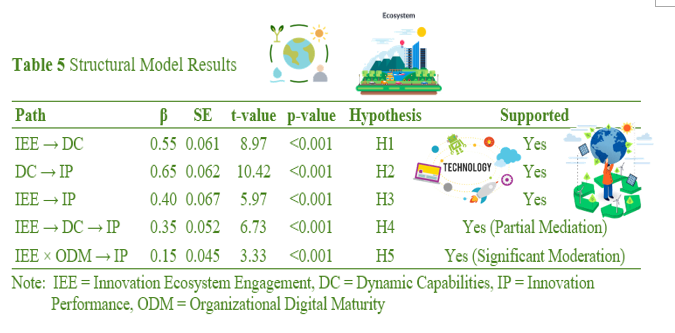
In the digital era, innovation ecosystem engagement (IEE) has emerged as a critical strategic imperative for firms seeking to enhance their innovation performance. This study investigates the complex relationship between IEE and firm innovation performance (IP), examining the mediating role of dynamic capabilities (DC) and the moderating effect of organizational digital maturity (ODM). Drawing on resource-based view, dynamic capabilities theory, and innovation ecosystem theory, we developed a comprehensive theoretical model tested through structural equation modeling with data from 354 employees across 44 firms in technology-intensive industries in City M, China. Results reveal that IEE significantly enhances innovation performance through the development of dynamic capabilities, with this relationship being strengthened by higher levels of organizational digital maturity. Specifically, dynamic capabilities partially mediate the relationship between IEE and innovation performance (β = 0.35, p < 0.001), while organizational digital maturity significantly moderates the IEE-IP relationship (β = 0.15, p < 0.001). The model explains 42% of variance in dynamic capabilities and 56% of variance in innovation performance. These findings contribute to innovation management literature by integrating ecosystem, capability, and digital transformation perspectives, providing actionable insights for managers seeking to optimize their innovation strategies in digital contexts.
Downloads
References
Adner, R. (2017). Ecosystem as structure: An actionable construct for strategy. Journal of Management, 43(1), 39–58. https://doi.org/10.1177/0149206316678451
Anderson, J. C., & Gerbing, D. W. (1988). Structural equation modeling in practice: A review and recommended two-step approach. Psychological Bulletin, 103(3), 411–423. https://doi.org/10.1037/0033-2909.103.3.411
Barney, J. (1991). Firm resources and sustained competitive advantage. Journal of Management, 17(1), 99–120. https://doi.org/10.1177/014920639101700108
Baron, R. M., & Kenny, D. A. (1986). The moderator–mediator variable distinction in social psychological research: Conceptual, strategic, and statistical considerations. Journal of Personality and Social Psychology, 51(6), 1173–1182. https://doi.org/10.1037/0022-3514.51.6.1173
Farzaneh, M., Wilden, R., Afshari, L., & Mehralian, G. (2022). Dynamic capabilities and innovation ambidexterity: The roles of intellectual capital and innovation orientation. Journal of Business Research, 148, 47–59. https://doi.org/10.1016/j.jbusres.2021.11.018
Gong, Y., Zhou, J., & Chang, S. (2021). Core knowledge employee creativity and firm performance: The moderating role of riskiness orientation, firm size, and realized absorptive capacity. Personnel Psychology, 66(2), 443–482. https://doi.org/10.1111/peps.12024
Hahn, R., Spieth, P., & Ince, I. (2018). Business model design in sustainable entrepreneurship: Illuminating the commercial logic of hybrid businesses. Journal of Cleaner Production, 176, 439–451. https://doi.org/10.1016/j.jclepro.2017.12.167
Hayes, A. F. (2017). Introduction to mediation, moderation, and conditional process analysis: A regression-based approach. Guilford Press.
Qiao, N., & Niu, L. (2024). The Impact of the Industrial Innovation Ecosystem on Innovation Performance—Using the Equipment Manufacturing Industry as an Example. Systems, 12(12), 578. https://doi.org/10.3390/systems12120578
Rabelo, N. J, Figueiredo, C., Gabrial, B. C., & Valente, R. (2024). Factors for innovation ecosystem frameworks: Comprehensive organizational aspects for evolution. Technological Forecasting and Social Change, 203, 123383. https://doi.org/10.1016/j.techfore.2024.123383
Teece, D. J., Pisano, G., & Shuen, A. (1997). Dynamic capabilities and strategic management. Strategic Management Journal, 18(7), 509–533. https://doi.org/10.1002/(SICI)1097-0266(199708)18:7<509::AID-SMJ882>3.0.CO;2-Z
Vial, G. (2019). Understanding digital transformation: A review and a research agenda. Journal of Strategic Information Systems, 28(2), 118–144. https://doi.org/10.1016/j.jsis.2019.01.003
Vial, G. (2021). Understanding Digital Transformation: A Review and a Research Agenda. In A. Hinterhuber, T. Vescovi, & F. Checchinato (Eds.), Managing Digital Transformation (pp. 13-66). Routledge.
https://doi.org/10.4324/9781003008637-4
Zhou, K. Z., Gao, G. Y., & Zhao, H. (2017). State Ownership and Firm Innovation in China: An Integrated View of Institutional and Efficiency Logics. Administrative Science Quarterly, 62(2), 375–404. https://doi.org/10.1177/0001839216674457
Zhou, S., Li, W., Lu, Z., & Yue, R. (2023). An analysis of multiple ecosystem services in a large-scale urbanized area of northern China based on the food-energy-water integrative framework. Environmental Impact Assessment Review, 98, 106913 https://doi.org/10.1016/j.eiar.2022.106913
Downloads
Published
How to Cite
Issue
Section
Categories
License
Copyright (c) 2026 Community and Social Development Journal

This work is licensed under a Creative Commons Attribution-NonCommercial-NoDerivatives 4.0 International License.