
Determinants of Continuance Intentions Toward Global OTT Video Streaming Service Platforms Among Thai Gen Y and Gen Z in Chiang Mai
DOI:
https://doi.org/10.57260/csdj.2026.283094Keywords:
Over-the-top (OTT), Video streaming service, Continuance intentionAbstract
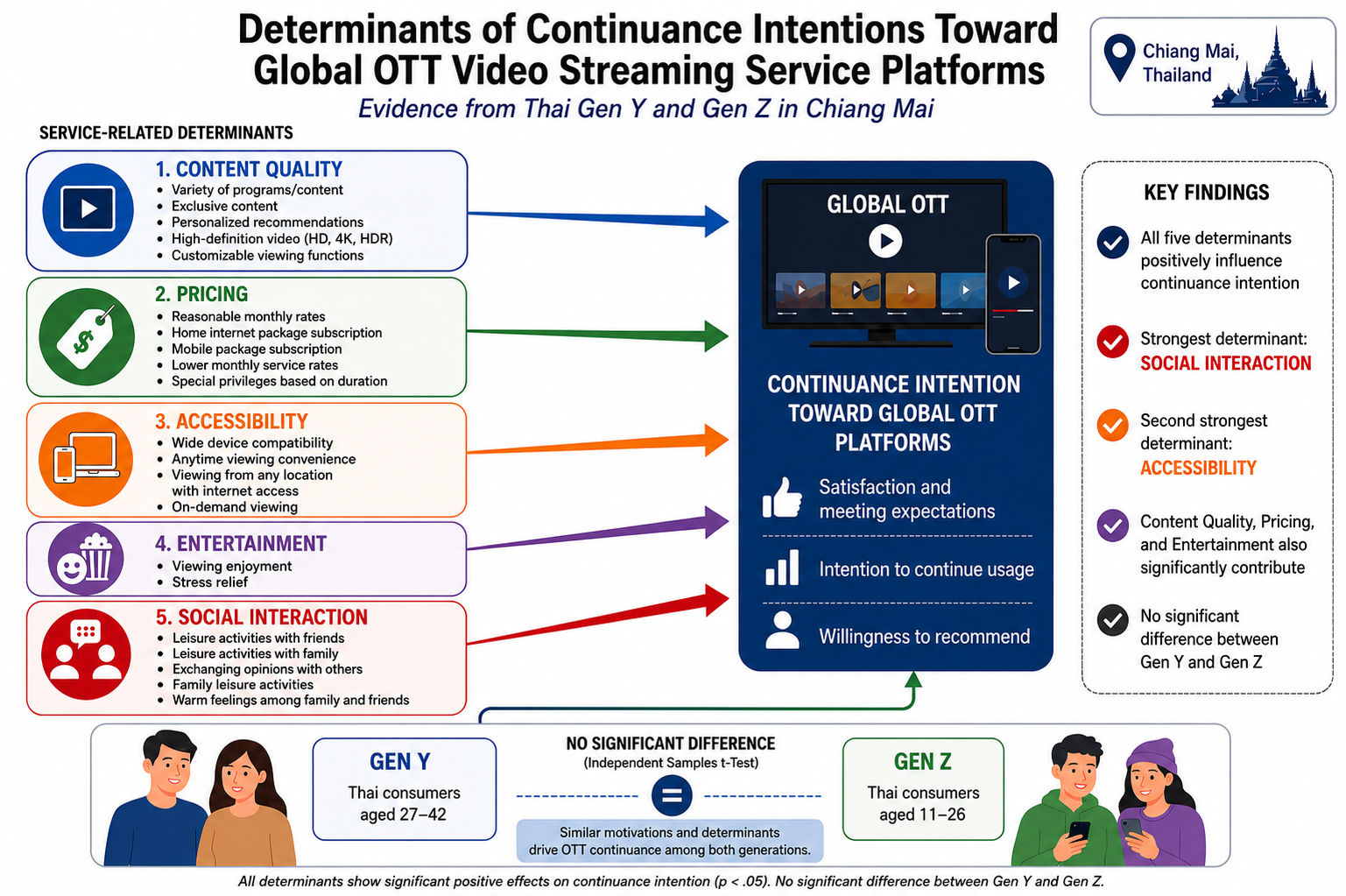
This study examines factors influencing continuance intentions toward global Over‑the‑Top (OTT) video streaming services among Thai Generation Y and Generation Z consumers in Chiang Mai. It focuses on five service‑related determinants, including content quality, pricing, accessibility, entertainment, and social interaction. Survey data from 450 respondents were analyzed using exploratory factor analysis, multiple regression, and an independent samples t‑test. The results indicate that all five factors significantly and positively affect continuance intentions, with social interaction exerting the strongest influence, followed by accessibility, while content quality, pricing, and entertainment also support continued OTT usage. No significant differences were found between Generation Y and Generation Z, suggesting that younger Thai cohorts share similar motivations for ongoing OTT consumption in Chiang Mai. Theoretically, the study extends OTT continuance research by highlighting social interaction as a central determinant and by providing empirical evidence from a major regional urban center beyond Bangkok. Practically, the findings underscore the need for global OTT providers to strengthen social features, ensure seamless cross‑device access, deliver diverse high‑quality content, and design flexible pricing options to improve user retention among Thai Gen Y and Gen Z consumers.
Downloads
References
Aruan, D. T. H., & Felicia, F. (2019). Factors influencing travelers’ behavioral intentions to use P2P accommodation based on trading activity: Airbnb vs Couchsurfing. International Journal of Culture, Tourism and Hospitality Research, 13(4), 487–504. https://doi.org/10.1108/IJCTHR-03-2019-0047
Bhattacharyya, S. S., Goswami, S., Mehta, R., & Nayak, B. (2021). Examining the factors influencing adoption of over the top (OTT) services among Indian consumers. Journal of Science and Technology Policy Management, 13(3), 652-682. https://doi.org/10.1108/JSTPM-09-2020-0135
Chaihanchanchai, P., & Anantachart, S. (2024). Unveiling the uses and gratifications of social media: A comparative study of Thai Generation Y internet users in Bangkok and upcountry. Journal of Mekong Societies, 20(1), 48–72. https://so03.tci-thaijo.org/index.php/mekongjournal/article/view/267632
Chang, P. C., & Chiu, Y. P. (2023). Factors influencing switching intention and customer retention of over-the-top (OTT) viewing behavior in Taiwan: The push–pull–mooring model. Emerging Media, 1(2), 196–217. https://doi.org/10.1177/27523543231210140
Chavadi, C. A., Sirothiya, M., Pandian, P., Ravindran, K., Thangam, D., & Menon, S. (2025). OTT users’ continuance intention and recommendation behaviour: Navigating engagement, experience and subscription costs. Vision: The Journal of Business Perspective. 278008200. https://doi.org/10.1177/09722629251330770
Chopra, S. (2021). Why are OTT platforms the first choice for content marketers. https://yourstory.com/2021/06/ott-platforms-first-choice-content-marketers
Choudhary, R., Shaik, Y. A., Yadav, P., & Rashid, A. (2024). Generational differences in technology behavior: A systematic literature review. Journal of Infrastructure, Policy and Development, 8(9), 6755. https://doi.org/10.24294/jipd.v8i9.6755
Cochran, W. G. (1953). Sampling Techniques. John Wiley & Sons.
Dananansuk, U., & Tubtiang, A. (2020). A Study of Behaviors and Factors Influencing the Decision-Making Involved of Using a Video Streaming Service in Bangkok. Journal of Humanities and Social Sciences, Rajapruk University, 7(2), 217-231. https://so03.tci-thaijo.org/index.php/rpu/article/view/254790
Greer, C. F., & Ferguson, D. A. (2015). Tablet computers and traditional television (TV) viewing: is the iPad replacing TV?. Convergence: The International Journal of Research into New Media Technologies, 21(2), 244-256. https://doi.org/10.1177/1354856514541928
Hair, J. F., Black, W. C., Babin, B. J., & Anderson, R. E. (2019). Multivariate data analysis. (8th ed.). Cengage Learning EMEA.
Jia, X., Pang, Y., & Li, W. (2023). Understanding consumers’ continuance intention to watch streams: A value‑based continuance intention model. Frontiers in Psychology, 14, 1073301. https://doi.org/10.3389/fpsyg.2023.1073301
Koul, S., Ambekar, S. S., & Hudnurkar, M. (2020). Determination and ranking of factors that are important in selecting an over-the-top video platform service among millennial consumers. International Journal of Innovation Science, 13(1), 53-66. https://doi.org/10.1108/IJIS-09-2020-0174
Langston Co. (2019). Streaming industry PRISM study – methodology. https://thelangstonco.com/streaming-study-methodology
Le, X. C., & Wang, H. (2022). Context-aware and social integrative-related factors as the precursors of efficient context aware advertising via mobile applications. International Journal of Mobile Communications, 20(3), 332-348. https://doi.org/ 10.1504/IJMC.2022.122611
Lo, M. C., Mohamad, A. A., Ibrahim, W. H. W., & Thong, J. Z. (2024). Unveiling the dynamics of Malaysian viewers’ continuance usage intention of OTT platforms: insights from the stimulus-organism-response (SOR) paradigm. Global Knowledge, Memory and Communication. https://doi.org/10.1108/GKMC-03-2024-0139
Lu, J., Wei, J., Yu, C. S., & Liu, C. (2017). How do post-usage factors and espoused cultural values impact mobile payment continuation?. Behaviour and Information Technology, 36(2), 140-164. https://doi.org/10.1080/0144929X.2016.1208773
Nazir, S., Khadim, S., Asadullah, M. A., & Syed, N. (2023). Exploring the influence of artificial intelligence technology on consumer repurchase intention: the mediation and moderation approach. Technology in Society, 72(4), 102190. https://doi.org/10.1016/j.techsoc.2022.102190
Park, I., & Park, H. S. (2014). Willingness to pay for the subscription fee of public broadcasting system. Advances in Journalism and Communication, 2(1), 1-7. https://doi.org/10.4236/ajc.2014.21001
Phaowijarn, R. (2019). The Study of Factors Affecting Video Streaming Subscribed Decision of Subscription Video on Demand Service Platform (SVOD) in Thailand. (Independent Study, Mahidol University).
Safari, A., & Albaum, G. (2019). Transactional or relational exchange theory in B2C marketing: an agenda for a different type of relational exchange theory. Journal of Customer Behaviour, 18(2), 87-100. https://doi.org/10.1362/147539219X15633616548579
Sahu, G., Gaur, L., & Singh, G. (2021). Applying niche and gratification theory approach to examine the users’ indulgence towards over-the-top platforms and conventional TV. Telematics and Informatics, 65, 101713. https://doi.org/10.1016/j.tele.2021.101713
Venkatesh, V., Thong, J. Y. L., & Xu, X. (2012). Consumer acceptance and use of information technology: extending the unified theory of acceptance and use of technology. MIS Quarterly, 36(1), 157-178. https://doi.org/10.2307/41410412
Walsh, P., & Singh, R. (2022). Determinants of millennial behaviour towards current and future use of video streaming services. Young Consumers, 23(3), 397-412. https://doi.org/10.1108/YC-08-2021-1374
Downloads
Additional Files
Published
How to Cite
Issue
Section
Categories
License
Copyright (c) 2026 Community and Social Development Journal

This work is licensed under a Creative Commons Attribution-NonCommercial-NoDerivatives 4.0 International License.