
Representations of Thai Soft Power & Cultural Identity in Foreign Video Games (1988-2025): A Content Analysis from Foreign Perspectives
DOI:
https://doi.org/10.57260/csdj.2026.283310Keywords:
Thai soft power, Thai Culture, Thainess, Video game, EsportsAbstract
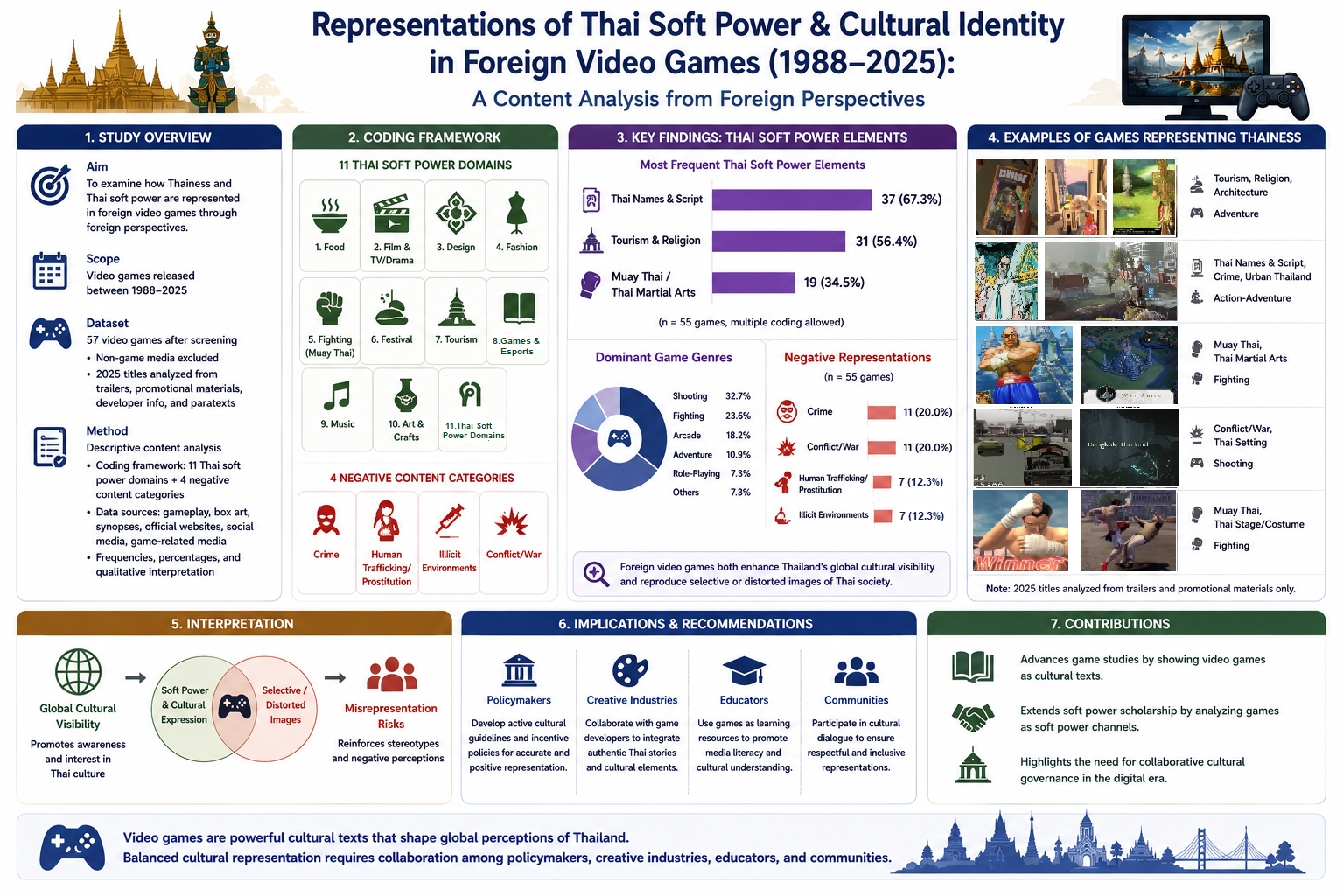
This descriptive content-analysis study examines foreign video games that represent Thainess and Thai soft power from foreign perspectives. After screening the dataset, 57 video games released between 1988 and 2025 were retained for analysis. Non-game media were excluded, and anticipated 2025 titles were analyzed only through official trailers, promotional materials, developer information, and other publicly available paratexts. The coding framework combined the eleven Thai soft-power domains identified by the National Soft Power Development Committee with four negative-content categories: crime, human trafficking/prostitution, illicit environments, and conflict/war. Data sources included gameplay, box art, synopses, official websites, social-media materials from publishers or developers, and game-related media. Frequencies and percentages were calculated, while qualitative interpretation was used to explain how representations function as cultural signs. The most frequent Thai soft-power elements were Thai names and script (37 cases, 64.91%), tourism and religion (31 cases, 54.39%), and Muay Thai or Thai martial arts (19 cases, 33.33%). The dominant game genres were shooting, fighting, and arcade games. The most frequent negative representations were crime and conflict/war, each appearing in 11 cases (19.30%). The findings show that foreign video games simultaneously increase Thailand's global cultural visibility and reproduce selective or distorted images of Thai society. The study therefore contributes to game studies and cultural-policy scholarship by showing how video games can operate as cultural texts, soft-power channels, and sites of misrepresentation that require more active cultural guidance from policymakers, creative industries, educators, and local communities.
Downloads
References
AmarinTV. (2024). Promoting Thai soft power with games: Incorporating ‘Korat cat pants’ in Free Fire. https://www.amarintv.com/spotlight/business-marketing/detail/58030
Ars OpenForum. (2014). Sex clubs and sex workers in video games. https://arstechnica.com/civis/threads/sex-clubs-and-sex-workers-in-video-games.1236289
Baltezarevic, R., Baltezarevic, B., & Baltezarevic, V. (2018). The video gaming industry (from play to revenue). International Review, 3–4, 71–76. https://doi.org/10.5937/IntRev1804071B
BBC Thai. (2023). Soft power (for) Thai: The policy guaranteed by Surapong Suebwonglee as “well thought out, doable”. https://www.bbc.com/thai/articles/czqe6x074d2o
Cade, R., & Gates, J. (2017). Gamers and video game culture: An introduction for counselors. The Family Journal, 25(1), 70–75. https://doi.org/10.1177/1066480716679809
Chearthong, R., & Rojprapayon, R. (2016). Values, ideologies and communication styles that characterize Thai people. NIDA Journal of Language and Communication, 21(29), 110–143. https://so04.tci-thaijo.org/index.php/NJLC/article/view/94424
Cunningham, S., Engelstätter, B., & Ward, M. R. (2011). Understanding the effects of violent video games on violent crime (ZEW Discussion Paper No. 11-042). Centre for European Economic Research (ZEW). https://doi.org/10.2139/ssrn.1886419
Edwards, A. (2019). 14 video games that let players take drugs and completely trip balls. https://www.ranker.com/list/ways-to-trip-balls-in-games/aaron-edwards
Essokolo, V. B., & Robinot, E. (2022). Let’s go deep into the game to save our planet! How an immersive and educational video game reduces psychological distance and raises awareness. Sustainability, 14(10), 5774. https://doi.org/10.3390/su14105774
European Commission. (2021). Video gaming and (violent) extremism: An exploration of the current landscape, trends, and threats. Publications Office of the European Union.
Exactitude Consultancy. (2024). Gaming market by game type (shooter, action, sports, role playing, and others), by device type (PC/MMO, tablet, mobile phone, and TV/console) and region, global trends and forecast from 2024 to 2030.
https://exactitudeconsultancy.com/reports/38267/gaming-market/
Hulsey, N. (2020). Games in everyday life: For play. Emerald Publishing.
Khruerattikan, S. (2008). The concept of soft power and public diplomacy. https://kositthiphon.blogspot.com/2008/12/soft-power-public-diplomacy.html
Kim, Y. H., Nauright, J., & Suveatwatanul, C. (2020). The rise of e-sports and potential for post-COVID continued growth. Sport in Society, 23(11), 1861–1871. https://doi.org/10.1080/17430437.2020.1819695
Ko, E., Lee, S., & Whang, H. (2013). Authenticity in traditional culture marketing: Consumers’ perceptions of Korean traditional culture. Journal of Global Fashion Marketing, 4(2), 93–111. https://doi.org/10.1080/20932685.2013.793513
Longtunman. (2023). 30 billion baht gaming industry creating jobs and income for Thai people. https://www.longtunman.com/45511
Matichon Online. (2023). Soft power board approves 5,164 million baht to drive 11 industries. https://www.matichon.co.th/economy/news_4309810
MGR Online. (2024). Prime Minister pushes Thai products and services into the global market through soft power plan, generating trade value of 6 billion.
https://mgronline.com/politics/detail/9670000022104
Mobygames. (2008). Los Pájaros de Bangkok. https://www.mobygames.com/game/34050/los-pajaros-de-bangkok/
NBC News. (2013). War crimes in video games should be punished, ICRC says. https://www.nbcnews.com/news/world/war-crimes-video-games-should-be-punished-icrc-says-flna8c11320332
Office of the Prime Minister. (2023). Prime Minister’s Office order no. 230/2023: Appointment of the National Soft Power Strategy Committee. https://sto.go.th
Oxford English Dictionary. (1989). The Oxford English Dictionary. (2nd ed.). Oxford University Press.
PeerPower. (2020). Thai game industry 2020. https://www.peerpower.co.th/blog/thai-game-industry
Phothisa, S. (2023). What is soft power? Thai cultural elements truly popular among foreigners. om https://www.thaipbs.or.th/now/content/491
Post Today. (2020). Economic column. https://www.posttoday.com/world
Prachachat. (2023). Exploring the power of “soft power”: How will Thai games stake a claim in the creative economy?. https://www.prachachat.net/ict/news-1415055 (
Qin, Z., Song, Y., & Tian, Y. (2019). The impact of product design with traditional cultural properties (TCPs) on consumer behavior through cultural perceptions: Evidence from the young Chinese generation. Sustainability, 11(2), Article 426. https://doi.org/10.3390/su11020426
Reddit/truegaming. (2017). Drugs in videogames. https://www.reddit.com/r/truegaming/comments/5vtnpx/drugs_in_videogames/
Saitong, P. (2019). Creative digital media production. Rajabhat Maha Sarakham University Press.
Saitong, P., Chantrachaturaphat, W., & Papirom, S. (2021). Digital game design. Santarpol College Academic Journal, 7(2), 217–228. https://so05.tci-thaijo.org/index.php/scaj/article/view/249082
Sanook.com. (2020). “Kaoklai Kaennorsing”: The K-1 game character and the real-life legend of the giant slayer in Japan. https://www.sanook.com/sport/1091359/
Tanskanen, S. (2018). Player immersion in video game: Designing an immersive game project. (Bachelor’s thesis, South-Eastern Finland University of Applied Sciences). https://www.theseus.fi/handle/10024/147016
Thairath Online. (2014). Soft power – hard power. https://www.thairath.co.th/news/foreign/401926
Downloads
Additional Files
Published
How to Cite
Issue
Section
Categories
License
Copyright (c) 2026 Community and Social Development Journal

This work is licensed under a Creative Commons Attribution-NonCommercial-NoDerivatives 4.0 International License.