
Causal Model of The Operational Competency of Accounting Practitioners with The Innovation Capability as The Mediator
DOI:
https://doi.org/10.57260/csdj.2026.283316Keywords:
Operational competency, Accounting practitioners, Innovation capabilityAbstract
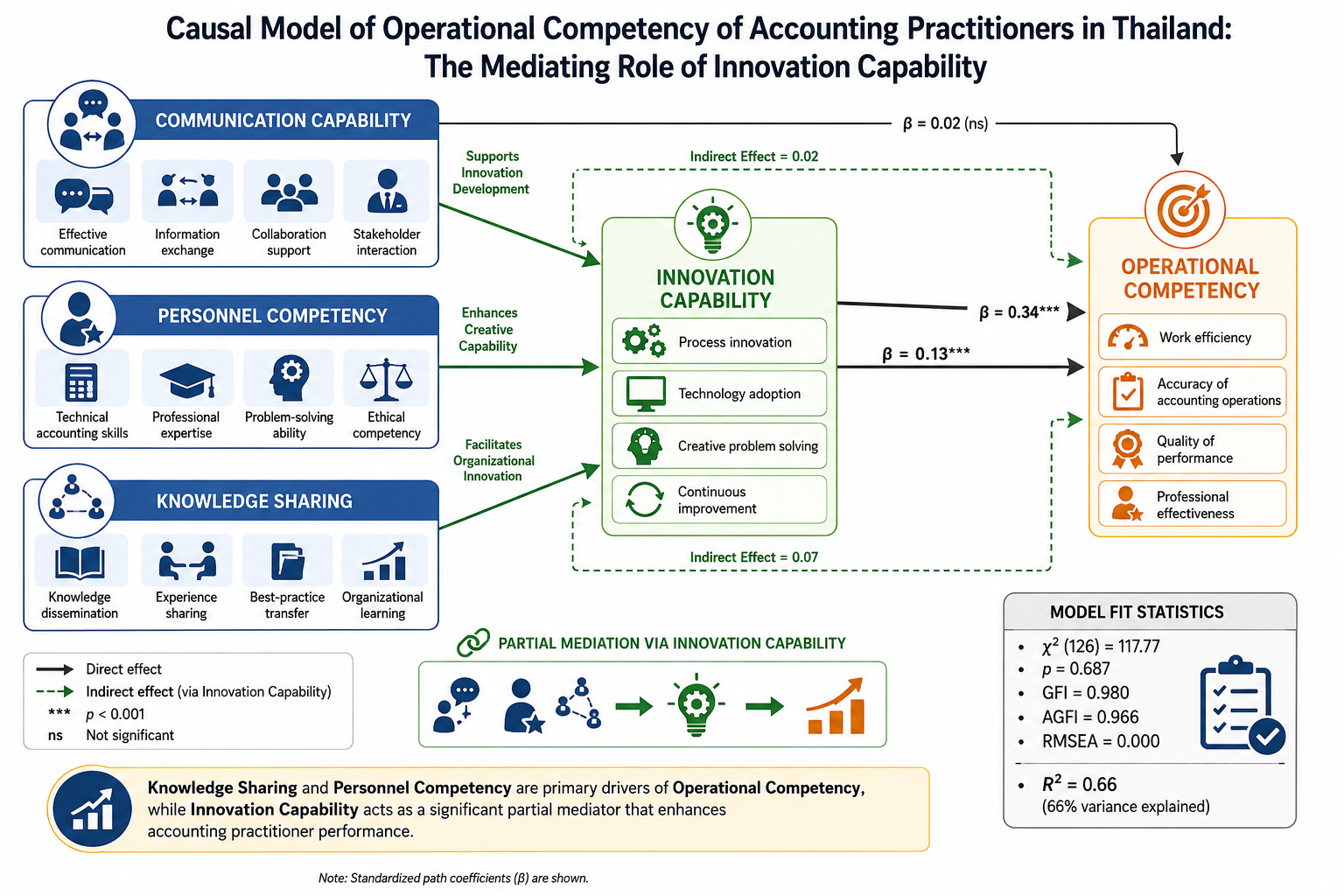
This research developed and validated a causal model of the operational competency of accounting practitioners in Thailand's Bangkok metropolitan area, with innovation capability as the mediating variable. The study used a sample of 560 accounting practitioners selected via cluster and snowball sampling. Data were collected using a questionnaire (Cronbach's alpha = .962) and analyzed using confirmatory factor analysis (CFA) and structural equation modeling (SEM). The causal model comprised five latent variables—communication capability, personnel competency, knowledge sharing, innovation capability, and operational competency—along with 20 observed variables.
Key findings indicate that operational competency was significantly influenced by knowledge sharing (β = 0.42), personnel competency (β = 0.34), and innovation capability (β = 0.13), all at p < .05. Innovation capability also partially mediated the relationships between knowledge sharing, personnel competency, and communication capability with operational competency (indirect effects: 0.07, 0.02, and 0.02, respectively). The model demonstrated good empirical fit: χ²(126) = 117.77, p = 0.687, GFI = 0.980, AGFI = 0.966, RMSEA = 0.000. The coefficient of determination (R² = 0.66) indicates that the model explains 66% of the variance in operational competency. These results highlight the importance of developing innovation capability alongside knowledge sharing and personnel competency to enhance the performance of accounting practitioners. Findings are specific to the Bangkok metropolitan area and should be generalized to national populations with caution.
Downloads
References
Chaivet, P., & Thanachitchai, N. (2026). Work Performance Efficiency Based on IES 3 Professional Accounting Skills of Treasury Registrars under District Government Offices in the Central Region. International Accounting and Management Science Journal (IAMSJ), 1(1), 1–10. https://so18.tci-thaijo.org/index.php/IAMSJ/article/view/2107
Chimthongdee, W., & Kamkate, W. (2015). A causal model of teacher's innovative ability with creative thinking as mediator. An Online Journal of Education (OJED), 10(4), 324–332. https://so01.tci-thaijo.org/index.php/OJED/article/view/35628
Faul, F., Erdfelder, E., Lang, A.-G., & Buchner, A. (2007). G*Power 3: A flexible statistical power analysis program for the social, behavioral, and biomedical sciences. Behavior Research Methods, 39(2), 175–191. https://doi.org/10.3758/BF03193146
Hair, J. F., Black, W. C., Babin, B. J., & Anderson, R. E. (2010). Multivariate data analysis. (7th ed.). Prentice Hall.
Hana, U. (2013). Competitive advantage achievement through innovation and knowledge. Journal of Competitiveness, 5(1), 82–96. https://doi.org/10.7441/joc.2013.01.06
Kumaraswamy, K. S., & Chitale, C. M. (2012). Collaborative knowledge sharing strategy to enhance organizational learning. Journal of Management Development, 31(3), 308–322. https://doi.org/10.1108/02621711211208934
Liao, S. H., Fei, W. C., & Chen, C. C. (2007). Knowledge sharing, absorptive capacity, and innovation capability: An empirical study. Journal of Information Science, 33(3), 340–359. https://doi.org/10.1177/0165551506070739
Mendoza-Silva, A. (2021). Innovation Capability: A Systematic Literature Review. European Journal of Innovation Management, 24(3), 707-734.
https://doi.org/10.1108/ejim-09-2019-0263
Momeni, M., Nielsen, S. B., & Kafash, M. H. (2015). Determination of innovation capability of organizations: Qualitative meta synthesis and Delphi method. In Proceedings of RESER2015 – Innovative Services in the 21st Century. https://backend.orbit.dtu.dk/ws/files/116283301/Determination_of_Innovation_Capability.pdf
Nuanla-ong, P. (2019). The effect of competency and core competency of accountants on financial reporting efficiency: A case study of accountants in the Excise Department. (Master's thesis, Prince of Songkla University). https://kb.psu.ac.th/server/api/core/bitstreams/c7b15cfe-9659-46ba-9f92-15e2b508f733/content
Nuanla-ong, P. (2023). The professional competencies of Thai accountants under international education standards for professional accountants. Research Community and Social Development Journal, 17(3), 1-14. https://doi.org/10.14456/nrru-rdi.2023.31
Ologbo, A. C., Khalil, M. N., & Okyere-Kwakye, E. (2015). The influence of knowledge sharing on employee innovation capabilities. International Journal of Human Resource Studies, 5(3), 102–120. https://doi.org/10.5296/ijhrs.v5i3.8210
Palabut, K. (2020). Strategic innovation capability affecting organizational sustainability: An empirical study of automobile businesses in Thailand. Journal of Accounting and Management, 12(3), 109–125. https://so02.tci-thaijo.org/index.php/mbs/article/view/243651
Pan, G., & Seow, P. S. (2016). Preparing accounting graduates for the digital era: A stakeholders’ perspective. Journal of Education for Business, 91(8), 437-444. https://ink.library.smu.edu.sg/soa_research/1474
Peterson, D. R., & Pattie, M. W. (2022). Think Outside and Inside the Box:The Role of Dual-Pathway Divergent Thinking in Creative Idea Generation. Creativity Research Journal, 36(2), 272-290. https://doi.org/10.1080/10400419.2022.2110738
Poonyawititroj, C., Lertputtharak, S., & Hangsapruke, T. (2020). The factors affecting the performance of accountants. In Proceedings of the International and National Conference on Business Administration and Accountancy 2020 (pp. 33–45). Burapha University. https://incbaa.kku.ac.th/img/files/articles/e441d-9.c9-149.pdf
Prathumchan, S. (2014). Relationships between core competency focus and working efficiency of supporting staffs of Mahasarakham University. Humanities and Social Sciences Journal of Mahasarakham University, Special, 388–396. https://doi.org/10.14456/humsu.2014.202
Rehman, S. U., Elrehail, H., Alsaad, A., & Bhatti, A. (2021). Intellectual capital and innovative performance: a mediation-moderation perspective. Journal of Intellectual Capital, 23(5), 998-1024. https://doi.org/10.1108/JIC-04-2020-0109
Silpjaru, T. (2012). Research and statistical data analysis with SPSS and AMOS. (13th ed.). Business R&D Partnership.
Sornsakda, A. (2019). Professional competencies for accountants in Thailand. Chulalongkorn University Press.
The Federation of Accounting Professions under the Royal Patronage of His Majesty the King. (2015). International education standards for professional accountants. https://acpro-std.tfac.or.th/uploads/files/2015_IES3.pdf
Tunjararuck, A., Saengnoree, A., & Teerawatananond, T. (2024). Innovative factors affecting performance of local government organizations in Thailand. Edelweiss Applied Science and Technology, 8(6), 4197–4211. https://doi.org/10.55214/25768484.v8i6.2912
Downloads
Additional Files
Published
How to Cite
Issue
Section
Categories
License
Copyright (c) 2026 Community and Social Development Journal

This work is licensed under a Creative Commons Attribution-NonCommercial-NoDerivatives 4.0 International License.