
The Impact of ESG Investments in Polluting Industries on Environmental Performance: An Empirical Study Based on A-Share Listed Companies in China
DOI:
https://doi.org/10.57260/csdj.2025.283386Keywords:
Environmental, Environmental social and governance (ESG) investments, Polluting industries, Carbon emission intensity, Environmental regulation, Green economy transitionAbstract
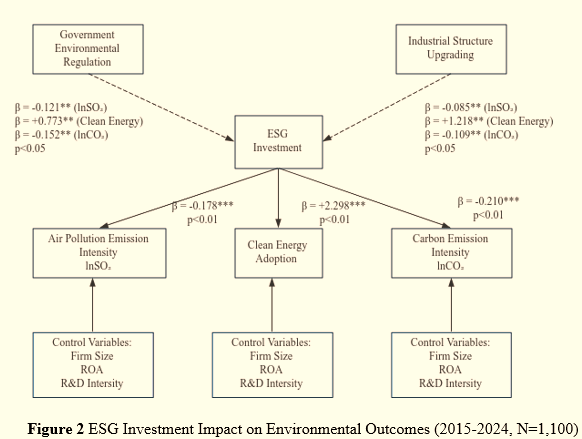
Against the backdrop of China’s “Dual Carbon” objectives and the global imperative for sustainable development, this study investigates the environmental implications of Environmental, Social, and Governance (ESG) investments in heavily polluting industries in China. Drawing upon a sample of A-share listed companies between 2015 and 2024, the Huazheng ESG Rating Index, and key environmental performance indicators including air pollutant emission intensity, clean energy consumption ratio, and carbon emission intensity a fixed-effects model is employed to examine the relationship. The empirical results demonstrate that ESG investments significantly mitigate both air pollutant and carbon emission intensities, while simultaneously fostering the adoption of clean energy. Quantitatively, a one-unit rise in the Huazheng ESG score is associated with a 0.178-log-point (~18%) reduction in SO₂ emission intensity, a 2.298 percentage-point increase in the clean-energy consumption ratio, and a 0.210-log-point (~21%) reduction in CO₂ emission intensity (all p < 0.01), with stronger effects under tighter environmental regulation and greater industrial upgrading. Furthermore, the moderating roles of governmental environmental regulation and industrial upgrading are found to reinforce these effects. This study contributes to the growing body of evidence supporting ESG as a mechanism for advancing pollution reduction and carbon abatement, and it offers actionable implications for policymakers and corporate stakeholders in guiding China’s transition toward a green economy.
Downloads
References
Arevalo, J. A. T. (2024). Climate Change versus Economic Growth: Case of Greenhouse Apply a Study of European Union Countries and England from 2010 to 2019 Using Linear Regression and Neural Networks. Sustainability, 16(5), 1884. https://doi.org/10.3390/su16051884
Chen, Q., & Fan, Y. (2024). ESG ratings and corporate success: analyzing the environmental, social, and governance ratings and implications. Frontiers in Energy Research. https://doi.org/10.3389/fenrg.2024.1371616
China Council for International Cooperation on Environment and Development (CCICED) Secretariat. (2023). Global Climate Governance and China’s Role. In: Green Recovery with Resilience and High Quality Development. Springer, Singapore. https://doi.org/10.1007/978-981-19-9470-8_1
China Securities Regulatory Commission. (2006). Guidelines on Industry Classification of Listed Companies. http://www.csrc.gov.cn/csrc_en/c102030/c1371087/content.shtml
Freeman, R. E. (1984). Strategic management: A stakeholder approach. Boston: Pitman.
Government of China. (2024). Provincial Statistical Yearbooks. Various provinces. https://citas.csde.washington.edu/data/provyrbk/yrbkdoc.htm
Hagart, G., & Knoepfel, I. (2006). Communicating ESG value drivers at the company-investor interface : Who Cares Wins annual event 2006 - conference report. , 1-39.
Hua, Y., Sun, W., & Zhao, D. (2023). The path towards sustainable finance: Venture capital and air pollution in China. China Economic Review, 79, 101979. https://doi.org/10.1016/j.chieco.2023.101979
Huazheng ESG Rating System. (n.d.). Shanghai Huazheng Index Information Services. https://ijbms.net/assets/files/1747689859.pdf
Jiang, Y., & Tang, Q. (2023). Mandatory carbon reporting, voluntary carbon disclosure and ESG performance. Pacific Accounting Review, 35(4), 534-561. https://doi.org/10.1108/par-08-2022-0133
Knoepfel, I., & Hagart, G. (2009). Future proof? : embedding environmental, social, and governance issues in investment markets - outcomes of the Who Cares Wins Initiative 2004-2008. Ivo Knoepfel, Gordon Hagart, onValues Investment Strategies and Research Ltd.
Kurniawaty, I., Fadhilah, F., & Anggiani, S. (2025). The relationship of CSR strategy towards organizational sustainability: The moderating effect of political CSR. Eduvest - Journal of Universal Studies, 5(2), 2775-3727. https://doi.org/10.59188/eduvest.v5i2.1707
Li, E., & Yu, J. (2024). Research on the Impact of ESG Performance on Cost of Corporate Debt Financing. Transactions on Economics, Business and Management Research, 14, 820-837. https://doi.org/10.62051/1mcxg463
Li, J., & Sasaki, M. (2023). The impact of state ownership on corporate social responsibility reporting: A comparison between state-owned and non-state-owned enterprises in China. Management Communication Quarterly, 38(3). https://doi.org/10.1177/08933189231209727
Li, S., Ao, X., Zhang, M., & Pu, M. (2025). ESG performance and carbon emission intensity: Examining the role of climate policy uncertainty and the digital economy in China’s dual-carbon era. Frontiers in Environmental Science, 12, 1-17. https://doi.org/10.3389/fenvs.2024.1526681
Li, X., & Zhang, Y. (2022). Sulfur dioxide emissions curbing effects and influencing factors in China’s emissions trading system. Environmental Economics, 17(11), e0276601. https://pmc.ncbi.nlm.nih.gov/articles/PMC9645632/
Li, Y., Chen, X., Wang, Y., & Li, D. (2023). ESG investment helps to develop the carbon economy. Frontiers in Science and Engineering, 3(11), 15-18. https://doi.org/10.54691/fse.v3i11.5703
Li, Y., Zhao, X., & Yang, X. (2025). ESG performance and corporate environmental investment: Incentive or inhibition? Finance Research Letters, 75, 106814. https://doi.org/10.1016/j.frl.2025.106814
Luu, H., & Le, T. (2024). Does mandatory greenhouse gas emissions reporting program deter corporate greenwashing? Journal of Environmental Management, 373, 123740. https://doi.org/10.1016/j.jenvman.2024.123740
Ministry of Ecology and Environment of the People’s Republic of China. (n.d.). Standards. https://english.mee.gov.cn/Resources/standards/
National Bureau of Statistics of China. (2024). China Energy Statistical Yearbook & China Electricity Statistical Yearbook. Beijing: China Statistics Press.
National Bureau of Statistics of China. (2024a). China Environmental Statistical Yearbook & provincial yearbooks. Beijing: China Statistics Press. https://www.stats.gov.cn/sj/ndsj/2024/indexeh.htm
National Bureau of Statistics of China. (2024b). China Statistical Yearbook. Beijing: China Statistics Press. https://www.stats.gov.cn/sj/ndsj/2024/indexeh.htm
Nguyen, P. T., & Le, C. Q. (2024). The impact of buying external technology on employment and air quality: An empirical approach in Vietnamese manufacturing SMEs. Journal of Science and Technology Policy Management, 1-19. https://doi.org/10.1108/jstpm-10-2022-0173
O' Connell, V. (2007). Dealing with panel data in accounting and managerial finance research. International Journal of Managerial Finance, 3(4), 372-389. https://doi.org/10.1108/17439130710824370
Panwar, R., Pandey, V., Suddaby, R., & Vidal, N. G. (2022). Did India’s CSR Mandate Enhance or Diminish Firm Value? Business & Society, 62(2), 401-433. https://doi.org/10.1177/00076503221085962
Rao, C., Huang, Q., Chen, L., Goh, M., & Hu, Z. (2023). Forecasting the carbon emissions in Hubei Province under the background of carbon neutrality: a novel STIRPAT extended model with ridge regression and scenario analysis. Environmental science and pollution research international, 30(20), 57460–57480. https://doi.org/10.1007/s11356-023-26599-w
Smith, W. K., Nelson, E., Johnson, J. A., Polasky, S., Milder, J., Gerber, J. S., Wesr, P. C., Siebert, S., Brauman, K. A., Carlson, K. M., Arbuthnot, M., Roxxa, J. A., & Pennington, D. N. (2019). Voluntary sustainability standards could significantly reduce detrimental impacts of global agriculture. PNAS, 116(6), 2130–2137. https://doi.org/10.1073/pnas.1707812116
Sohn, W. S. (2025). Towards a Sustainable Future: Addressing Climate Change and Promoting Sustainable Development. Sustainable Development, 1–22. https://doi.org/10.1002/sd.70105
Wang, J., & Azam, W. (2024). Natural resource scarcity, fossil fuel energy consumption, and total greenhouse gas emissions in top emitting countries. Geoscience Frontiers, 15(2), 101757. https://doi.org/10.1016/j.gsf.2023.101757
World Commission on Environment and Development (WCED). (1987). Our common future. Oxford University Press.
Xie, Y. (2024). The interactive impact of green finance, ESG performance, and carbon neutrality. Journal of Cleaner Production, 456, 142269. https://doi.org/10.1016/j.jclepro.2024.142269
Ye, J., & Xu, W. (2023). Carbon reduction effect of ESG: empirical evidence from listed manufacturing companies in China. Frontiers in Ecology and Evolution, 11, 1311777. https://doi.org/10.3389/fevo.2023.1311777
Zhao, D. (2022). ESG Risk Management and Compliance Practices in China. Law and Economy, 1(4), 27–32. https://doi.org/10.56397/le.2022.11.04
Zhao, Y., Dong, L., Sun, Y., Ma, Y., & Zhang, N. (2024). Is air pollution the original sin of firms? The impact of air pollution on firms' ESG scores. Energy Economics, 136, 107704. https://doi.org/10.1016/j.eneco.2024.107704
Zhou, M., & Niu, Y. (2024). Cross-ownership and corporate ESG investment: Promotion or suppression?. Corporate Social Responsibility and Environmental Management, 31(5), 4612-4629. https://doi.org/10.1002/csr.2821
Zhu, C. (2025). Study on the Impact of ESG Investment on Corporate Carbon Intensity. Scientific Journal of Economics and Management Research, 7(4), 40-52. https://doi.org/10.54691/c7bkm975
Downloads
Published
How to Cite
Issue
Section
Categories
License
Copyright (c) 2025 Community and Social Development Journal

This work is licensed under a Creative Commons Attribution-NonCommercial-NoDerivatives 4.0 International License.