Guidelines for Addressing Debt Burden Among Personnel in the Academic Division of Chulachomklao Royal Military Academy
DOI:
https://doi.org/10.57260/csdj.2026.286625Keywords:
Debt burden, Contributing factors, Debt management strategiesAbstract
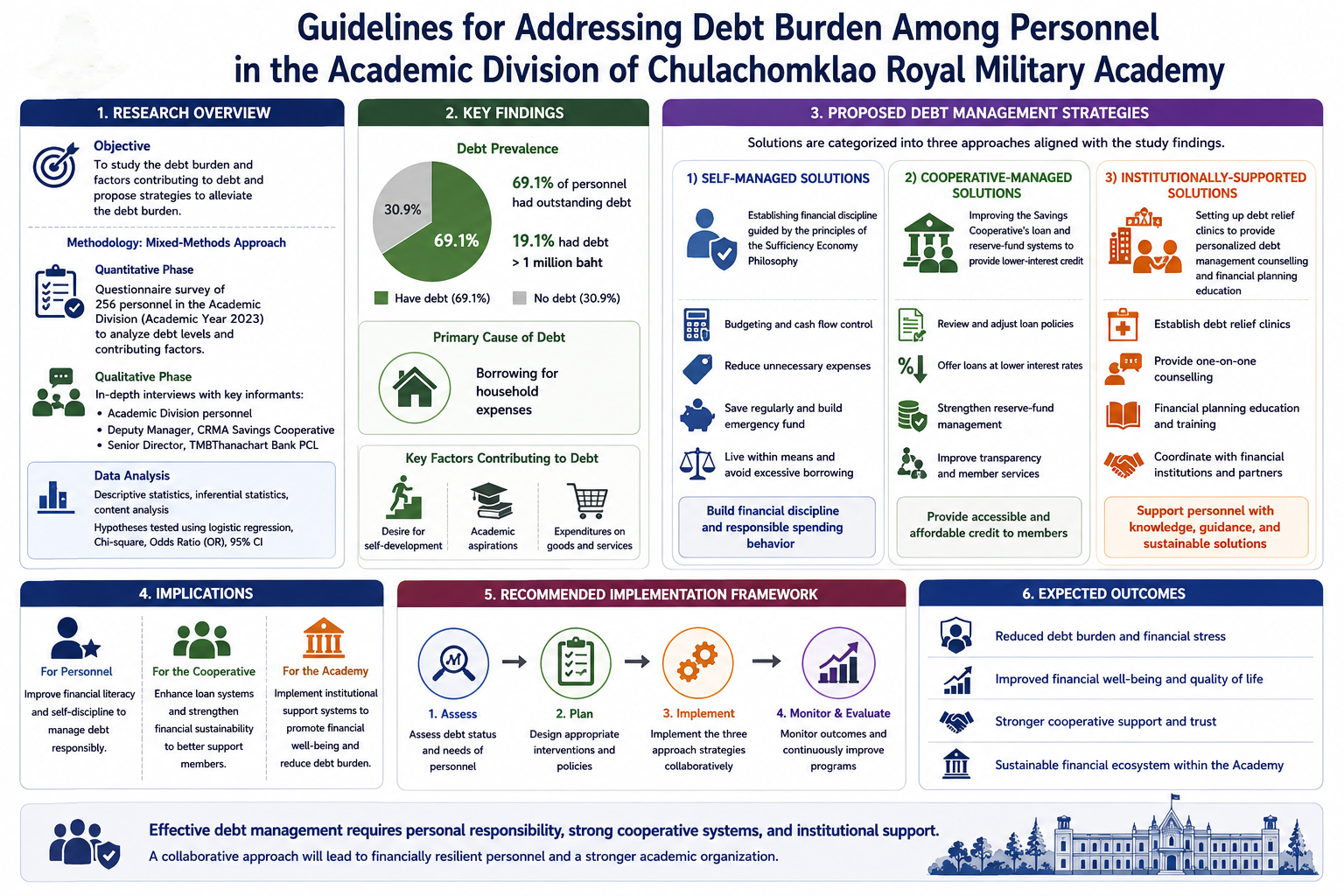
This research aimed to study the debt burden and the factors contributing to debt and propose strategies to alleviate the debt burden among personnel in the Academic Division of the Chulachomklao Royal Military Academy (CRMA). A mixed-methods approach was employed with 256 personnel from the Academic Division for the 2023 academic year. Quantitative data were collected using a questionnaire to analyze debt levels and contributing factors. The qualitative phase focused on developing solutions, drawing insights from key informants, including Academic Division personnel, the Deputy Manager of CRMA’s Savings Cooperative, and a Senior Director from TMBThanachart Bank Public Company Limited. In-depth interviews were conducted, and data were analyzed using descriptive statistics, inferential statistics, and content analysis. Hypotheses were tested using logistic regression with Chi-square statistics, odds ratio (OR), and a 95% confidence interval (CI). Findings: The study found that 69.10% of personnel in the Academic Division had outstanding debt, with 19.10% carrying debts exceeding 1 million baht. The primary cause of debt was borrowing for household expenses. Factors contributing to the debt burden included the desire for self-development, academic aspirations, and expenditures on goods and services. Proposed solutions for managing debt were categorized into three approaches, consistent with the study’s results: 1) Self-Managed Solutions: Establishing financial discipline guided by the principles of the Sufficiency Economy Philosophy. 2) Cooperative-Managed Solutions: Improving the Savings Cooperative’s loan and reserve-fund systems to provide lower-interest credit. 3) Institutionally-Supported Solutions: Setting up debt relief clinics to provide personalized debt management counselling and financial planning education.
Downloads
References
Alderfer, C. (1972). Existence, relatedness and growth: Human needs in organizational settings. Free Press.
Boonsong, K., Pratomta, N., Ngentong, C., Anuntanitiwat, T., & Buatong, S. (2020). Debt Status of Teachers in Phetchaburi Province. Academic Journal of Phetchaburi Rajabhat University, 10(1), 31-37. https://journal.pbru.ac.th/admin/upload/article/7006-2020-11-06.pdf
Bualuang, N. (2007). Framework for improving the quality of work life for civil servants. Civil Service Journal, 52(5), 11–18. https://shorturl.asia/jJGau
Chantarat, S., Lamsam, A., Samphantharak, K., & Tangsawasdirat, P. (2019). Exploring Urban and Rural Lifestyles and the Role of Gender in Thai Household Debt Through Credit Bureau Big Data. https://www.pier.or.th/abridged/2019/06/
Cheeking, T., Komenkul, K., Sawang, S., & Chankit, P. (2020). Factors that influence the financial discipline of officers of Royal Thai Armed Forced Headquarters. Modern Management Journal, 18(1), 72–87. https://so04.tci-thaijo.org/index.php/stou-sms-pr/article/view/233639
Department of Public Relations. (2021). The government unveils a roadmap to resolve civil servant debt, starting with teachers and police, targeting 2022 as the year of household debt resolution. https://www.prd.go.th/th/content/category/detail/id/37/iid/65922
Hosmer, D. W., & Lemeshow, S. (2000). Applied logistic regression. (2nd ed.). John Wiley & Sons.
Insung, R., Tachasakuljaroen, B., molo, M., Pinjapo, P., Saenglee, S., & Yumuang, N. (2021). Quality of work life of municipal officials in Prachinburi Province. Nisit Wang Journal, 23(2), 1–11. https://so06.tci-thaijo.org/index.php/jonw/article/view/253628
Krungsri Bank. (2021). Transform yourself into a disciplined saver in 21 days. https://www.keptbykrungsri.com/kept-tips/saving-technique/money-tips-21days
Mekara, P. (2022). Factors affecting the indebtedness of non-commissioned officer belong to the Special Equipment Engineer Battalion Engineer Division. (Independent Study for Master's Degree, Ramkhamhaeng University).
Modmonthin, S., & Theerampon, S. (2025). Factors affecting formal and informal household debt creation. Journal of Social Science Panyapat, 7(2), 1–14. Retrieved from https://so06.tci-thaijo.org/index.php/JSSP/article/view/284026
National Statistical Office. (2021). Results of the economic and social conditions survey for households during the first half of 2021. Arun Printing.
Navaritsavi, P., & Srisorn, W. (2023). Applying sufficiency economy philosophy to solve informal debt problems. Journal of Corporate Governance and Local Innovation, 9(4), 412–425. https://so04.tci-thaijo.org/index.php/jsa-journal/article/view/258927
Nethin, R., Wanaset, A., & Ouyyanont, P. (2017). Factors affecting the debt of primary school teachers in Muang District, Nonthaburi Province. (Master’s Thesis in Economics, Sukhothai Thammathirat Open University). https://repository.stou.ac.th/items/ea0a8514-b71c-48c3-934a-424a0d0a3d15
Pearson, K. (1900). On the criterion that a given system of deviations from the probable in the case of a correlated system of variables is such that it can be reasonably supposed to have arisen from random sampling. Philosophical Magazine Series 5, 50(302), 157–175. https://doi.org/10.1080/14786440009463897
Puttaruksa, P. (2021). Quality of work life of personnel in the National Statistical Office (Headquarters. http://www.mpa-mba.ru.ac.th/images/Project/treatise_bangkok14_09092021/6217950038.pdf
Saelee, K., Sapwarobol, T., & Sompornserm, T. (2025). Effects of Sandwich Generation and Financial Literacy on Over-indebtedness of Government Officers in Office of the Permanent Secretary, Ministry of Commerce. Journal of Social Science Panyapat, 7(3), 57–70. https://so06.tci-thaijo.org/index.php/JSSP/article/view/285838
Satanunphiphat, C. (2016). Factors influencing informal debt: A case study of personnel under the Department of Local Administration, Muang District, Pathum Thani Province. (Independent Study for Master's Degree, Thammasat University). https://ethesisarchive.library.tu.ac.th/thesis/2016/TU_2016_5803010791_5503_5166.pdf
Sogunle, P. T., & Sogunle, E. O. (2020). Understanding Biostatistics: Chi Square Analysis Versus Odds Ratio in the Analysis of Categorical Data. NFMJ Continuous Professional Development, 1(3), 1-8. https://www.researchgate.net/publication/343365665
Suaysuwan, S., & Chansom, N. (2021). Debt Status: A Case Study of Non-Commissioned Officers in the Armed Forces Security Center, Royal Thai Armed Forces Headquarters. National Defence Studies Institute Journal, 12(1), 94-105. https://so04.tci-thaijo.org/index.php/ndsijournal/article/view/248961
Sukharat, P. (2023). Debt Formation and Debt Management toward Financial Freedom: A Case Study of Savings and Credit Cooperation Limited. (Master’s Thesis in Business Administration, Prince of Songkla University). https://kb.psu.ac.th/server/api/core/bitstreams/c1f6bd04-3a92-42c0-8557-9ca0887c2307/content
Supapoj, C. (2017). Guidelines for managing the debt burden of Royal Thai Army personnel by applying the sufficiency economy philosophy in life. (Undergraduate Independent Study, Thammasat University). https://www.awc.ac.th/storage/research/41.pdf
Supapoj, P. (2018). Factor Affecting Decisions to Accept Unsecured Personal loan by First-Time Employees in Bangkok. (Independent Study for Master's Degree, Thammasat University). https://ethesisarchive.library.tu.ac.th/thesis/2018/TU_2018_6004010671_9976_10453.pdf
Supawong, P. (2006). Debt conditions and the need for supplementary family income among police officers in Provincial Police Region 5. (Special Project Report for Master’s Degree in Business Administration, Maejo University). https://shorturl.asia/Cm8Ub
Thai PBS. (2024). Increase cost-of-living allowances for civil servants, employees, and soldiers with less than a bachelor’s degree. https://policywatch.thaipbs.or.th/article/government-33
Thianboonsong, T., & Marin, T. (2023). Financial Planning for Royal Thai Naval Cadets to Prepare for Financial Stability. Rajabhat Chiang Mai Research Journal, 24(3), 193-207. https://doi.org/10.57260/rcmrj.2023.265042
Tiptipakorn, S., & Siriwong, P. (2016). A situation of employees’ debt burden in SMEs: Case studies in a printing establishment in Nakhon Pathom province. Veridian E-Journal, Silpakorn University (Humanities, Social Sciences and arts), 9(2), 1276–1292. https://he02.tci-thaijo.org/index.php/Veridian-E-Journal/article/view/67226
Wijitwanna, S. (2022). Correlation in Statistics: How to Use. Journal of Humanities and Social Sciences, Rajapruk University, 8(2), 1-15. https://so03.tci-thaijo.org/index.php/rpu/article/view/262965
Wiyaporn, P. (2016). The Solving Process of the Financial Liabilities Problems of Teachers and Education Personnel. (Doctoral’s Thesis in Educational Administration, Silpakorn University).
Downloads
Additional Files
Published
How to Cite
Issue
Section
Categories
License
Copyright (c) 2026 Community and Social Development Journal

This work is licensed under a Creative Commons Attribution-NonCommercial-NoDerivatives 4.0 International License.