
The Role of Media Exposure in the Relationship Between the Use of Artificial Intelligence and Sustainable Investment Behavior Among Generation Z
DOI:
https://doi.org/10.57260/csdj.2026.287733Keywords:
Media exposure, Artificial intelligence, Sustainable investment behavior, Generation ZAbstract
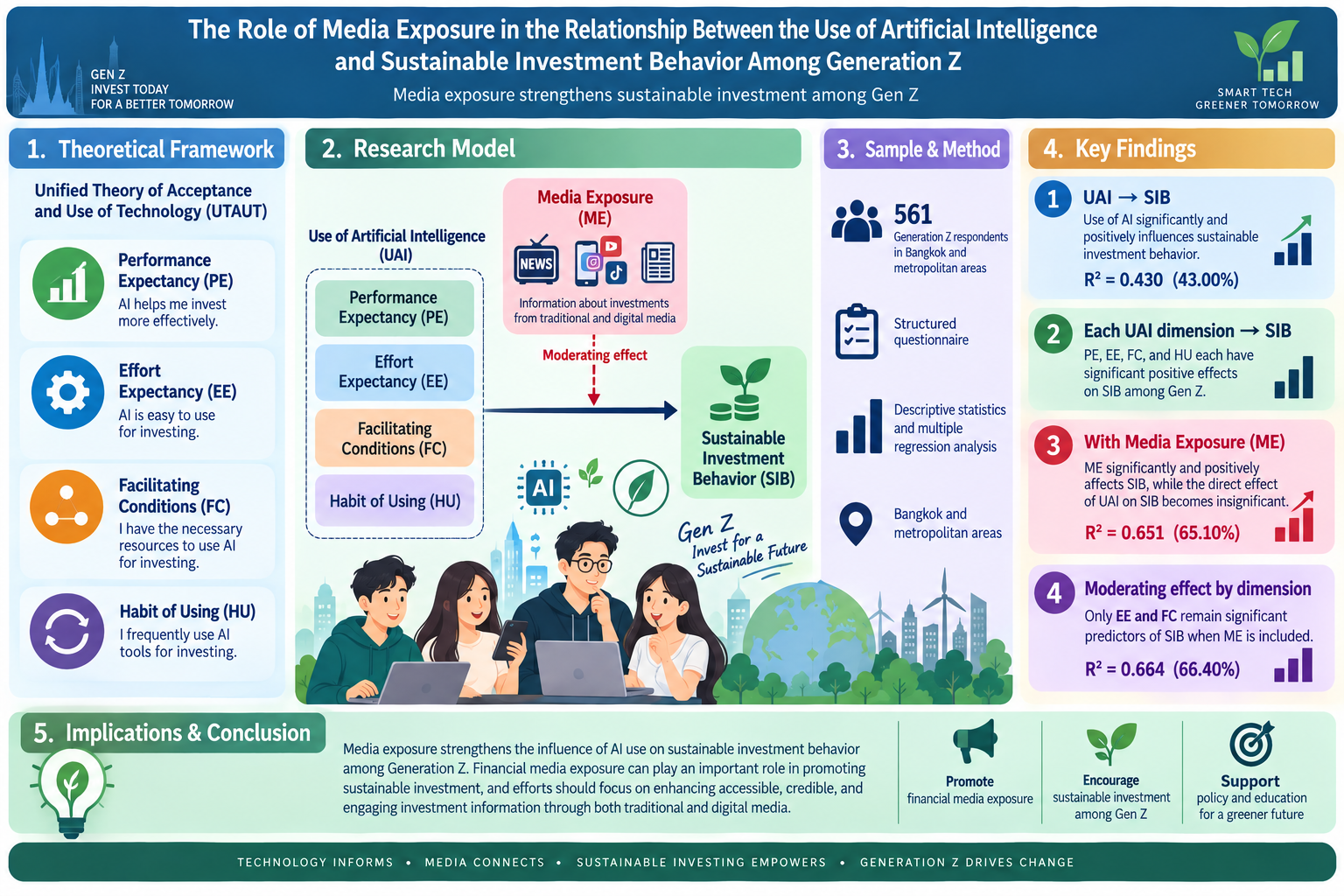
This study examines the moderating role of media exposure (ME) in the relationship between the use of artificial intelligence (UAI) and sustainable investment behavior (SIB) among Generation Z (Gen Z). The study was based on the Unified Theory of Acceptance and Use of Technology (UTAUT), focusing on performance expectancy (PE), effort expectancy (EE), facilitating conditions (FC), and habit of using (HU). This research adopted a quantitative approach. The sample consisted of 561 respondents residing in Bangkok and its metropolitan areas. Data was collected using a structured questionnaire and analyzed using descriptive statistics and multiple regression analysis. The results revealed that: 1) UAI had a statistically significant positive influence on the SIB among Gen Z in Bangkok and metropolitan areas, with a predictive power of 43.00 % (R2 = 0.430). 2) When analyzed by individual dimensions of the use of AI, including PE, EE, FC, and HU, each dimension also demonstrated a significant positive influence on SIB among Gen Z. However, 3) When ME was included as a moderating variable, ME had a significant positive effect on Gen Z’s SIB, whereas the effect of the use of AI on SIB became statistically insignificant, while the model’s predictive power increased to 65.10% (R² = 0.651). Furthermore, 4) When examining the moderating effect of ME on each dimension of the use of AI, it was found that only EE and FC remained statistically significant predictors of SIB among Gen Z, explaining 66.40 % of the variance (R2 =0.664), compared to 43.10 % (R2 =0.431) in the model without the moderating variable. The findings extend the application of UTAUT by highlighting the moderating role of media exposure in sustainable investment behavior and, practically, suggest that financial media exposure may contribute to promoting sustainable investment among Gen Z in Bangkok and metropolitan areas.
Downloads
References
Blessilda, E. (2025). How Gen Z and Millennials Are Redefining Employee Advocacy on Social Media. ClearView Social. https://clearviewsocial.com/blog/how-gen-z-and-millennials-are-redefining-employee-advocacy-on-social-media/
Bollen, N. P. B. (2007). Mutual fund attributes and investor behavior. Journal of Financial and Quantitative Analysis, 42(3), 683–708. https://doi.org/10.1017/S0022109000004142
Buarai Khing, T. (2025). The role of financial influencers in shaping ESG investment behavior of Generation Z investors in the Thai capital market. https://media.set.or.th/common/research/1513.pdf
Cochran, W. G. (1977). Sampling techniques. (3rd ed.). John Wiley & Sons.
Davenport, T. H., & Ronanki, R. (2018). Artificial Intelligence for the Real World. Harvard Business Review (HBR).
Dwivedi, Y. K., Hughes, L., Ismagilova, E., Aarts, G., Coombs, C., Crick, T., Duan, Y., Dwivedi, R., Edwards, J., Eirug, A., Galanos, V., Ilavarasan, P. V., Janseen, M., Jones, P., Kar, A. K., Kizgin, H., Kronemann, B., Lal, B., Lucini, B., Medaglia, R., Meunier-FitzHugh, K. L., Meunier-FitzHugh, L. C. L., Misra, S., Mogagi, E., Sharma, S. K., Singh, J. B., Raghavan, V., Raman, R., Rana, N. P., Samothrakis, S., Spencer, J., Tamilmani, K., Tubadji, A., Walton, P., Williams, M. D. (2021). Artificial intelligence (AI): Multidisciplinary perspectives on emerging challenges, opportunities, and agenda for research, practice and policy. International Journal of Information Management, 57, 101994. https://doi.org/10.1016/j.ijinfomgt.2019.08.002
Jinsong, S., & Jing, Z. (2025). Digital media sentiment, financial cooperation, and corporate investment efficiency. Finance Research Letters, 86, 108842. https://doi.org/10.1016/j.frl.2025.108842
Khamglad, P. (2025). Factors affecting Behavioral Intention of Generation-Y Investors in Online Stock Trading. Journal of Business Administration and Accountancy, 9(3), 39-58. https://so04.tci-thaijo.org/index.php/kkbsjournal/article/view/278403
Khatik, S. K., Joshi, R., & Adwani, V. K. (2021). Inferring The Role of Social Media on Gen Z'S Investments Decisions. Journal of Content, Community and Communication, 14(7), 309–317. https://doi.org/10.31620/JCCC.12.21/24
Kuldilok, C., & Satitsamitpong, M. (2023). The impact of social and environmental factors on cryptocurrency investment behavior among Gen Z in Thailand. ANPOR Annual Conference Proceedings, 10(1). https://journal.anpor.net/index.php/proceedings/article/view/127
Lestari, D., & Wiryono, S. K. (2023). The perception reality of sustainable investment in millennial and generation Z. International Research Journal of Business Studies, 16(2), 123–138. https://doi.org/10.21632/irjbs.16.2.123-138
Lin, R., & Lee, J. (2025). How the UTAUT motivates consumers' continuous use of green FinTech: the moderation effect of consumer social responsibility and long-term orientation. Aslib Journal of Information Management,77(5),1052–1078. https://doi.org/10.1108/AJIM-09-2023-0371
Lupiyoadi, R., Pramesti, M., Ikhsan, R. B., Usman, L. H., Games, D., Kurniawan, & Fakhrorazi, A. (2025). Extending UTAUT with perceived intelligence for the adoption of artificial intelligence in MSMEs and startups in Indonesia: A multi-group analysis. Journal of Open Innovation: Technology, Market, and Complexity, 11(4), 100673. https://doi.org/10.1016/j.joitmc.2025.100673
McCombs, M. (2020). Setting the agenda: Mass media and public opinion. Polity.
Miles, J. & Shevlin, M. (2001). Applying Regression and Correlation: A Guide for Students and Researchers. SAGE Publications.
Morgan Stanley. (2023). How AI can bolster sustainable investing. https://www.morganstanley.com/ideas/ai-sustainable-investing-use-potential
Morgan Stanley. (2025). Sustainable Signals Individual Investors 2025. https://www.morganstanley.com/content/dam/msdotcom/en/assets/pdfs/2025_Sustainable_Signals_Individual_Investors_2025_report.pdf
Nagarajan, S. (2023). Crypto prices predicted by social media sentiment more than headlines: Study. Blockworks. https://blockworks.com/news/crypto-prices-sentiment-news
Park, S. R., & Oh, K.-S. (2022). Integration of ESG information into individual investors’ corporate investment decisions: Utilizing the UTAUT framework. Frontiers in Psychology, 13, 899480. https://doi.org/10.3389/fpsyg.2022.899480
Pedhazur, E. J. (1997). Multiple Regression in Behavioral Research: Explanation and Prediction. (3rd ed.). Harcourt Brace College Publishers.
Phung, N. T. K., & Quyen, N. L. B. (2025). Finfluencer exposure and Gen Z investment behavior: Risk perception and social influence in play. Journal of Economics, Finance and Management Studies, 8(8), 5692–5704. https://doi.org/10.47191/jefms/v8-i8-62
Sanders, P. (2025). Gen Z turns to social media for investment advice says Charles Schwab. https://www.trustnet.com/news/13449167/gen-z-turns-to-social-media-for-investment-advice-says-charles-schwab
Schrank, J. (2025). The impact of artificial intelligence on behavioral intentions to use mobile banking in the post-COVID-19 era. Frontiers in Artificial Intelligence, 8, 1649392. https://doi.org/10.3389/frai.2025.1649392
Shalu, Verma, N., Dev, K., Balodi Bhardwaj, A., & Kumar, K. (2026). The cognitive cost of AI: How AI anxiety and attitudes influence decision fatigue in daily technology use. Annals of Neurosciences, 33(1), 73–84. https://doi.org/10.1177/09727531251359872
Stock Exchange of Thailand. (2025) . Keeping pace with investing in the era of social media finfluencers. https://www.set.or.th/th/about/mediacenter/news-release/article/675-social-media-finfluencer
Treetanont, S., & Chantuk, T. (2016). A study on investment behaviors affecting needs of investors in the Market for Alternative Investment (MAI) to receive internet securities trading services. Veridian E-Journal, Silpakorn University (Humanities, Social Sciences and Arts), 9(3), 289–306. https://he02.tci-thaijo.org/index.php/Veridian-E-Journal/article/view/71703
United Nations. (2015). Transforming our world: The 2030 agenda for sustainable development. https://sdgs.un.org/2030agenda
WallStreetZen. (2023). Where Did Gen Z Learn About Money?. https://www.wallstreetzen.com/blog/genz-money-social-media-survey/#xd_co_f=NWI5ZDI2YWQtNmQzZi00ZjI5LTg5ODMtY2I2OTk2NDAxMDQz~
Wang L.(2026). Leveraging artificial intelligence policy for inclusive and sustainable youth entrepreneurship: micro evidence from China. Front Public Health, 14, 1745563. https://doi.org/10.3389/fpubh.2026.1745563
Wong, W. C. (2025). The rise of finfluencers and social implications. NUS Institute of Real Estate and Urban Studies. https://ireus.nus.edu.sg/finfluencers-social-implications/
Xia, R. (2025). The impact of ESG information disclosure quality on investor decision-making: An analysis based on behavioral finance theory. SHS Web of Conferences, 225, Article 03034. https://doi.org/10.1051/shsconf/202522503034
Downloads
Additional Files
Published
How to Cite
Issue
Section
Categories
License
Copyright (c) 2026 Community and Social Development Journal

This work is licensed under a Creative Commons Attribution-NonCommercial-NoDerivatives 4.0 International License.