Factors Influencing Consumer Trust and Buying Behavior in the Live Streaming Commerce in Thailand: A Qualitative Interview Study
DOI:
https://doi.org/10.57260/csdj.2026.287749Keywords:
Live streaming, Live streaming commerce, Trust, Buying behavior, Interview studyAbstract
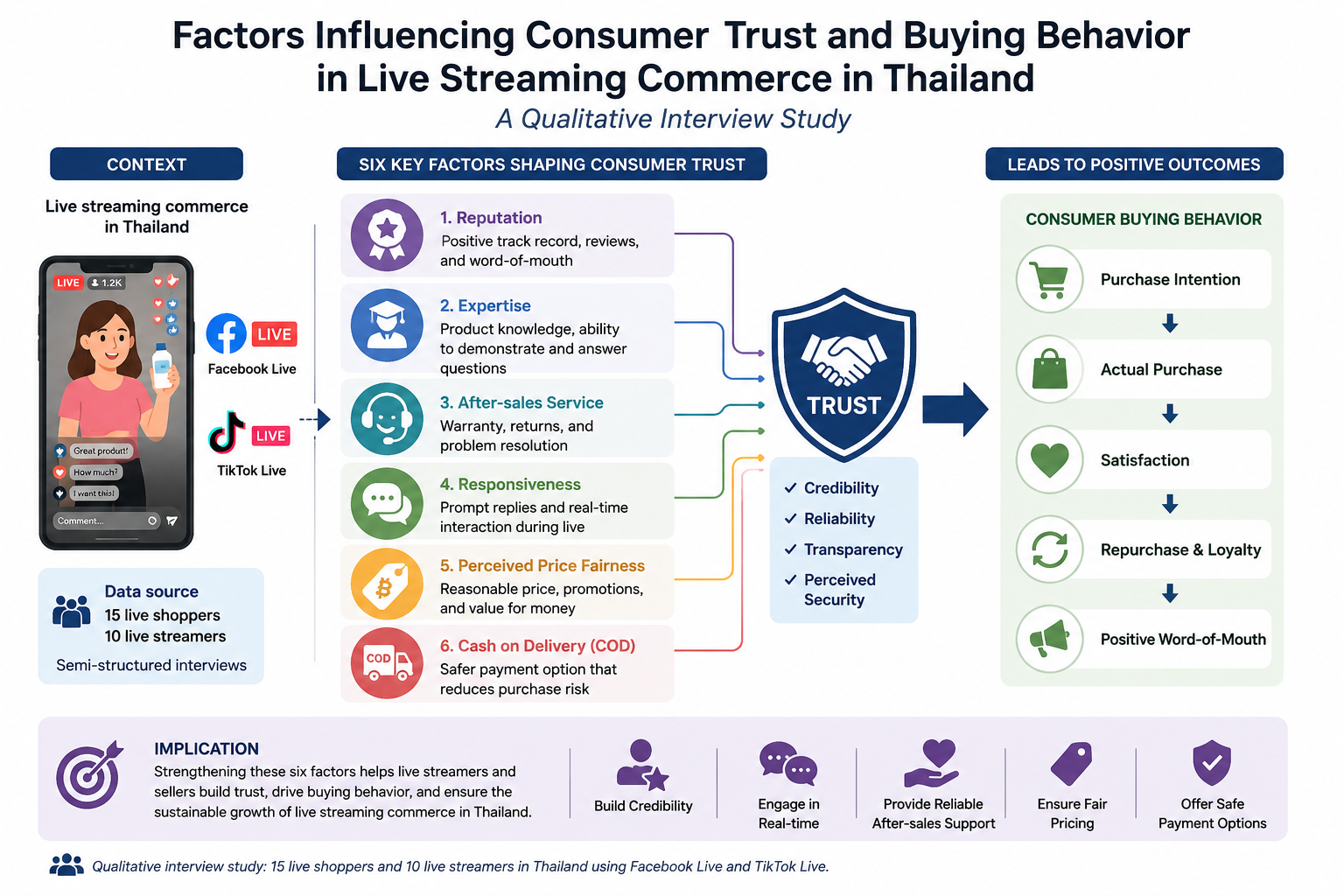
This study explores the factors shaping consumer trust and buying behavior in the live streaming commerce in Thailand. Using a qualitative approach, semi-structured interviews were conducted with 15 live shoppers and 10 live streamers who had direct experience buying or selling through Facebook Live and TikTok Live. The collected interview data were analyzed through thematic analysis to identify key themes and meaningful insights on consumer trust and buying behavior in live streaming commerce. The results identify six interrelated factors that shape trust and buying behavior: reputation, expertise, after-sales service, responsiveness, perceived price fairness, and cash on delivery (COD). These factors show that consumer trust in live streaming commerce is shaped not only by seller credibility and product knowledge, but also by real-time interaction, post-purchase support, fair pricing, and safer payment options. This study addresses a gap in the literature by providing in-depth qualitative evidence on trust formation and buying behavior, an area that remains underexplored in existing qualitative studies on live streaming commerce. The findings are valuable to local sellers and digital entrepreneurs in building consumer trust, enhancing buying behavior, and supporting the economic sustainability of live streaming commerce.
Downloads
References
Ahmad, M., & Wilkins, S. (2024). Purposive sampling in qualitative research: A framework for the entire journey. Quality & Quantity, 59, 1461-1479. https://doi.org/10.1007/s11135-024-02022-5
Artuğer, S., Sayın, K., & Kilinç Şahi̇n, S. (2024). The effect of social servicescape on price fairness and customer trust: A study in coffee shops. British Food Journal, 126(7), 2982-2998. https://doi.org/10.1108/BFJ-01-2024-0059
Birt, L., Scott, S., Cavers, D., Campbell, C., & Walter, F. (2016). Member checking: A tool to enhance trustworthiness or merely a nod to validation?. Qualitative Health Research, 26(13), 1802-1811. https://doi.org/10.1177/1049732316654870
Braun, V., & Clarke, V. (2006). Using thematic analysis in psychology. Qualitative Research in Psychology, 3(2), 77-101. https://doi.org/10.1191/1478088706qp063oa
Chand, S. P. (2025). Methods of data collection in qualitative research: Interviews, focus groups, observations, and document analysis. Advances in Educational Research and Evaluation, 6(1), 303–317. https://doi.org/10.25082/AERE.2025.01.001
Chen, C. D., Zhao, Q., & Wang, J. L. (2022). How livestreaming increases product sales: Role of trust transfer and elaboration likelihood model. Behaviour & Information Technology, 41(3), 558-573. https://doi.org/10.1080/0144929X.2020.1827457
Chen, X., Zhang, X.-E., & Chen, J. (2024). TAM-based study of farmers’ live streaming e-commerce adoption intentions. Agriculture, 14(4), 518. https://doi.org/10.3390/agriculture14040518
Deng, K., & Tian, B. (2025). How to alleviate the lack of trust in live streaming: A moderated mediation model of immersive technology. International Journal of Human–Computer Interaction, 41(13), 8385-8397. https://doi.org/10.1080/10447318.2024.2408621
Ding, R., Chen, X., Wei, S., & Wang, J. (2025). What drives trust building in live streaminge-commerce? From an elaboration likelihood model perspective. Industrial Management & Data Systems, 125(3), 969-999. https://doi.org/10.1108/IMDS-03-2024-0273
Eftekhari, H. (2024). Transcribing in the digital age: Qualitative research practice utilizing intelligent speech recognition technology. European Journal of Cardiovascular Nursing, 23(5), 553–560. https://doi.org/10.1093/eurjcn/zvae013
Guan, Z., & Zhou, O. T. (2025). Wanghong e-commerce in/as China’s economic transformation: A case study of beauty wanghong. Global Media and China, 10(3), 391–406. https://doi.org/10.1177/20594364241278103
Kim, D. Y., & Kim, H. Y. (2021). Trust me, trust me not: A nuanced view of influencer marketing on social media. Journal of Business Research, 134, 223-232. https://doi.org/10.1016/j.jbusres.2021.05.024
Lim, W. M. (2025). What is qualitative research? An overview and guidelines. Australasian Marketing Journal, 33(2), 199–229. https://doi.org/10.1177/14413582241264619
Nii Laryeafio, M., & Ogbewe, O. C. (2023). Ethical consideration dilemma: Systematic review of ethics in qualitative data collection through interviews. Journal of Ethics in Entrepreneurship and Technology, 3(2), 94–110. https://doi.org/10.1108/JEET-09-2022-0014
Maharani, N. Z., Eitiveni, I., Purwandari, B., & Purwaningsih, E. H. (2025). How do celebrity characteristics as streamers in live-streaming commerce influence impulsive buying? A case study of Shopee Live. Human Behavior and Emerging Technologies, 2025(1), 6977436. https://doi.org/10.1155/hbe2/6977436
Mobility Foresights. (2025). Thailand live streaming market size and forecasts 2031. Mobility Foresights. https://mobilityforesights.com/product/thailand-live-streaming-market
Qin, H., Zhu, Y., Jiang, Y., Luo, S., & Huang, C. (2024). Examining the impact of personalization and carefulness in AI-generated health advice: Trust, adoption, and insights in online healthcare consultations experiments. Technology in Society, 79, 102726. https://doi.org/10.1016/j.techsoc.2024.102726
Sansern, C., & Damnet, A. (2024). Market method and process for selling agriculture products through online channels via groups of high-selling farmers. Asian Social Science and Humanities Research Journal, 6(1), 39–50. https://journal.ucyp.edu.my/index.php/ASHREJ/article/view/291
Sassenberg, A.-M., Acharya, N., Kar, P., & Eshaghi, M. S. (2026). Beyond accuracy: The cognitive economy of trust and absorption in the adoption of AI-generated forecasts. Forecasting, 8(1), 8. https://doi.org/10.3390/forecast8010008
Senali, M. G., Iranmanesh, M., Ghobakhloo, M., Foroughi, B., Asadi, S., & Rejeb, A. (2024). Determinants of trust and purchase intention in social commerce: Perceived price fairness and trust disposition as moderators. Electronic Commerce Research and Applications, 64, 101370. https://doi.org/10.1016/j.elerap.2024.101370
Stam, A., & Diaz, P. (2023). Qualitative data anonymisation: Theoretical and practical considerations for anonymising interview transcripts. FORS Guides, 20, 1-15. https://doi.org/10.24449/FG-2023-00020
Wang, B., Xie, F., Kandampully, J., & Wang, J. (2022). Increase hedonic products purchase intention through livestreaming: The mediating effects of mental imagery quality and customer trust. Journal of Retailing and Consumer Services, 69, 103109. https://doi.org/10.1016/j.jretconser.2022.103109
Wongkitrungrueng, A., & Assarut, N. (2020). The role of live streaming in building consumer trust and engagement with social commerce sellers. Journal of Business Research, 117, 543-556. https://doi.org/10.1016/j.jbusres.2018.08.032
Wutich, A., Beresford, M., & Bernard, H. R. (2024). Sample sizes for 10 types of qualitative data analysis: An integrative review, empirical guidance, and next steps. International Journal of Qualitative Methods, 23, 16094069241296206. https://doi.org/10.1177/16094069241296206
Xiao, L., Zhang, Y., & Fu, B. (2019). Exploring the moderators and causal process of trust transfer in online-to-offline commerce. Journal of Business Research, 98, 214-226. https://doi.org/10.1016/j.jbusres.2019.01.069
Xiong, J., & Li, F. (2024). How do live-streamers attract their consumers: Insights from a multi-group analysis. Asia Pacific Journal of Marketing and Logistics, 36(12), 3353-3370. https://doi.org/10.1108/APJML-01-2024-0017
Xiong, J., Wang, Y., & Li, Z. (2024). Understanding the relationship between IT affordance and consumers’ purchase intention in e-commerce live streaming: The moderating effect of gender. International Journal of Human–Computer Interaction, 40(20), 6303-6313. https://doi.org/10.1080/10447318.2023.2250607
Yahia, I. B., Al-Neama, N., & Kerbache, L. (2018). Investigating the drivers for social commerce in social media platforms: Importance of trust, social support and the platform perceived usage. Journal of Retailing and Consumer Services, 41, 11-19. https://doi.org/10.1016/j.jretconser.2017.10.021
Zhang, M., Liu, Y., Wang, Y., & Zhao, L. (2022). How to retain customers: Understanding the role of trust in live streaming commerce with a socio-technical perspective. Computers in Human Behavior, 127, 107052. https://doi.org/10.1016/j.chb.2021.107052
Downloads
Additional Files
Published
How to Cite
Issue
Section
Categories
License
Copyright (c) 2026 Community and Social Development Journal

This work is licensed under a Creative Commons Attribution-NonCommercial-NoDerivatives 4.0 International License.