
Human Resource Intelligence as a Higher-Order Capability: Evidence from HR Professionals in Thai Listed Companies
DOI:
https://doi.org/10.57260/csdj.2026.287914Keywords:
Human resource intelligence, Artificial intelligence, Digital transformation, Higher-order construct, Stock exchange of Thailand, Human resource managementAbstract
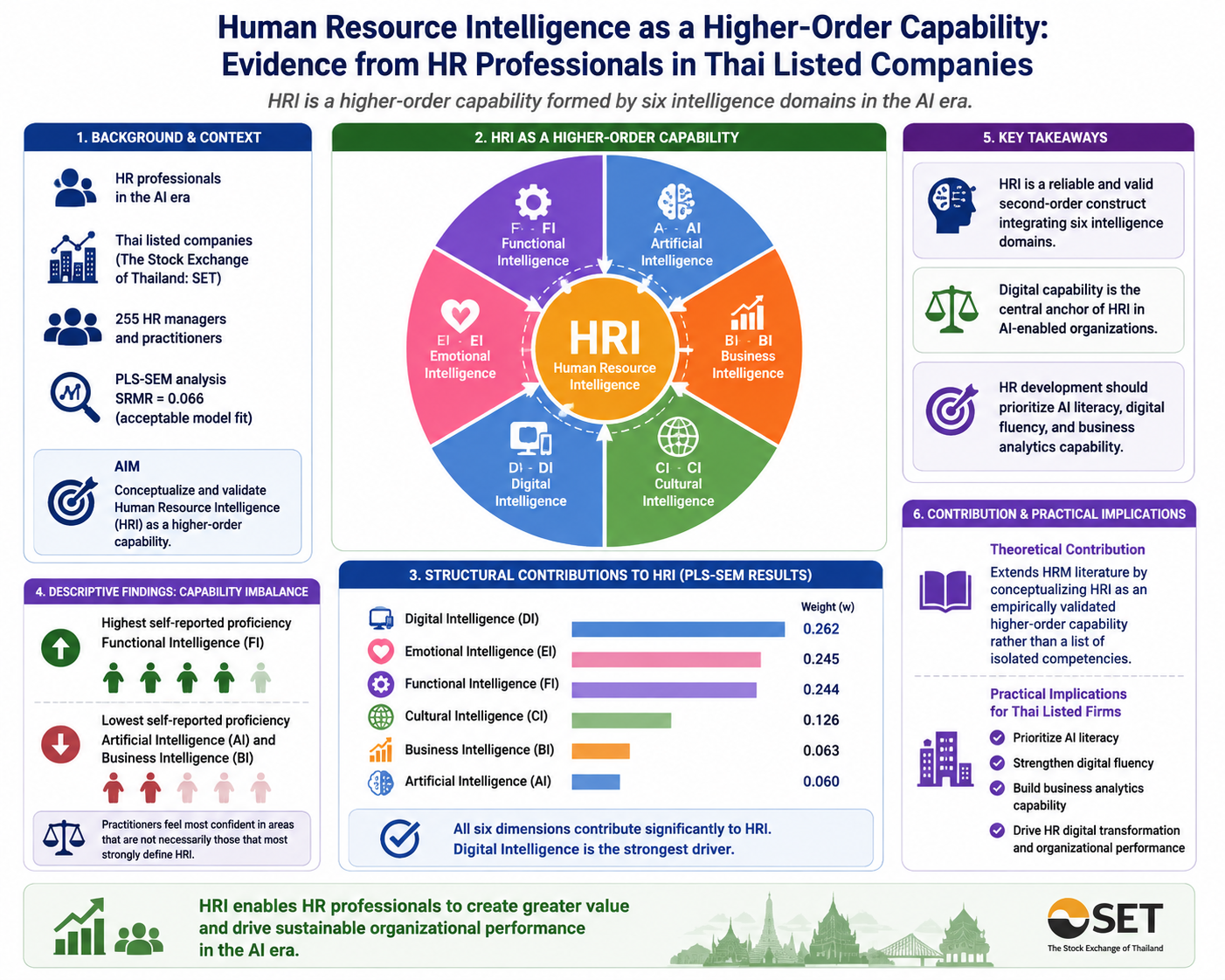
This study conceptualizes and empirically validates Human Resource Intelligence (HRI) as a higher-order capability for HR professionals in the AI era. Drawing on data from 255 HR managers and practitioners in companies listed on the Stock Exchange of Thailand (SET), the study examines how six intelligence domains—Artificial Intelligence, Business Intelligence, Cultural Intelligence, Digital Intelligence, Emotional Intelligence, and Functional Intelligence—jointly constitute HRI. Using PLS-SEM, the results support HRI as a reliable and valid second-order construct, with acceptable model fit (SRMR = 0.066). All six dimensions contributed significantly to HRI. Digital Intelligence showed the strongest structural contribution (w = 0.262), followed by Emotional Intelligence (w = 0.245) and Functional Intelligence (w = 0.244), indicating that digital capability functions as the central anchor of HRI. Descriptive findings, however, showed that HR professionals reported the highest proficiency in Functional Intelligence and the lowest proficiency in Artificial Intelligence and Business Intelligence. This divergence reveals a capability imbalance: the areas in which practitioners feel most confident are not necessarily those that most strongly define HRI in AI-enabled organizations. The study contributes to HRM literature by showing that HRI is better understood not as a list of isolated competencies, but as an empirically validated higher-order capability. Practically, the findings suggest that HR development in Thai listed firms should prioritize AI literacy, digital fluency, and business analytics capability.
Downloads
References
Akbarighatar, P., Pappas, I. O., & Vassilakopoulou, P. (2023). A sociotechnical perspective for responsible AI maturity models: Findings from a mixed-method literature review. International Journal of Information Management Data Insights, 3(2), 100193. https://doi.org/10.1016/j.jjimei.2023.100193
Ang, S., & Van Dyne, L. (2008). Handbook of cultural intelligence: Theory, measurement, and applications. M. E. Sharpe.
Ang, S., Van Dyne, L., Koh, C., Ng, K. Y., Templer, K. J., Tay, C., & Chandrasekar, N. A. (2007). Cultural intelligence: Its measurement and effects on cultural judgment and decision making, cultural adaptation and task performance. Management and Organization Review, 3(3), 335–371. https://doi.org/10.1111/j.1740-8784.2007.00082.x
Bader, B., Schuster, T., Bader, A. K., & Shaffer, M. (2019). The dark side of expatriation: Dysfunctional relationships, expatriate crises, prejudice and a VUCA world. Journal of Global Mobility, 7(2), 126–136. https://doi.org/10.1108/JGM-06-2019-070
Bandara, R., Biswas, K., Akter, S., Shafique, S., & Rahman, M. (2025). Addressing algorithmic bias in AI‐driven HRM systems: Implications for strategic HRM effectiveness. Human Resource Management Journal, 35(4), 1047-1063. https://doi.org/10.1111/1748-8583.12609
Barney, J. (1991). Firm resources and sustained competitive advantage. Journal of Management, 17(1), 99–120. https://doi.org/10.1177/014920639101700108
Bondarouk, T., & Brewster, C. (2016). Conceptualising the future of HRM and technology research. The International Journal of Human Resource Management, 27(21), 2652–2671. https://doi.org/10.1080/09585192.2016.1232296
Boon, C., Den Hartog, D. N., & Lepak, D. P. (2019). A systematic review of human resource management systems and their measurement. Journal of Management, 45(6), 2498–2537. https://doi.org/10.1177/0149206318818718
Bottesch, S., Schwenke, C., Förster, M. et al. Driving business value through people analytics: Literature review and research agenda from an information systems perspective. Electron Markets 35, 106(2025), 1-38. https://doi.org/10.1007/s12525-025-00842-3
Boudreau, J. W., Cascio, W. F., Conger, J. A., Lawler, E. E., Lewin, D., Ulrich, D., Vicere, A. A., & Welbourne, T. M. (2015). Pursue insight. Three: The Human Resources Emerging Executive. Wiley.
Boxall, P., & Purcell, J. (2022). Strategy and human resource management. (5th ed.). Bloomsbury Academic.
Boyatzis, R. E. (1982). The competent manager: A model for effective performance. Wiley.
Budhwar, P., Chowdhury, S., Wood, G., Aguinis, H., Bamber, G.J., Beltran, J.R., Boselie, P., Cooke, F. L., Decker, S., Denisi, A., Dey, P. K., Guest, D., Knoblich, A. J., Malik, A., Paauwe, J., Papagiannidis, S., Patel, C., Pereira, V>, Ren, S., Rogelberg, S., Saunders, M. N. K., Tung, R. L., Varma, A. (2023) Human Resource Management in the Age of Generative Artificial Intelligence: Perspectives and Research Directions on Chatgpt. Human Resource Management Journal, 33, 606-659. https://doi.org/10.1111/1748-8583.12524
Budhwar, P., Malik, A., De Silva, M. T. T., & Thevisuthan, P. (2022). Artificial intelligence – Challenges and opportunities for international HRM: A review and research agenda. The International Journal of Human Resource Management, 33(6), 1065–1097. https://doi.org/10.1080/09585192.2022.2035161
Carolus, A., Koch, M., Straka, S., Latoschik, M., & Wienrich, C. (2023). MAILS – Meta AI literacy scale: Development and testing of an AI literacy questionnaire based on well‑founded competency models and psychological change‑ and meta‑competencies. https://doi.org/10.48550/arXiv.2302.09319
Charlwood, A., & Guenole, N. (2022). Can HR adapt to the paradoxes of artificial intelligence?. Human Resource Management Journal, 32(4), 729–742. https://doi.org/10.1111/1748-8583.12433
Chee, H., Ahn, S., & Lee, J. (2024). A competency framework for AI literacy: Variations by different learner groups and an implied learning pathway. British Journal of Educational Technology, 56(5), 2146-2183. https://doi.org/10.1111/bjet.13556
Chen, H., Chiang, R. H. L., & Storey, V. C. (2012). Business intelligence and analytics: From big data to big impact. MIS Quarterly, 36(4), 1165–1188. https://doi.org/10.2307/41703503
Cherniss, C. (2010). Emotional intelligence: Toward clarification of a concept. Industrial and Organizational Psychology, 3(2), 110–126. https://doi.org/10.1111/j.1754-9434.2010.01231.x
Chowdhury, S., Budhwar, P., & Wood, G. (2024). Generative artificial intelligence in business: Towards a strategic human resource management framework. British Journal of Management, 35(4), 1680-1691. https://doi.org/10.1111/1467-8551.12824
Chowdhury, S., Dey, P., Joel‑Edgar, S., Bhattacharya, S., Rodriguez‑Espindola, O., Abadie, A., & Truong, L. (2023). Unlocking the value of artificial intelligence in human resource management through AI capability framework. Human Resource Management Review, 33(1), 100899. https://doi.org/10.1016/j.hrmr.2022.100899
Deepa, R., Sekar, S., Malik, A., Kumar, J., & Attri, R. (2024). Impact of AI‑focussed technologies on social and technical competencies for HR managers – A systematic review and research agenda. Technological Forecasting and Social Change, 202, 123301. https://doi.org/10.1016/j.techfore.2024.123301
Dutta, D., & Naveen, P. M. (2025). Transforming recruitment and selection practices in organizations through discriminative and generative AI adoption: A structuration lens. Human Resource Management, 65(1), 77-115. https://doi.org/10.1002/hrm.70018
Dwivedi, Y. K., Hughes, L., Ismagilova, E., Aarts, G., Coombs, C., Crick, T., Duan, Y., Dwivedi, R., Edwards, J., Eirug, A., Galanos, V., Ilavarasan, P. V., Janssen, M., Jones, P., Kar, A. K., Kizgin, H., Kronemann, B., Lal, B., Lucini, B., Medaglia, R., & Williams, M. D. (2021). Artificial intelligence (AI): Multidisciplinary perspectives on emerging challenges, opportunities, and agenda for research, practice and policy. International Journal of Information Management, 57, 101994. https://doi.org/10.1016/j.ijinfomgt.2019.08.002
Enholm, I.M., Papagiannidis, E., Mikalef, P. and Krogstie, J. (2021) Artificial Intelligence and Business Value: A Literature Review. Information Systems Frontiers, 24, 1709-1734. https://doi.org/10.1007/s10796-021-10186-w
Ferrari, A. (2013). DIGCOMP: A framework for developing and understanding digital competence in Europe. Publications Office of the European Union.
Fornell, C., & Larcker, D. F. (1981). Evaluating structural equation models with unobservable variables and measurement error. Journal of Marketing Research, 18(1), 39–50. https://doi.org/10.2307/3151312
Garcia, R., & Kwok, L. (2025). Generative artificial intelligence in human resource management: A critical reflection on impacts, resilience and roles. International Journal of Contemporary Hospitality Management, 37(9), 3136-3158. https://doi.org/10.1108/ijchm-01-2025-0159
Goleman, D. (1995). Emotional intelligence: Why it can matter more than IQ. Bantam Books.
Gong, Q., Fan, D., & Bartram, T. (2025). Integrating artificial intelligence and human resource management: A review and future research agenda. The International Journal of Human Resource Management, 36(1), 103-141. https://doi.org/10.1080/09585192.2024.2440065
Gurcan, F., Ayaz, A., Menekse Dalveren, G. G., & Derawi, M. (2023). Business intelligence strategies, best practices, and latest trends: Analysis of scientometric data from 2003 to 2023 using machine learning. Sustainability, 15(13), 9854. https://doi.org/10.3390/su15139854
Hair, J. F., Hult, G. T. M., Ringle, C. M., & Sarstedt, M. (2022). A primer on partial least squares structural equation modeling (PLS-SEM). (3rd ed.). Sage.
Henseler, J., Ringle, C. M., & Sarstedt, M. (2015). A new criterion for assessing discriminant validity in variance-based structural equation modeling. Journal of the Academy of Marketing Science, 43(1), 115–135. https://doi.org/10.1007/s11747-014-0403-8
Hmoud, B. I., & Várallyai, L. (2020). Artificial intelligence in human resources information systems: Investigating its trust and adoption determinants. International Journal of Engineering and Management Sciences, 5(1), 749–765. https://doi.org/10.21791/IJEMS.2020.1.65
Hu, P., Wang, X., & Wang, J. (2026). Integrating human support with algorithmic control: Psychological reactance in platform work. Technological Forecasting and Social Change, 225, 124520. https://doi.org/10.1016/j.techfore.2025.124520
Jarrahi, M. H., Lutz, C., & Newlands, G. (2022). Artificial intelligence, human intelligence and hybrid intelligence based on mutual augmentation. Big Data & Society, 9(2). https://doi.org/10.1177/20539517221142824
Joseph, D. L., Jin, J., Newman, D. A., & O’Boyle, E. H. (2015). Why Does Self-Reported Emotional Intelligence Predict Job Performance? A Meta-Analytic Investigation of Mixed EI. Journal of Applied Psychology, 100, 298-342.
https://doi.org/10.1037/a0037681
Kellogg, K. C., Valentine, M. A., & Christin, A. (2020). Algorithms at work: The new contested terrain of control. Academy of Management Annals, 14(1), 366–410. https://doi.org/10.5465/annals.2018.0174
Kock, N. (2015). Common method bias in PLS-SEM: A full collinearity assessment approach. International Journal of e-Collaboration, 11(4), 1–10. https://doi.org/10.4018/ijec.2015100101
Kock, N., & Hadaya, P. (2018). Minimum sample size estimation in PLS-SEM: The inverse square root and gamma-exponential methods. Information Systems Journal, 28(1), 227–261. https://doi.org/10.1111/isj.12131
Levenson, A. (2018). Using workforce analytics to improve strategy execution. Human Resource Management, 57(3), 685–700. https://doi.org/10.1002/hrm.21850
Li, H., & Kim, S. (2024). Developing AI literacy in HRD: Competencies, approaches, and implications. Human Resource Development International, 27(4), 345–366. https://doi.org/10.1080/13678868.2024.2337962
Margherita, A. (2022). Human resources analytics: A systematization of research topics and directions for future research. Human Resource Management Review, 32(2), 100795. https://doi.org/10.1016/j.hrmr.2020.100795
Marler, J. H., & Boudreau, J. W. (2017). An evidence‑based review of HR Analytics. The International Journal of Human Resource Management, 28(1), 3–26. https://doi.org/10.1080/09585192.2016.1244699
McCartney, S., & Fu, N. (2022). Bridging the gap: Why, how and when HR analytics can impact organizational performance. Management Decision, 60(13), 25-47. https://doi.org/10.1108/MD-12-2020-1581
McKinsey & Company. (2025). HR Monitor 2025: A comprehensive look at the HR landscape. https://www.mckinsey.com/capabilities/people-and-organizational-performance/our-insights/hr-monitor-2025
Meijerink, J., & Bondarouk, T. (2023). The duality of algorithmic management: Toward a research agenda on HRM algorithms, autonomy and value creation. Human Resource Management Review, 33(1), 100876. https://doi.org/10.1016/j.hrmr.2021.100876
Mithas, S., & McFarlan, F. W. (2017). What is digital intelligence?. IT Professional, 19(4), 3-6. https://doi.org/10.1109/MITP.2017.3051329
Pirsoul, T., Parmentier, M., Sovet, L., & Nils, F. (2023). Emotional intelligence and career‑related outcomes: A meta‑analysis. Human Resource Management Review, 33(3), 100967. https://doi.org/10.1016/j.hrmr.2023.100967
Podsakoff, P. M., MacKenzie, S. B., Lee, J.-Y., & Podsakoff, N. P. (2003). Common method biases in behavioral research: A critical review of the literature and recommended remedies. Journal of Applied Psychology, 88(5), 879–903. https://doi.org/10.1037/0021-9010.88.5.879
Prentice, C., Wong, I. A., & Lin, Z. C. (2023). Artificial intelligence as a boundary-crossing object for employee engagement and performance. Journal of Retailing and Consumer Services, 73, 103376. https://doi.org/10.1016/j.jretconser.2023.103376
Qamar, Y., Agrawal, R. K., Samad, T. A., & Jabbour, C. J. C. (2021). When technology meets people: The interplay of artificial intelligence and human resource management. Journal of Enterprise Information Management, 34(5), 1339–1370. https://doi.org/10.1108/JEIM-11-2020-0436
Raisch, S., & Krakowski, S. (2021). Artificial intelligence and management: The automation–augmentation paradox. Academy of Management Review, 46(1), 192–210. https://doi.org/10.5465/amr.2018.0072
Rasmussen, T. H., Ulrich, M., & Ulrich, D. (2023). Moving people analytics from insight to impact. Human Resource Development Review, 23(1), 11-29. https://doi.org/10.1177/15344843231207220
Rodgers, W., Murray, J. M., Stefanidis, A., Degbey, W. Y., & Tarba, S. Y. (2023). An artificial intelligence algorithmic approach to ethical decision-making in human resource management processes. Human Resource Management Review, 33(1), 100925. https://doi.org/10.1016/j.hrmr.2022.100925
Salovey, P., & Mayer, J. D. (1990). Emotional intelligence. Imagination, Cognition and Personality, 9(3), 185–211. https://doi.org/10.2190/DUGG-P24E-52WK-6CDG
Sarstedt, M., Hair, J. F., Cheah, J.-H., Becker, J.-M., & Ringle, C. M. (2019). How to specify, estimate, and validate higher-order constructs in PLS-SEM. Australasian Marketing Journal, 27(3), 197–211. https://doi.org/10.1016/j.ausmj.2019.05.003
Schlaegel, C., Richter, N. F., & Taras, V. (2021). Cultural intelligence and work-related outcomes: A meta-analytic examination of joint effects and incremental predictive validity. Journal of World Business, 56(4), 101209. https://doi.org/10.1016/j.jwb.2021.101209
Shahzad, K., Javed, Y., Khan, S. A., Iqbal, A., Hussain, I., & Jaweed, M. V. (2022). Relationship between IT self‑efficacy and personal knowledge and information management for sustainable lifelong learning and organizational performance: A systematic review from 2000 to 2022. Sustainability, 15(1), 5. https://doi.org/10.3390/su15010005
Strohmeier, S. (2020). Digital human resource management: A conceptual clarification. German Journal of Human Resource Management: Zeitschrift Für Personalforschung, 34(3), 345-365. https://doi.org/10.1177/2397002220921131
Strohmeier, S., & Piazza, F. (2015). Artificial intelligence techniques in human resource management—A conceptual exploration. In Intelligent techniques in engineering management (pp. 149–172). Springer. https://doi.org/10.1007/978-3-319-17906-3_7
Tambe, P., & Cappelli, P. (2019). Artificial intelligence in human resources management. California Management Review, 61(4), 15–42. https://doi.org/10.1177/0008125619867910
Tang, L., & Zhang, C. (2024). Analysis and mapping of scientific literature on cross‑cultural adaptation of global immigrants (1963–2022). SAGE Open, 14(2), 1-25. https://doi.org/10.1177/21582440241255684
Tavera Romero, C. A., Ortiz, J. H., Khalaf, O. I., & Prado, A. R. (2021). Business intelligence: Business evolution after Industry 4.0. Sustainability, 13(18), 10026. https://doi.org/10.3390/su131810026
Teece, D. J., Pisano, G., & Shuen, A. (1997). Dynamic capabilities and strategic management. Strategic Management Journal, 18(7), 509–533. https://doi.org/10.1002/(SICI)1097-0266(199708)18:7%3C509::AID-SMJ882%3E3.0.CO;2-Z
Ulrich, D., & Brockbank, W. (2005). The HR value proposition. Harvard Business School Press.
Ulrich, D., Younger, J., Brockbank, W., & Ulrich, M. (2012). HR from the outside in: Six competencies for the future of human resources. McGraw-Hill.
Vrontis, D., Christofi, M., Pereira, V., Tarba, S., Makrides, A., & Trichina, E. (2022). Artificial intelligence, robotics, advanced technologies and human resource management: A systematic review. The International Journal of Human Resource Management, 33(6), 1237–1266. https://doi.org/10.1080/09585192.2020.1871398
Wiblen, S. L., & Marler, J. H. (2021). Digitalised talent management and automated talent decisions: The implications for HR professionals. International Journal of Human Resource Management, 32(12), 2592–2621. https://doi.org/10.1080/09585192.2021.1886149
Wright, P. M., & McMahan, G. C. (2011). Exploring human capital: Putting ‘human’ back into strategic human resource management. Human Resource Management Journal, 21(2), 93–104. https://doi.org/10.1111/j.1748-8583.2010.00165.x
Wright, P. M., & Snell, S. A. (2005). Partner or guardian? HR’s challenge in balancing value and values. Human Resource Management, 44(2), 177–182. https://doi.org/10.1002/hrm.20061
Downloads
Additional Files
Published
How to Cite
Issue
Section
Categories
License
Copyright (c) 2026 Community and Social Development Journal

This work is licensed under a Creative Commons Attribution-NonCommercial-NoDerivatives 4.0 International License.