Comparative Analysis of Community-Based Tourism Management: Case Studies from Bhutan and Thailand
DOI:
https://doi.org/10.57260/csdj.2026.288058Keywords:
Comparative analysis, Community-Based tourism management, SWOT-TOWS analysis, Eusu Gewog Haa Dzongkhag district Bhutan, Buakkhang subdistrict ThailandAbstract
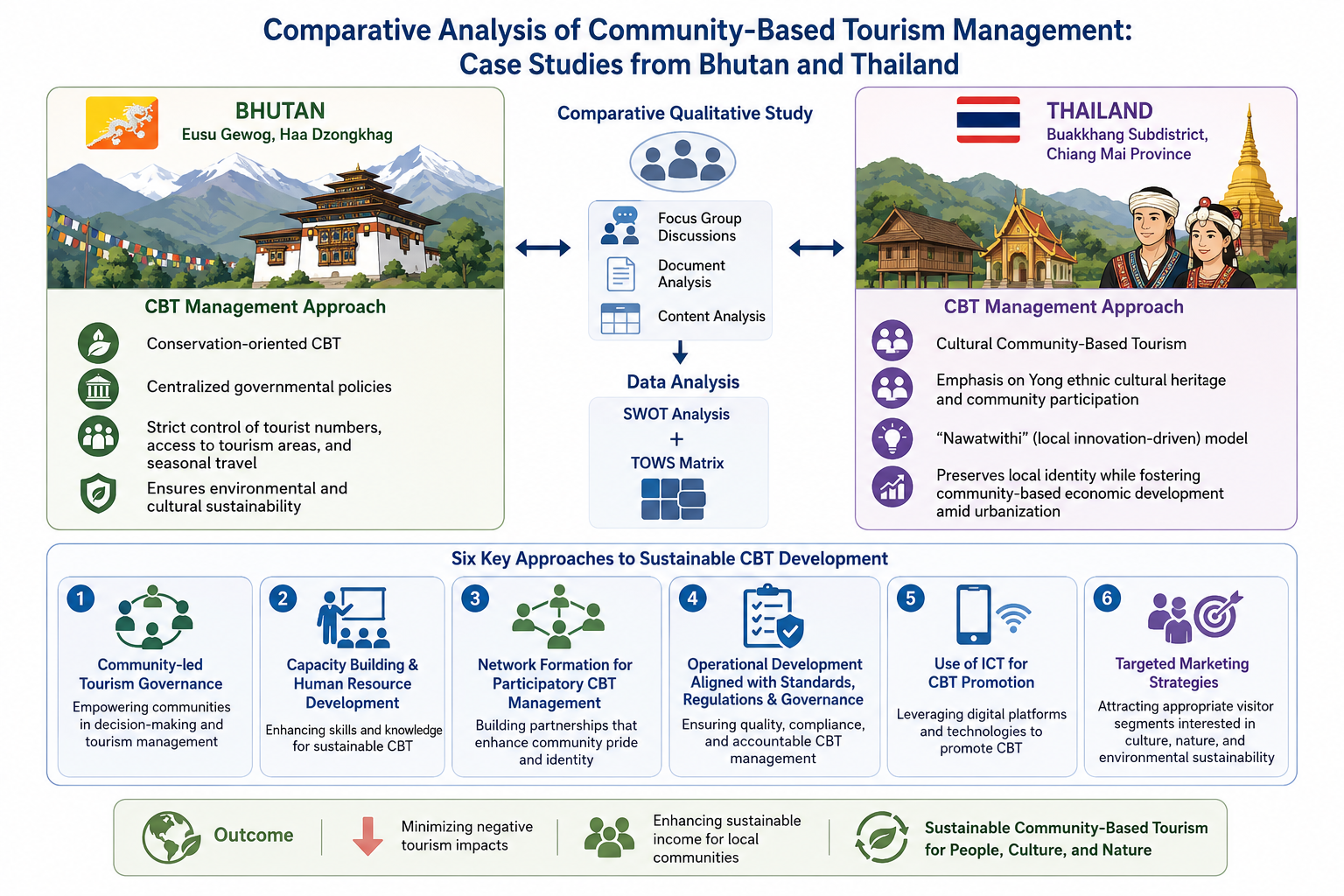
This study aims to conduct a comparative analysis of community-based tourism (CBT) management between Bhutan and Thailand through a qualitative research approach. Sample group from purposive sampling, including focus group discussions with key stakeholders. The research instruments consisted of content analysis tables, guidelines and questions for focus group discussions and document analysis. Analytical method with SWOT Analysis and TOWS matrix. The findings indicate that both countries adopt participatory CBT development frameworks in which the public sector, private sector, and local communities play integral roles in strengthening tourism capacity and governance. In Eusu Gewog, Haa Dzongkhag (District), Bhutan, CBT management is strongly conservation-oriented and regulated through centralized governmental policies that strictly control tourist numbers, access to tourism areas, and seasonal travel in order to ensure environmental and cultural sustainability. Conversely, CBT management in Buakkhang Subdistrict, Chiang Mai Province, Thailand, is grounded in Cultural Community-Based Tourism, emphasizing Yong ethnic cultural heritage, community participation, and the “Nawatwithi” (local innovation-driven) model. This approach prioritizes the preservation of local identity while fostering community-based economic development amid increasing urbanization. The comparative findings identify six key approaches to sustainable CBT development in both contexts: 1) community-led tourism governance; 2) capacity building and human resource development in community-based tourism; 3) network formation for participatory CBT management that enhances community pride and identity; 4) operational development aligned with CBT standards, regulations, and governance frameworks; 5) development and strategic use of information and communication technologies for CBT promotion; and 6) targeted marketing strategies aimed at attracting appropriate visitor segments, particularly tourists with strong interests in culture, nature, and environmental sustainability. These approaches contribute to minimizing negative tourism impacts while enhancing sustainable income generation for local communities.
Downloads
References
Bunpradap, N., & Banterng, T. (2026). Tourism Communication and Marketing Strategies: A Comparative Analysis of Thailand and Malaysia's Tourism Advertisement Spots on Online Media. Journal of Communication Arts Review, 30(1), 270-283. https://so06.tci-thaijo.org/index.php/jca/article/view/291022
Cai, Y., Li, G., Wen, L., & Liu, C. (2024). Intellectual landscape and emerging trends of big data research in hospitality and tourism: A scientometric analysis. International Journal of Hospitality Management, 117, 103633. https://doi.org/10.1016/j.ijhm.2023.103633
Chaiyasut, K., Wattanalaungarun, W., & Sa-ingthong , K. (2025). Digital Storytelling: Enhancing the Inno-Life Tourism Community Prototype Identities Through the Power of the Community Innovators Storytellers. University of the Thai Chamber of Commerce Journal Humanities and Social Sciences, 45(3), 153–168. https://so06.tci-thaijo.org/index.php/utccjournalhs/article/view/287228
Chinbutranont, R., Wattanapornprom, N., & Wattanapornprom, R. (2025). Integration of Samadhi and Panna with Sustainable Development Goals for Sustainable Development. Journal of MCU Social Science Review, 14(2), 263–277. https://so03.tci-thaijo.org/index.php/jssr/article/view/285795
Choochat, C., Wattanalaungarun, W., & Sa-ingthong, K. (2022). The Sufficiency Economy-Based Tourism Model of the Upper Wang River Area . Community and Social Development Journal, 23(2), 138–154. https://doi.org/10.14456/rcmrj.2022.251150
Correia, A., & Kozak, M. (2022). Past, present and future: Trends in tourism research. Current Issues in Tourism, 25(6), 995–1010. https://doi.org/10.1080/13683500.2021.1918069
Department of Community Development. (2018). OTOP Innovative Tourism Community Handbook. https://korat.cdd.go.th/wp-content/uploads/sites/22/2018/05
Destination Haa. (2018). Tourism action plan, 2018-2023. Dzongkhag administration, haa.
Hill, T., & Westbrook, R. (1997). SWOT analysis: It's time for aproduct recall. Long Range Planning, 30(1), 46–52. https://doi.org/10.1016/S0024-6301(96)00095-7
Kim, S., & Kang, Y. (2020). Why do residents in an overtourism destination develop anti-tourist attitudes? An exploration of residents’ experience through the lens of the community-based tourism. Asia Pacific Journal of Tourism Research, 25(8), 858–876. https://doi.org/10.1080/10941665.2020.1768129
Krittayaruangroj, K., Suriyankietkaew, S., & Hallinger, P. (2023). Research on sustainability in community-based tourism: a bibliometric review and future directions. Asia Pacific Journal of Tourism Research, 28(9), 1031-1051. https://doi.org/10.1080/10941665.2023.2276477
Li, X., & Law, R. (2020). Network analysis of big data research in tourism. Tourism Management Perspectives, 33, 100608. https://doi.org/10.1016/j.tmp.2019.100608
Mailap, Y. (2024). The Kingdom of Thailand and the Kingdom of Bhutan: More than three decades of relations based on similarities and closeness. Bangkok: Thai Society of Lifestyle Medicine and Health.
Mukem, A., & Orsantinutsakul, D. (2023). The Growth of the Sufficiency Economy Philosophy of Bhutan Soul Farmers Livelihood Center. Journal for Social Science Research, 14(1), 1-20. https://so02.tci-thaijo.org/index.php/ssr/article/view/258930
Ngernklay, P. (2018). A Comparative Study of Creative Tourism Policy and Model between Thailand and Lao People's Democratic Republic. Kasem Bundit Journal, 19, 161–174. https://so04.tci-thaijo.org/index.php/jkbu/article/view/117365
Scheyvens, R., & Van der Watt, H. (2021). Tourism, empowerment and sustainable development: A new framework for analysis. Sustainability, 13(22), 12606. https://doi.org/10.3390/su132212606
Suthasupa, S. (2024). A Study of Nature Conservation in Bhutan: Some Implications for Thailand. Journal of Roi Kaensarn Academi, 9(7), 137–152. https://so02.tci-thaijo.org/index.php/JRKSA/article/view/270339
Tourism Authority of Thailand. (2025). Thansettakij.com: TAT Boosts Thai-Bhutan Tourism: Two Kingdoms One Destination. https://www.thansettakij.com/business/tourism/625468
Ura, D. K., Alkire, D. K. S., & Zangmo, T. (2011). Happiness index of Bhutan: Method and illustrative results. Oxford: The Centre for Bhutan Studies.
Wattanakul, W. (2022). OGOP Product Development Project: One Gewog One Product in Bhutan. Chiang Mai Rajabhat University.
Wattanakul, S., Ekiem, B., Panyadee, C., & Techatunminasakul, S. (2023). The Strategy of OTOP Nawatvithi Community Tourism Development for Banpatan, Buak Khang Sub-District San Kam Phaeng District, Chiang Mai Province. School of Administrative Studies Academic Journal, 6(2), 102–119. https://so05.tci-thaijo.org/index.php/SASAJ/article/view/263532
Wattanalaungarun, W., Sa-ingthong, K., & Chaiwoot, A. (2019). Study for Uniqueness in Tourism Base on Sustainable Tourism Management, Mae Rim District Chiang Mai Province. Community and Social Development Journal, 20(2), 53–68. https://so05.tci-thaijo.org/index.php/cmruresearch/article/view/217621
Wattanalaungarun, W., Suwan, M., Somyana, P., & Wattanakul, W. (2025). The Study and Development of a Community-Based Tourism Management Model Based on the Principles of the King’s Philosophy for Sustainability: A Case Study of Ban Muang Kham, Chiang Mai Province. Dhammathas Academic Journal, 25(3), 161–178. https://so06.tci-thaijo.org/index.php/dhammathas/article/view/282466
Weihrich, H. (1982). The TOWS matrix-A tool for situation alanalysis. Long Range Planning, 15(2), 54–66. https://doi.org/10.1016/0024-6301(82)90120-0
Downloads
Additional Files
Published
How to Cite
Issue
Section
Categories
License
Copyright (c) 2026 Community and Social Development Journal

This work is licensed under a Creative Commons Attribution-NonCommercial-NoDerivatives 4.0 International License.