The Effects of Design Thinking Activities on Learning Achievement and Innovative Thinking Skills Among Undergraduate English Major Students in Thailand
DOI:
https://doi.org/10.57260/csdj.2026.284134Keywords:
Design thinking, Innovative thinking, Learning activity, English for communication, Learning achievementAbstract
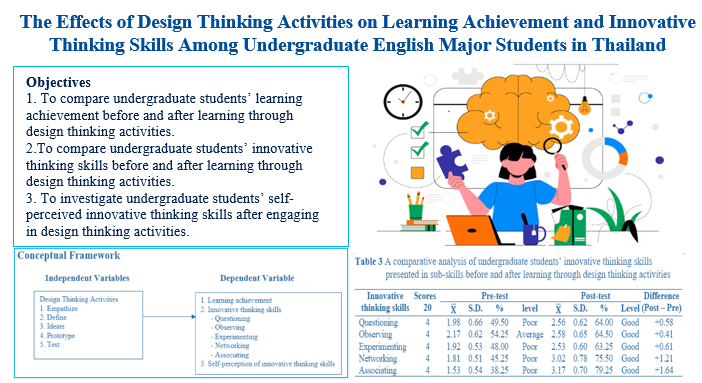
The purposes of this research were to compare undergraduate students’ learning achievements and innovative thinking skills before and after learning through design thinking activities in English for communication in service industry course, and to study undergraduate students’ self-perception on their innovative thinking skill after learning through design thinking activities. A one-group pretest–posttest design was employed. The sample group of this research was 59 undergraduate students majoring in English who enrolled in English for communication in service industry course in academic year 2024. Total population sampling was employed, representing 95.1% of the population. The research instruments included design thinking activity plans in English for communication in service industry course, a learning achievement test, an innovative thinking skills test and a self-perception of innovative thinking skills questionnaire. All instruments were validated by experts for content validity (IOC = 0.67–1.00). The internal consistency reliability of the instruments was examined using the Kuder–Richardson Formula 20 (KR-20) for the learning achievement test and the innovative thinking skills test, and Cronbach’s alpha for the self-perceived innovative thinking skills questionnaire. The reliability coefficients were 0.74, 0.79, and 0.91, respectively. Data were analyzed using mean, standard deviation, t-test (dependent samples), and Cohen’s d. The results indicated that post-test scores for learning achievement were significantly higher than pre-test scores at the .05 level, with a very large effect size (d = 2.57). Similarly, innovative thinking skills significantly improved, with a very large effect size (d = 2.14). Students’ perceptions of their innovative thinking skills were rated at a high level after the intervention.
Downloads
References
Alaimi, M., Law, E., Pantasdo, K. D., Oudeyer, P. Y., & Sauzeon, H. (2020). Pedagogical agents for fostering question-asking skills in children. In Proceedings of the 2020 CHI conference on human factors in computing systems, 1-13. https://doi.org/10.48550/arXiv.2004.03472 DOI: https://doi.org/10.1145/3313831.3376776
Avcı, Ü., & Durak, H. Y. (2023). Innovative thinking skills and creative thinking dispositions in learning environments: Antecedents and consequences. Thinking Skills and Creativity, 47, 101225. https://doi.org/10.1016/j.tsc.2022.101225 DOI: https://doi.org/10.1016/j.tsc.2022.101225
Brown, T. (2009). Change by design: How design thinking creates new alternatives for business and society. New York, NY: Harper Business.
Brown, T. (2020). Change by design: How design thinking creates new alternatives for business and society. (2nd ed.). New York, NY: Harper Business.
Carroll, M., Goldman, S., Britos, L., Koh, J., Royalty, A., & Hornstein, M. (2010). Destination, imagination and the fires within: Design thinking in a middle school classroom. International Journal of Art & Design Education, 29(1), 37–53. https://doi.org/10.1111/j.1476-8070.2010.01632.x DOI: https://doi.org/10.1111/j.1476-8070.2010.01632.x
Chesbrough, H. (2003). Open innovation: The new imperative for creating and profiting from technology. Harvard Business School Press.
Christensen, C. M., Raynor, M. E., & McDonald, R. (2013). The innovator’s solution: Creating and sustaining successful growth. Harvard Business Review Press.
Cohen, J. (1988). Statistical power analysis for the behavioral sciences. (2nd ed.). Lawrence Erlbaum Associates.
Crossan, M. M., & Apaydin, M. (2010). A multi‐dimensional framework of organizational innovation: A systematic review of the literature. Journal of Management Studies, 47(6), 1154-1191. https://doi.org/10.1111/j.1467-6486.2009.00880.x DOI: https://doi.org/10.1111/j.1467-6486.2009.00880.x
Cross, N. (2023). Design thinking: Understanding how designers think and work. Bloomsbury Publishing. DOI: https://doi.org/10.5040/9781350305090
Dyer, J., Gregersen, H., & Christensen, C. (2011). The innovator's DNA: Mastering the five skills of disruptive innovators. Harvard Business Review Press. https://www.hbs.edu/faculty/Pages/item.aspx?num=41229
Gao, N. (2023). Design and Implementation of Comprehensive Evaluation System for Vocational College Students with Innovative Thinking Training. International Journal of Education and Humanities, 10(2), 27-32. https://doi.org/10.54097/ijeh.v10i2.11323 DOI: https://doi.org/10.54097/ijeh.v10i2.11323
Gao, G., & Jeong, D. (2024). Influence of Design Thinking in Art and Design Majors on Cultivating College Students’ Creativity. Journal of Educational Research and Policies, 6(11), 127–129. https://doi.org/10.53469/jerp.2024.06(11).29 DOI: https://doi.org/10.53469/jerp.2024.06(11).29
Gregory, E., Hardiman, M., Yarmolinskaya, J., Rinne, L., & Limb, C. (2013). Building creative thinking in the classroom: From research to practice. International Journal of Educational Research, 62, 43–50. https://doi.org/10.1016/j.ijer.2013.06.003 DOI: https://doi.org/10.1016/j.ijer.2013.06.003
Harris, D. P. (1969). Testing English as a second language. New York: MaGraw Hill.
Hart, S. (1996). Beyond Special Needs: enhancing children's learning through innovative thinking. Sage.
Holmes, N. G., Wieman, C. E., & Bonn, D. A. (2015). Teaching critical thinking. PNAS Proceedings of the National Academy of Sciences of the United States of America, 112(36), 11199–11204. https://doi.org/10.1073/pnas.1505329112 DOI: https://doi.org/10.1073/pnas.1505329112
Jones, L., & Peck, A. (2023). Redesigning Student Success. About Campus, 27(6), 12-15. https://doi.org/10.1177/10864822231151879 DOI: https://doi.org/10.1177/10864822231151879
Kelley, T., & Kelley, D. (2013). Creative confidence: Unleashing the creative potential within us all. Harper Collins.
Klinart, C. (2019). An Action Research on Developing 11th Grade Students Creative Ability and Innovation Using Design Thinking Process on the Topic of Electrochemistry. Independent Study, M.Ed. in Science Education, Naresuan University.
Kolb, D. A. (2014). Experiential learning: Experience as the source of learning and development. FT press.
Liedtka, J. (2015). Perspective: Linking design thinking with innovation outcomes through cognitive bias reduction. Journal of Product Innovation Management, 32(6), 925–938. https://doi.org/10.1111/jpim.12163 DOI: https://doi.org/10.1111/jpim.12163
Martin, R. L. (2009). The design of business: Why design thinking is the next competitive advantage. Harvard Business Press.
Nunnally, J. C., & Bernstein, I. H. (1994). Psychometric theory. (3rd ed.). McGraw-Hill.
Ravankar, A. A., Imai, S., Ravankar, A., Kato, T., Takasuka, T., Tsuji, T., & Saito, K. (2018). Towards Better Problem Finding and Creativity in Graduate School Education: A Case Study of Nitobe School Program," 2018 7th International Congress on Advanced Applied Informatics (IIAI-AAI), Yonago, Japan, 2018, pp. 414-418. https://doi.org/10.1109/IIAI-AAI.2018.00088 DOI: https://doi.org/10.1109/IIAI-AAI.2018.00088
Sawhney, M., Wolcott, R. C., & Arroniz, I. (2006). The 12 different ways for companies to innovate. MIT Sloan Management Review, 47(3), 75–81. https://doi.org/10.1109/EMR.2007.329139 DOI: https://doi.org/10.1109/EMR.2007.329139
Seelig, T. (2012). inGenius: A Crash Course on Creativity. Stanford Social Innovation Review. https://doi.org/10.48558/T5CY-S536
Swallow, E. (2012). Can innovative thinking be learned. Forbes.
Tidd, J., & Bessant, J. (2018). Managing innovation: Integrating technological, market and organizational change. (6th ed.). Wiley.
Yu, Q., Yu, K., & Lin, R. (2024). A meta-analysis of the effects of design thinking on student learning. Humanities & Social Sciences Communications, 11, 742. https://doi.org/10.1057/s41599-024-03237-5 DOI: https://doi.org/10.1057/s41599-024-03237-5
Downloads
Published
How to Cite
Issue
Section
Categories
License
Copyright (c) 2026 Community and Social Development Journal

This work is licensed under a Creative Commons Attribution-NonCommercial-NoDerivatives 4.0 International License.
1. Articles, information, content, images, etc published in the “Community and Social Development Journal” are copyrighted by the Community and Social Development Journal, Chiang Mai Rajabhat University. In order to properly distribute the articles through print and electronic media, the authors still hold the copyright for the published articles under the Creative Commons Attribution (CC BY) license, which allows the re-distribution of the articles in other sources. References must be made to the articles in the journal. The authors are responsible for requesting permission to reproduce copyrighted content from other sources.
2. The content of the articles appearing in the journal is the direct responsibility of the article authors. The editorial board of the journal does not necessarily agree with or share any responsibility.