
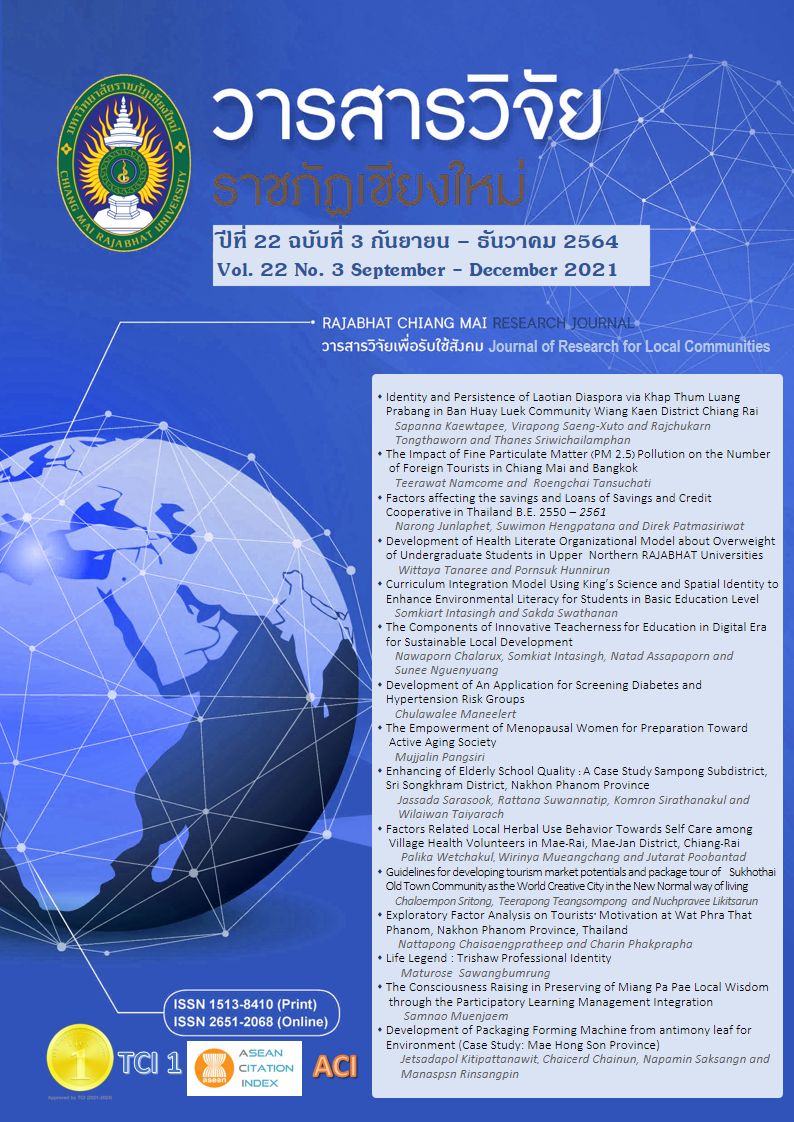
การสร้างจิตสำนึกในการอนุรักษ์ภูมิปัญญาท้องถิ่นชาเมี่ยงป่าแป๋ ผ่านการบูรณาการการจัดการเรียนรู้แบบมีส่วนร่วม
DOI:
https://doi.org/10.14456/rcmrj.2021.242745คำสำคัญ:
การอนุรักษ์, สร้างจิตสำนึก, ภูมิปัญญาท้องถิ่น, ชาเมี่ยงบทคัดย่อ
การวิจัยในครั้งนี้ มีวัตถุประสงค์เพื่อสร้างรูปแบบการสร้างจิตสำนึกและศึกษาผลการใช้รูปแบบ การสร้างจิตสำนึกในการอนุรักษ์ภูมิปัญญาท้องถิ่นชาเมี่ยงที่มีต่อจิตสำนึกในการอนุรักษ์ภูมิปัญญาท้องถิ่นของนักเรียนโรงเรียนป่าแป๋วิทยา ประชากรคือนักเรียนจำนวน 128 คน เครื่องมือที่ใช้ในการวิจัยได้แก่ แบบวิเคราะห์เอกสาร แนวทางการระดมสมอง แบบสังเกตพฤติกรรมการมีส่วนร่วมของผู้มีส่วนเกี่ยวข้อง แบบสังเกตพฤติกรรมการสอนของครู แบบสัมภาษณ์ชุมชน แบบสัมภาษณ์ความคิดเห็นของผู้มีส่วนเกี่ยวข้อง แบบประเมินคุณภาพของรูปแบบ แบบประเมินคุณภาพของคู่มือภูมิปัญญาท้องถิ่นชาเมี่ยง และแบบวัดจิตสำนึกในการอนุรักษ์ภูมิปัญญาท้องถิ่นชาเมี่ยง วิเคราะห์ข้อมูลเชิงปริมาณโดยใช้ค่าร้อยละ ค่าเฉลี่ย ค่าเบี่ยงเบนมาตรฐาน และการวิเคราะห์เชิงเนื้อหา
ผลการวิจัยพบว่า รูปแบบการสร้างจิตสำนึกในการอนุรักษ์ภูมิปัญญาท้องถิ่นชาเมี่ยงของนักเรียนโรงเรียนป่าแป๋วิทยาประกอบด้วย 4 องค์ประกอบ 1) หลักการ 2) วัตถุประสงค์ของรูปแบบ 3) กระบวนการสร้างจิตสำนึกในการอนุรักษ์ภูมิปัญญาท้องถิ่นชาเมี่ยง และ 4) เงื่อนไขความสำเร็จ ผลการประเมินคุณภาพของรูปแบบพบว่ารูปแบบ มีคุณภาพด้านความเป็นประโยชน์ ความเป็นไปได้ ความเหมาะสม และความถูกต้องอยู่ในระดับมากที่สุด ผลการใช้รูปแบบการสร้างจิตสำนึกในการอนุรักษ์ภูมิปัญญาท้องถิ่นชาเมี่ยงพบว่า ค่าเฉลี่ย ร้อยละของคะแนนจิตสำนึกในการอนุรักษ์ภูมิปัญญาท้องถิ่นชาเมี่ยงของนักเรียนชั้นประถมศึกษาปีที่ 1 ถึง ชั้นมัธยมศึกษาปีที่ 3 ผ่านเกณฑ์ที่โรงเรียนร่วมกันกำหนดไว้ทุกระดับชั้น
Downloads
เอกสารอ้างอิง
Buosoute, R. (2012). Direction and Area of Evaluation. (3rd ed.). Nakhon Sawan: Rimping Karnpim. (In Thai)
Choenghom, A., Sankhacha, M., Chornburi, S., & Onsampant, S. (2014). Development Learning Model for Growing an Honesty Consciousness for Student of Baanhadphaeng School (Hadphaengwittaya). Journal of Educational Administration, 4(3), 220-233. https://so02.tci-thaijo.org/index.php/EdAd/article/view/57459 (In Thai)
Jaritped, J. (2014). The Participation of Personnel Administration of the Teachers under Lop Buri Primary Educational Service Area Office. (Master of Education Thesis, Thepsatri Rajabhat University). (In Thai)
Kaewdaeng, R. (2003). Guide for recruiting and selecting Thai wisdom teachers. Bangkok: Parbpim Printing. (In Thai)
Kanjanawasee, S. (2016). Research and Development for Thai Education. Silpakorn Educational Research Journal, 8(2), 1-18. https://so05.tci-thaijo.org/index.php/suedureasearchjournal/article/view/77495 (In Thai)
Papae Subdistrict Administrative Organization. (2015). Strategic Plan for the Development of PaPae Subdistrict Administrative Organization. Chiang Mai : Papae Subdistrict Administrative Organization. (In Thai)
Papae Witthaya School. (2018). Annual Action Plan 2018. Chiangmai: Papae Witthaya School School. (In Thai)
Pathan, A. (2015). Local Wisdom and Natural Disaster Management for the Self-Reliance of the Community Way of Life. Phetchabun: Phetchabun Rajabhat University. (In Thai)
Pengsawat, W. (2009). Research and Development. Sakonnakhon Rajabhat University Journal, 1(2), 1-12. https://ph01.tci-thaijo.org/index.php/snru_journal/article/view/10186 (In Thai)
Phongthong, T. (2016). Parents’ Participation In Early Childhood Education Management Of School In Kaeng Hang Maeo District Under The Chanthaburi Primary Educational Service Area Office 1. (Master of Education Thesis, Burapha University). (In Thai)
Plant Genetic Conservation Project Office Under The Royal initiative of Her Royal Highness Princess Maha Chakri Sirindhorn. (2019). Plant Genetic Conservation Project Under The Royal initiative of Her Royal Highness Princess Maha Chakri Sirindhorn. Retrieved from http://www.rspg.or.th/activities/index.htm. (In Thai)
Rodnual, P. (2012). Consciousness for balanced and sustainable development in the Thai social context. Retrieved from http://preedar.blogspot.com/2012/11/blog-post.html. (In Thai)
Suttiyotin, N. (2016). Theory of consciousness Building awareness And cultivating consciousness. Retrieved from http://nattawatt.blogspot.com/2016/12/ consciousness.html. (In Thai)
Tawarit, K., Soonthornroj, W., & Jansaeng, A. (2016). Development of Model for Learning Management for Enhancing Local Consciousness of Senior High school Students through Socialization Process. Journal of Educational Measurement Mahasarakham University, 22(2), 42-51. https://so02.tci-thaijo.org/index.php/jemmsu/article/view/157538 (In Thai)
Toonthong, T., Chawianghong, B., & Dawan, S. (2017). A Model of Public Mind Development for Youths in Lop Buri Province by Using Cognitive Behavior Modification. Journal of Education, 28(2), 65-74. http://ojslib3.buu.in.th/index.php/education2/article/view/4949 (In Thai)
ดาวน์โหลด
เผยแพร่แล้ว
รูปแบบการอ้างอิง
ฉบับ
ประเภทบทความ
สัญญาอนุญาต
ลิขสิทธิ์ (c) 2021 วารสารวิจัยราชภัฏเชียงใหม่

อนุญาตภายใต้เงื่อนไข Creative Commons Attribution-NonCommercial-NoDerivatives 4.0 International License.
1. บทความ ข้อมูล เนื้อหา รูปภาพ ฯลฯ ที่ได้รับการตีพิมพ์ใน “Community and Social Development Journal” ถือเป็นลิขสิทธิ์ของ Community and Social Development Journal มหาวิทยาลัยราชภัฏเชียงใหม่ และเพื่อให้เผยแพร่บทความได้อย่างเหมาะสมผ่านสื่อสิ่งพิมพ์และอิเล็กทรอนิกส์ ผู้เขียนยังคงถือครองลิขสิทธิ์บทความที่ตีพิมพ์ภายใต้ใบอนุญาต Creative Commons Attribution (CC BY) ซึ่งอนุญาตให้เผยแพร่บทความซ้ำในแหล่งอื่นได้ โดยอ้างอิงต้องอ้งอิงบทความในวารสาร ผู้เขียนต้องรับผิดชอบในการขออนุญาตผลิตซ้ำเนื้อหาที่มีลิขสิทธิ์จากแหล่งอื่น
2. เนื้อหาบทความที่ปรากฏในวารสารเป็นความรับผิดชอบของผู้เขียนบทความโดยตรง ซึ่งกองบรรณาธิการวารสารไม่จำเป็นต้องเห็นด้วยหรือร่วมรับผิดชอบใดๆ