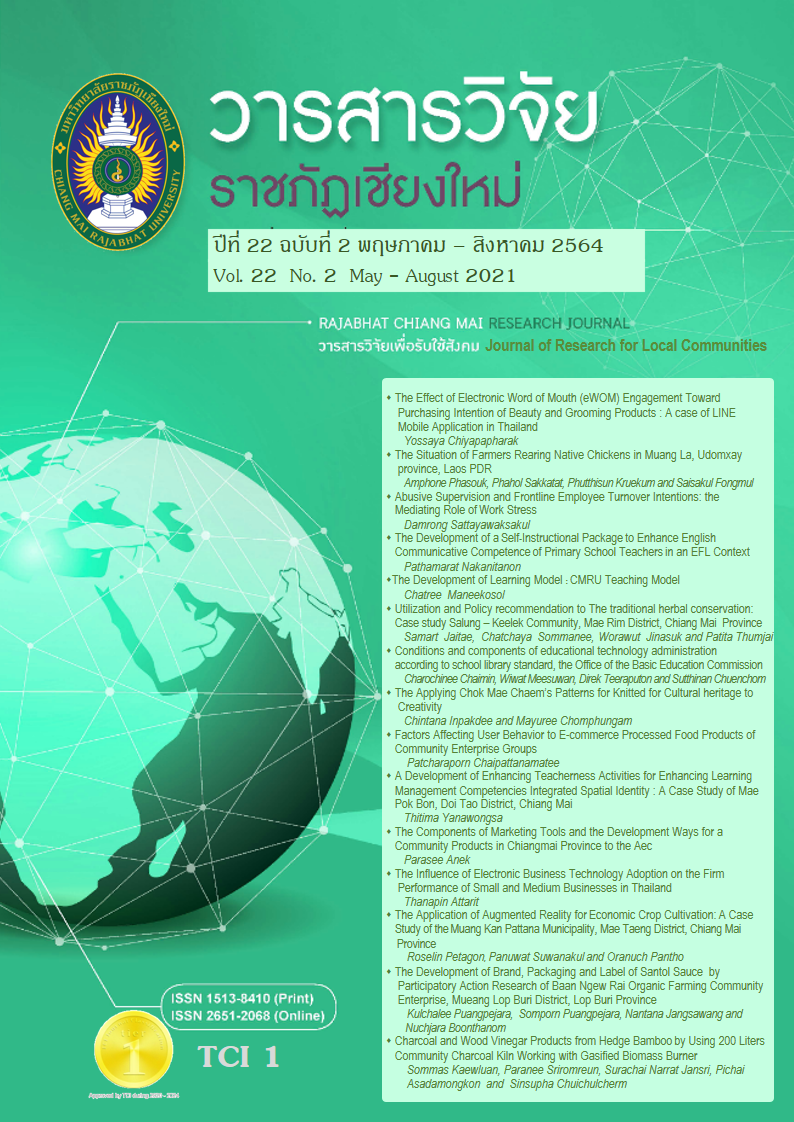
ความรู้สึกถูกควบคุมดูแลที่ไม่เหมาะสมและความตั้งใจออกจากงานของพนักงาน ส่วนหน้า: บทบาทการส่งผ่านของตัวแปรความเครียดจากการทำงาน
DOI:
https://doi.org/10.14456/rcmrj.2021.247922คำสำคัญ:
ความรู้สึกถูกควบคุมดูแลที่ไม่เหมาะสม, ความเครียดจากการทำงาน, ความตั้งใจออกจากงานบทคัดย่อ
งานวิจัยนี้มีวัตถุประสงค์เพื่อสำรวจความสัมพันธ์ทางตรงและทางอ้อม ระหว่างความรู้สึกถูกควบคุมดูแลที่ไม่เหมาะสม ความเครียดจากการทำงาน และความตั้งใจออกจากงาน ของพนักงานส่วนหน้าในเขตกรุงเทพฯ โดยใช้แบบสอบถามเป็นเครื่องมือในการรวบรวมข้อมูล กลุ่มตัวอย่างที่ตอบแบบสอบถามจำนวน 368 คน โดยใช้เทคนิคการสุ่มตัวอย่างแบบง่าย ทดสอบสมมติฐานโดยการวิเคราะห์อิทธิพลตัวแปรจากโมเดลสมการโครงสร้างกำลังสองน้อยที่สุด (PLS-SEM) ผลการวิจัยพบว่าทุกตัวแปรมีความสัมพันธ์ทางตรงเชิงบวกอย่างมีนัยสาคัญทางสถิติ โดยการความรู้สึกถูกควบคุมดูแลที่ไม่เหมาะสมมีอิทธิพลทางตรงต่อความตั้งใจออกจากงาน ความรู้สึกถูกควบคุมดูแลที่ไม่เหมาะสมมีอิทธิพลทางตรงต่อความเครียดจากการทำงาน และความเครียดจากการทำงานมีอิทธิพลทางตรงต่อความตั้งใจออกจากงาน นอกจากนี้ยังพบความสัมพันธ์ทางอ้อมอย่างมีนัยสาคัญทางสถิติระหว่างความรู้สึกถูกควบคุมดูแลที่ไม่เหมาะสม และความตั้งใจออกจากงานผ่านทางตัวแปรส่งผ่านความเครียดจากการทำงาน ผลการวิจัยนี้สามารถนำไปใช้เป็นข้อมูลในการบริหารงานด้านความตั้งใจออกจากงานของพนักงานส่วนหน้า โดยเฉพาะพฤติกรรมของหัวหน้างานที่ส่งผลต่อความเครียดจากการทำงานและความตั้งใจออกจากงานของพนักงาน
Downloads
เอกสารอ้างอิง
Agarwal, U. A. (2019). Examining links between abusive supervision, PsyCap, LMX and outcomes. Management Decision, 57(5), 1304-1334. DOI:10.1108/MD-02-2017-0103
Arshadi, N., & Damiri, H. (2013). The Relationship of Job Stress with Turnover Intention and Job Performance: Moderating Role of OBSE. Procedia - Social and Behavioral Sciences, 84(9), 706–710. DOI:10.1016/j.sbspro.2013.06.631
Avolio, B. J., Gardner, W. L., Walumbwa, F. O., Luthans, F., & May, D. R. (2004). Unlocking the mask: A look at the process by which authentic leaders impact follower attitudes and behavior. The Leadership Quarterly, 15(6), 801-823. DOI:10.1016/j.leaqua.2004.09.003
Bamfo, B. A., Dogbe, C. S. K., & Mingle, H. (2018). Abusive customer behaviour and frontline employee turnover intentions in the banking industry: The mediating role of employee satisfaction. Cogent Business & Management, 5(1), 1-15. DOI:10.1080/23311975.2018.1522753
Bouckenooghe, D., Zafar, A., & Raja, U. (2015). How ethical leadership shapes employees’ job performance: The mediating roles of goal congruence and psychological capital. Journal of Business Ethics, 129(2), 251–264. DOI:10.1007/s10551-014-2162-3
Brees, J., Martinko, M., & Harvey, P. (2016). Abusive supervision: Subordinate personality or supervisor behavior? Journal of Managerial Psychology, 31(2), 405-419. DOI:10.1108/JMP-04-2014-0129
Chattrawanit, J., & Jadesadalug, V. (2019). Influence of Psychological Empowerment Job Resource Effect to Job Satisfaction and Intention to Resign of Frontline Employees in Restaurant Business. Veridian E-Journal, 12(4), 163-179. https://he02.tci-thaijo.org/index.php/Veridian-E-Journal/article/view/170682 (In Thai)
Cheng, P. Y., Yang, J. T., Wan, C. S., & Chu, M. C. (2013). Ethical contexts and employee job responses in the hotel industry: The roles of work values and perceived organizational support. International Journal of Hospitality Management, 34(1), 108-115. DOI:10.1016/j.ijhm.2013.03.007
Chin, W.W. (1998). The partial least squares approach to structural equation modeling. Modern Methods for Business Research, 295(2), 295-336.
Cho, Y., Rutherford, B. N., Friend, S. B., Hamwi, G. A., & Park, J. (2017). The Role of Emotions on Frontline Employee Turnover Intentions. Journal of Marketing Theory and Practice, 25(1), 57-68. DOI:10.1080/10696679.2016.1235960
Cohen, J. (1988). Statistical Power Analysis for the Behavioral Sciences. (2nded.). New Jersey: Lawrence Erlbaum.
Cronbach, L.J. (1951). Coefficient alpha and the internal structure of tests. Psychometrika, 16(1), 297–334. DOI:10.1007/BF02310555
Dijkstra, T.K., & Henseler, J. (2015). Consistent and asymptotically normal PLS estimators for linear structural equations. Computational Statistic& Data Analysis, 18(1), 10-23. DOI:10.1016/j.csda.2014.07.008
Dollard, M. F., Winefield, A. H., & Winefield, H. R. (2003). Occupational stress in the service professions. London: Taylor & Francis.
Ferris, G. R., Zinko, R., Brouer, R. L., Buckley, M. R., & Harvey, M. G. (2007). Strategic bullying as a supplementary, balanced perspective on destructive leadership. The Leadership Quarterly, 18(3), 195–206. DOI:10.1016/j.leaqua.2007.03.004
Fornell, C., & Larcker, D. F. (1981). Evaluating Structural Equation Models with Unobservable Variables and Measurement Error. Journal of Marketing Research, 18(1), 39-50. DOI:10.1177/002224378101800104
Fukui. S., Wu, W., & Salyers, M.P. (2019). Impact of supervisory support on turnover intention: The mediating role of burnout and job satisfaction in a longitudinal study. Administration and Policy in Mental Health and Mental Health Services Research, 46(4), 488-497. DOI:10.1007/s10488-019-00927-0
Ganster, D. C., & Rosen, C. C. (2013). Work Stress and Employee Health: A Multidisciplinary Review. Journal of Management, 39(5), 1085–1122. DOI.org/10.1177/0149206313475815
Greenbaum, R. L., Mawritz, M. B., Mayer, D. M., & Priesemuth, M. (2013). To act out, to withdraw, or to constructively resist? employee reactions to supervisor abuse of customers and the moderating role of employee moral identity. Human Relations, 66(7), 925. DOI.org/10.1177/0018726713482992
Hair, J.F., Hult, G.T.M., Ringle, C.M., & Sarstedt, M. (2014), A Primer on Partial Least Squares Structural Equation Modeling. California: SAGE Publication.
Hair, J.F., Hult, G.T.M., Ringle, C.M., & Sarstedt, M. (2017). A Primer on Partial Least Square Structural Equation Modeling (PLS-SEM). (2nded.) California: SAGE Publication.
Hair, J.F., Ringle, C.M., & Sarstedt, M. (2011). PLS-SEM: Indeed a Silver Bullet. Journal of Marketing Theory and Practice, 19(2), 139-152. DOI:10.2753/MTP1069-6679190202
Hassard, J., Cox, T., Murawski, S., De Meyer, S., Muylaert, K., Flintrop, J. & Podniece, Z. (2013). Mental health promotion in the workplace-A good practice report. Luxembourg: Publications Office of the European Union.
Henseler, J., Hubona, G. S., & Ray, P. A. (2016). Using PLS path modeling in new technology research: updated guidelines. Industrial Management & Data Systems, 116(1), 2–20. DOI:10.1108/IMDS-09-2015-0382
Henseler, J., Ringle, C. M., & Sarstedt, M. (2015). A new criterion for assessing discriminant validity in variance-based structural equation modeling. Journal of the Academy of Marketing Science, 43(1), 115–135. DOI:10.1007/s11747-014-0403-8
Hobfoll, S. E. (1989). Conservation of resources – a new attempt at conceptualizing stress. American Psychologist, 44(3), 513–524. DOI: 10.1037/0003-066X.44.3.513
Hu, L.T., & Bentler, P.M. (1998). Fit indices in covariance structure modeling: sensitivity to under parameterized model misspecification. Psychological Methods, 3(4), 424. DOI:10.1037/1082-989X.3.4.424
Inness, M., Barling, J., & Turner, N. (2005). Understanding supervisor-targeted aggression: A within-person, between-jobs design. Journal of Applied Psychology, 90(4), 731–739. DOI:10.1037/0021-9010.90.4.731
Jamal, M. (2005). Burnout among Canadian and Chinese employees: a cross-cultural study. European Management Review, 2(3), 224–230. DOI:10.1057/palgrave.emr.1500038
Kashif, M., Braganca, E., Awang, Z., & Cyril De Run, E. (2017). You abuse but I will stay: The combined effects of job stress, customer abuse, and emotional intelligence on employee turnover. The Journal of Management Development, 36(7), 899-914. DOI:10.1108/JMD-06-2016-0095
Kiewitz, C., Restubog, S., Shoss, M., Garcia, P., & Tang, R. (2016). Suffering in Silence: Investigating the Role of Fear in the Relationship Between Abusive Supervision and Defensive Silence. Journal of Applied Psychology, 101(5), 731-742. DOI:10.1037/apl0000074
Kim, K. Y., Eisenberger, R., & Baik, K. (2016). Perceived organizational support and affective organizational commitment: Moderating influence of perceived organizational competence. Journal of Organizational Behavior, 37(4), 558-583. DOI:10.1002/job.2081
Kock, N., & Lynn, G. (2012). Lateral collinearity and misleading results in variance-based SEM: an illustration and recommendations. Journal of the Association for Information System, 13 (7), 546-580. DOI:10.17705/1jais.00302
Lee, T.W., & Mowday, R.T. (1987). Voluntarily leaving an organization: An empirical investigation of Steers and Mowday’s model for turnover. Academy of Management Journal, 30(4), 721-743. DOI:10.5465/256157
Li, J.J., Kim, W.G., & Zhao, X. R. (2017). Multilevel model of management support and casino employee turnover intention. Tourism Manage., 59(1), 193-204. DOI:10.1016/j.tourman.2016.08.006
Lian, H., Ferris, D. L., & Brown, D. J. (2012). Does taking the good with the bad make things worse? how abusive supervision and leader-member exchange interact to impact need satisfaction and organizational deviance. Organizational Behavior and Human Decision Processes, 117(1), 41–52. DOI:10.1016/j.obhdp.2011.10.003
Lim, A.J.P., Loo, J.T.K., & Lee, P.H. (2017). The impact of leadership on turnover intention: The mediating role of organizational commitment and job satisfaction. Journal of Applied Structural Equation Modeling, 1(1), 27-41. DOI:10.47263/JASEM.1(1)04
Lindblom, A., Kajalo, S., & Mitronen, L. (2015). Exploring the links between ethical leadership, customer orientation and employee outcomes in the context of retailing. Management Decision, 53(7), 1642-1658. DOI:10.1108/MD-04-2015-0126
Maertz, C.P., Griffeth, R.W., Campbell, N.S., & Allem, D.G. (2007). The effects of perceived organizational support and perceived supervisor support on employee turnover. Journal of Organizational Behavior, 28(8), 1059-1075. DOI:10.1002/job.472
Mobley, W. H. (1982). Employee Turnover: Causes, Consequences, and Control. Philippines: Addison-Wesley Publishing Company, Inc.
National Labour Information Center. (2020). Labour Statistics for Bangkok 2020. Retrieved from http://analytic.nlic.mol.go.th/analytics/saw.dll?Dashboard. (In Thai)
Palanski, M., Avey, J. B., & Jiraporn, N. (2014). The effects of ethical leadership and abusive supervision on job search behaviors in the turnover process: JBE. Journal of Business Ethics, 121(1), 135-146. DOI:10.1007/s10551-013-1690-6
Peterson, R. A., & Kim, Y. (2013). On the Relationship Between Coefficient Alpha and Composite Reliability. Journal of Applied Psychology, 98(1), 194-198. DOI:10.1037/a0030767
Richard, O. C., Dorian, B. O., Chen, H., & Ford, D. L. (2020). Supervisor abuse effects on subordinate turnover intentions and subsequent interpersonal aggression: The role of power-distance orientation and perceived human resource support climate. Journal of Business Ethics, 164(3), 549-563. DOI:10.1007/s10551-018-4019-7
Shih-Tse Wang, E. (2014). The effects of relationship bonds on emotional exhaustion and turnover intentions in frontline employees. The Journal of Services Marketing, 28(4), 319-330. DOI:10.1108/JSM-11-2012-0217
Tedeschi, J. T., & Felson, R. B. (1994). Violence, Aggression, and Coercive Actions. Washington DC: American Psychological Association.
Tepper, B. (2000). Consequences of abusive supervision. Academy of Management Journal, 43(2), 178−190. DOI:10.2307/1556375
Tepper, B. J. (2007). Abusive supervision in work organizations: Review, synthesis, and research agenda. Journal of Management, 33(3), 261-289. DOI:10.1177/0149206307300812
Tepper, B. J., Henle, C. A., Lambert, L. S., Giacalone, R. A., & Duffy, M. K. (2008). Abusive supervision and subordinates' organization deviance. Journal of Applied Psychology, 93(4), 721–732. DOI:10.1037/0021-9010.93.4.721
Tso-Jen, C., & Chi-Min, W. (2017). Improving the turnover intention of tourist hotel employees: Transformational leadership, leader-member exchange, and psychological contract breach. International Journal of Contemporary Hospitality Management, 29(7), 1914-1936. DOI:10.1108/IJCHM-09-2015-0490
Wayne, S., & Liden, A. (2013). Perceived Organizational The Support, Leaders Member Exchange. The academy of The Management Journal, 40(1), 82-111. DOI:10.2307/257021
Work Institute. (2019). 2019 Retention Report. Retrieved from https://info.workinstitute.com/hubfs/2019%20Retention%20Report/Work%20Institute%202019%20Retention%20Report%20final-1.pdf (In Thai)
Wu, X., An-Jin Shie, & Gordon, D. (2017). Impact of customer orientation on turnover intention: Mediating role of emotional labour. International Journal of Organizational Analysis, 25(5), 909-927. DOI:10.1108/IJOA-06-2017-1184
Yamane, T. (1967). Statistics, An Introductory Analysis. (2nded.). New York: Harper and Row.
Zhang, Y., & Liao, Z. (2015). Consequences of abusive supervision: A meta-analytic review: APJM. Asia Pacific Journal of Management, 32(4), 959-98. DOI: 10.1007/s10490-015-9425-0
ดาวน์โหลด
เผยแพร่แล้ว
รูปแบบการอ้างอิง
ฉบับ
ประเภทบทความ
สัญญาอนุญาต
1. บทความ ข้อมูล เนื้อหา รูปภาพ ฯลฯ ที่ได้รับการตีพิมพ์ใน “Community and Social Development Journal” ถือเป็นลิขสิทธิ์ของ Community and Social Development Journal มหาวิทยาลัยราชภัฏเชียงใหม่ และเพื่อให้เผยแพร่บทความได้อย่างเหมาะสมผ่านสื่อสิ่งพิมพ์และอิเล็กทรอนิกส์ ผู้เขียนยังคงถือครองลิขสิทธิ์บทความที่ตีพิมพ์ภายใต้ใบอนุญาต Creative Commons Attribution (CC BY) ซึ่งอนุญาตให้เผยแพร่บทความซ้ำในแหล่งอื่นได้ โดยอ้างอิงต้องอ้งอิงบทความในวารสาร ผู้เขียนต้องรับผิดชอบในการขออนุญาตผลิตซ้ำเนื้อหาที่มีลิขสิทธิ์จากแหล่งอื่น
2. เนื้อหาบทความที่ปรากฏในวารสารเป็นความรับผิดชอบของผู้เขียนบทความโดยตรง ซึ่งกองบรรณาธิการวารสารไม่จำเป็นต้องเห็นด้วยหรือร่วมรับผิดชอบใดๆ