Determinants of Quality of Life among Older Adults Living in Agricultural Communities in Nakhon Si Thammarat, Thailand
DOI:
https://doi.org/10.57260/csdj.2026.285137Keywords:
Quality of life, Older adults, WHOQOL-OLD, Agricultural communities, Rural agingAbstract
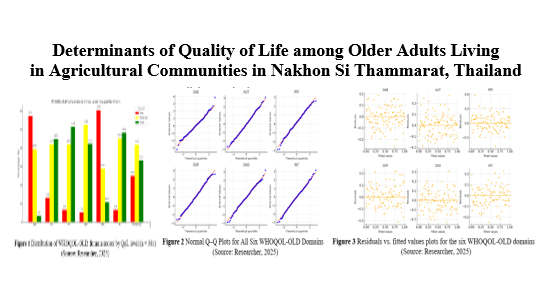
This cross-sectional analytical study examined the quality of life (QoL) and its associated determinants among 381 older adults residing in agricultural communities in Nakhon Si Thammarat, Thailand, using the WHOQOL-OLD instrument. The study aimed to examine domain-specific patterns of QoL and to identify the sociodemographic, health, lifestyle, and psychosocial determinants associated with each WHOQOL-OLD domain in rural agricultural settings. Descriptive statistics were used to summarize participant characteristics, and multivariate linear regression models were applied to determine the independent predictors of each QoL domain.
The sample was predominantly female (51.40%), with most participants aged 60–69 years (57.70%) and 79.00% reporting at least one chronic illness. Poor QoL was most prevalent in the Sensory Abilities (57.22%) and Death and Dying (60.37%) domains, reflecting age-related sensory decline and heightened mortality concerns common in agricultural environments. In contrast, higher levels of good QoL were observed in Past–Present–Future Activities (51.44%) and Intimacy (48.29%), highlighting strong engagement in meaningful roles and close social bonds. Regression analyses indicated that sociodemographic factors (higher education and income), health factors (absence of chronic illness), lifestyle factors (regular physical activity and adequate sleep of 7–8 hours), and psychosocial factors (strong family relationships) were significantly associated with multiple QoL domains. Chronic illness emerged as a strong negative predictor, particularly in the Sensory Abilities, Social Participation, and Death and Dying domains. These findings demonstrate the multidimensional influence of sociodemographic, health, lifestyle, and psychosocial determinants on the well-being of older adults.
This study contributes new knowledge by applying the WHOQOL-OLD framework within agricultural communities, a population underrepresented in aging research. The findings highlight key modifiable factors influencing domain-specific QoL and offer practical implications for community health planning, chronic disease management, and family-centered support strategies to promote healthy and meaningful aging in rural agricultural settings.
Downloads
References
Abdul Mutalip, M. H., Abdul Rahim, F. A., Mohamed Haris, H., Yoep, N., Mahmud, A. F., Salleh, R., Lodz, N. A., Sooryanarayana, R., Tan, M. P., & Ahmad, N. A. (2020). Quality of life and its associated factors among older persons in Malaysia. Geriatrics & Gerontology International, 20(2), 92–97. https://doi.org/10.1111/ggi.13961
Adhikari, R., Shah, R., Ghimire, K., Khanal, B., Baral, S., Adhikari, A., Malla, D. K., & Khanal, V. (2025). The quality of life and associated factors among older adults in central Nepal: A cross-sectional study using the WHOQOL-OLD tool. International Journal of Environmental Research and Public Health, 22(5), 693. https://doi.org/10.3390/ijerph22050693
Anantanasuwong, D. (2021). Population ageing in Thailand: Critical issues in the twenty-first century. In Education for the Elderly in the Asia Pacific (pp. 31-56). Springer Nature Singapore. https://doi.org/10.1007/978-981-16-3326-3_3
Angel, J. L., Markides, K. S., Torres-Gil, F. M., & Vega, W. A. (2024). Aging and health in the Americas: Past, present and future research on the US Hispanic and Mexican populations. In Older Mexicans and Latinos in the United States: Where worlds meet (pp. 3-24). Springer International Publishing.
Aung, T. N. N., Moolphate, S., Koyanagi, Y., Angkurawaranon, C., Supakankunti, S., Yuasa, M., & Aung, M. N. (2022). Determinants of health-related quality of life among community-dwelling Thai older adults in Chiang Mai, Northern Thailand. Risk Management and Healthcare Policy, 15, 1761-1774. https://doi.org/10.2147/rmhp.s370353
Baird, I. G. (2025). Heritage alcohol in Laos: Complex contradictions. In Hooch and Hard Liquor in East Asia (pp. 175-199). Routledge.
Bashir, T., Akhouri, D., Afroj, S., Khan, K. A., & Hamza, H. (2025). Lifelong learning: Demographic trends and economic participation in older adults. In Perspectives on the Economics of Aging (pp. 21-48). IGI Global Scientific Publishing. https://doi.org/10.4018/979-8-3693-7753-6.ch002
Beridze, G., Ayala, A., Ribeiro, O., Fernández-Mayoralas, G., Rodríguez-Blázquez, C., Rodríguez-Rodríguez, V., Rojo-Pérez, F., Forjaz, M. J., & Calderón-Larrañaga, A. (2020). Are loneliness and social isolation associated with quality of life in older adults? Insights from Northern and Southern Europe. International Journal of Environmental Research and Public Health, 17(22), 8637. https://doi.org/10.3390/ijerph17228637
Dai, H., Sun, C., Chen, J., Zhou, X., Li, H., Martin, P., & Zhang, Q. (2024). The mediating effect of eHealth literacy on the relationship between health personality and quality of life in community-dwelling older adults. Geriatric Nursing, 56, 237–243. https://doi.org/10.1016/j.gerinurse.2024.02.002
Department of Older Persons. (2025). Statistics of the Thai older persons 2025. Ministry of Social Development and Human Security. https://www.dop.go.th/
Eser, E., Bilgin Şahin, B., & Eser, S. (2022). Normative and psychometric properties of the WHOQOL older adults module (WHOQOL-OLD) in the national repository. Turk Geriatri Dergisi, 25(4), 476-494. https://doi.org/10.31086/tjgeri.2022.306
Ghose, B., Huang, R., Etowa, J., & Tang, S. (2021). Social participation as a predictor of morbid thoughts and suicidal ideation among the elderly population: A cross-sectional study on four low-middle-income countries. Psychiatry International, 2(2), 169-179. https://doi.org/10.3390/psychiatryint2020013
Gomes, R. D. S., Barbosa, A. R., Meneghini, V., Confortin, S. C., d’Orsi, E., & Rech, C. R. (2020). Association between chronic diseases, multimorbidity and insufficient physical activity among older adults in southern Brazil: A cross-sectional study. Sao Paulo Medical Journal, 138(6), 545-553. https://doi.org/10.1590/1516-3180.2020.0282.r1.15092020
Hajek, A., & König, H. H. (2022). Loneliness, perceived isolation and sleep quality in later life: Longitudinal evidence from a population-based German study. Archives of Gerontology and Geriatrics, 103, 104795. https://doi.org/10.1016/j.archger.2022.104795
Handajani, Y. S., Schröder-Butterfill, E., Hogervorst, E., Turana, Y., & Hengky, A. (2022). Functional dependency and its associated factors among older adults in Indonesia. Aging Medicine and Healthcare, 14(3), 146-155. https://doi.org/10.33879/amh.143.2022.05051
Jantapo, A., & Kusoom, W. (2021). Lifestyle and cultural factors related to longevity among older adults in the Northeast of Thailand. Journal of Transcultural Nursing, 32(3), 248-255. https://doi.org/10.1177/1043659620921225
Jeon, H. O. (2020). Correlation of physical, psychological, and functional factors with independent medication adherence in Korean older adults with chronic illness: Using the 2017 national survey of older Koreans. Archives of Gerontology and Geriatrics, 90, 104130. https://doi.org/10.1016/j.archger.2020.104130
Kangwanrattanakul, K. (2025). Validation of the Thai World Health Organization Quality of Life-OLD (WHOQOL-OLD) among Thai older adults: Rasch analysis. Scientific Reports, 15(1), 12978. https://doi.org/10.1038/s41598-025-97824-4
Keil, S. A., Schindler, A. G., Wang, M. X., Piantino, J., Silbert, L. C., Elliott, J. E., Werhane, M. L., Thomas, R. G., Willis, S., Lim, M. M., & Iliff, J. J. (2023). Longitudinal sleep patterns and cognitive impairment in older adults. JAMA Network Open, 6(12), e2346006. https://doi.org/10.1001/jamanetworkopen.2023.46006
Komalasari, D. R., Jalayondeja, C., Jalayondeja, W., & Romadon, Y. A. (2025). Predictors of quality of life among older residents in rural and urban areas in Indonesia: An approach using the international classification of functioning, disability, and health. Journal of Preventive Medicine and Public Health, 58(2), 199-207. https://doi.org/10.3961/jpmph.24.423
Kumar, S., Gundi, M., Atre, S., Bich Ngoc, L., Nguyen, T. T., & Rammohan, A. (2023). Alcohol consumption among adults in Vietnam: Prevalence, patterns, and its determinants. Journal of Substance Use, 28(1), 57-65. https://doi.org/10.1080/14659891.2021.2006343
Li, S., Spector, J. T., Choi, S. D., Zhao, M., Scott, E., Germain, C. M., & Zhang, K. (2025). Health, safety, and aging in elderly farmers in the United States and beyond: A systematic scoping review. Journal of Agromedicine, 30(4), 812-832. https://doi.org/10.1080/1059924X.2025.2539127
Lin, J. P., Yu, C. W., & Huang, C. H. (2021). Intergenerational family relationships and their impact on preferences for meeting future care needs among middle-aged and older adults in Taiwan. In Aging Families in Chinese Society (pp. 234-250). Routledge. https://doi.org/10.4324/9781003015529-12
Nouri, F., Feizi, A., Mohammadifard, N., & Sarrafzadegan, N. (2018). Methods of sampling and sample size determination of a comprehensive integrated community-based interventional trial: Isfahan Healthy Heart Program. ARYA Atherosclerosis, 14(2), 58-70. https://pmc.ncbi.nlm.nih.gov/articles/PMC6087631/
Nutley, A. (2025). Assessing the impact of environmental satisfaction on the quality of life of elderly residents in a rural village of northern Thailand. Journal of Urban Design, 31, 154-178. https://doi.org/10.1080/13574809.2025.2486045
Phulkerd, S., Thapsuwan, S., Chamratrithirong, A., & Gray, R. S. (2021). Influence of healthy lifestyle behaviors on life satisfaction in the aging population of Thailand: A national population-based survey. BMC Public Health, 21(1), 43. https://doi.org/10.1186/s12889-020-10032-9
Power, M., Quinn, K., & Schmidt, S. (2005). Development of the WHOQOL-OLD module. Quality of Life Research, 14, 2197-2214. https://doi.org/10.1007/s11136-005-7380-9
Provincial Social Development and Human Security Office, Nakhon Si Thammarat. (2024). Social situation report of Nakhon Si Thammarat Province 2024. https://nakhonsithammarat.m-society.go.th/
Punaglom, N., & Dumrongpakapakorn, P. (2025). Exploration of spiritual healing practices and cultural beliefs of grieving parents after child loss: A qualitative study in Northeastern Thailand. Pacific Rim International Journal of Nursing Research, 29(1), 44-57. https://doi.org/10.60099/prijnr.2025.270478
Rolin, K. S. (Ed.). (2024). Evidence-based assessment of the older adult. In Evidence-Based Physical Examination: Best Practices for Health and Well-Being Assessment (p. 95). Springer Publishing. https://doi.org/10.1891/9780826155320
Saadeh, M., Welmer, A. K., Dekhtyar, S., Fratiglioni, L., & Calderón-Larrañaga, A. (2020). The role of psychological and social well-being on physical function trajectories in older adults. The Journals of Gerontology: Series A, 75(8), 1579-1585. https://doi.org/10.1093/gerona/glaa114
Sapbruangthong, L., Subruangthong, S., & Somwang, K. (2025). Quality of life of elderly farmers in Chainat Province: An analysis using United Nations quality of life indicators. Rajapark Journal, 19(65), 284-298. https://so05.tci-thaijo.org/index.php/RJPJ/article/view/283067
Senkrua, A. (2025). Determinants of self-reported health among older adults in Thailand. Journal of Business, Innovation and Sustainability (JBIS), 20(1), 113-128. https://doi.org/10.71185/jbis.2025.274043
Shukla, K., Patil, Y. B., Estoque, R. C., & López de Haro, P. A. (Eds.). (2024). Quality of life and climate change: Impacts, sustainable adaptation, and social-ecological resilience. IGI Global. https://doi.org/10.4018/978-1-6684-9863-7
Su, Y., Liu, M. S., De Silva, P. V., Østbye, T., & Jin, K. Z. (2021). Health-related quality of life in Chinese workers: A systematic review and meta-analysis. Global Health Research and Policy, 6(1), 29. https://doi.org/10.1186/s41256-021-00209-z
Tay, E. H., Koh, Y. S., Vaingankar, J. A., Abdin, E., Sambasivam, R., Zhang, Y., Shafie, S., & Subramaniam, M. (2024). Association between sleep quality and quality of life in Singapore. Quality of Life Research, 33, 1707–1717. https://doi.org/10.1007/s11136-024-03621-3
Teerawichitchainan, B. (2020). Older persons in Thailand: An update from a recent national survey. Asian Population Studies, 16(3), 243-247. https://doi.org/10.1080/17441730.2020.1794311
Tran, N. Q. L., Nghiem, S., Chu, C., Luong, M. A., Ho, T. T., & Phung, D. (2023). The prevalence of heat-related illnesses and associated factors among rice farmers in Vietnam. Journal of Agromedicine, 28(3), 486-496. https://doi.org/10.1080/1059924x.2022.2154086
Tsubouchi, Y., Yorozuya, K., Tainosyo, A., & Naito, Y. (2021). A conceptual analysis of older adults’ empowerment in contemporary Japanese culture. BMC Geriatrics, 21, 672. https://doi.org/10.1186/s12877-021-02631-x
United Nations. (2025). World Population Prospects 2025: Summary of results. Department of Economic and Social Affairs, Population Division. https://population.un.org/wpp/
World Health Organization. (2006). WHOQOL-OLD manual (English version). https://www.ufrgs.br/qualidep/images/Whoqol-OLD/WHOQOL-OLD_manual_Ingles.pdf
Yamane, T. (1967). Statistics: An introductory analysis. (2nd ed.). Harper & Row.
Yodmai, K., Somrongthong, R., Nanthamongkolchai, S., & Suksatan, W. (2021). Effects of the older family network program on improving quality of life among older adults in Thailand. Journal of Multidisciplinary Healthcare, 14, 1373-1383. https://doi.org/10.2147/jmdh.s315775
Zubiashvili, T., & Zubiashvili, N. (2021). Population aging—a global challenge. Ecoforum Journal, 10(2), 1-7. https://ecoforumjournal.ro/index.php/eco/article/view/1775
Downloads
Published
How to Cite
Issue
Section
Categories
License
Copyright (c) 2026 Community and Social Development Journal

This work is licensed under a Creative Commons Attribution-NonCommercial-NoDerivatives 4.0 International License.
1. Articles, information, content, images, etc published in the “Community and Social Development Journal” are copyrighted by the Community and Social Development Journal, Chiang Mai Rajabhat University. In order to properly distribute the articles through print and electronic media, the authors still hold the copyright for the published articles under the Creative Commons Attribution (CC BY) license, which allows the re-distribution of the articles in other sources. References must be made to the articles in the journal. The authors are responsible for requesting permission to reproduce copyrighted content from other sources.
2. The content of the articles appearing in the journal is the direct responsibility of the article authors. The editorial board of the journal does not necessarily agree with or share any responsibility.