
What Challenges and Opportunities Shape Tourism Development in China?
DOI:
https://doi.org/10.57260/csdj.2026.286624Keywords:
Sustainable tourism development, Tourism governance, Tourism digitization, China, Qualitative researchAbstract
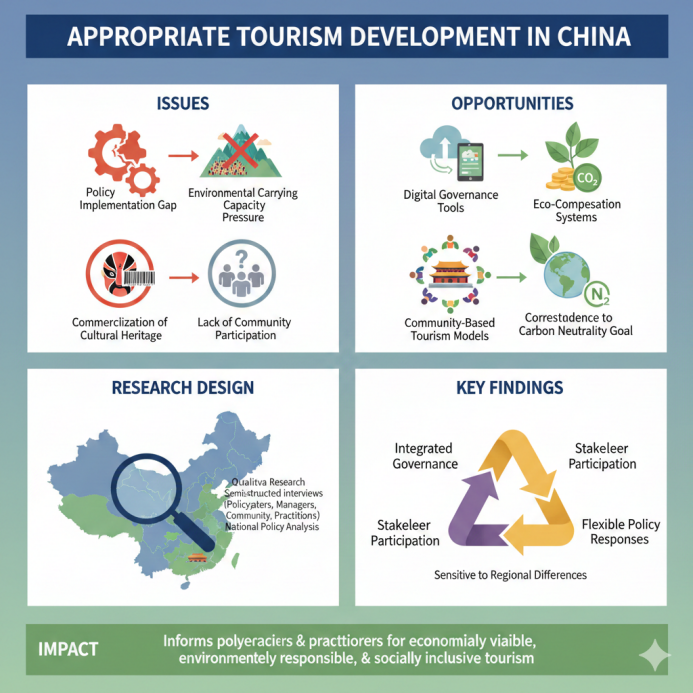
Sustainable tourism development has become a strategic agenda in China as the nation tries to strike a balance between economic growth and environmental and cultural conservation as well as social equity. This study examines the key challenges and emerging opportunities for achieving appropriate and sustainable tourism development in China. Semi-structured interviews were conducted with tourism policymakers, destination managers, community representatives, and tourism practitioners. Additionally, analysis of national tourism policies and sustainability frameworks was supplemented to explain what institutional and socio-cultural factors shaping tourism governance. The results indicate that there are four issues that are interdependent and connected: 1) A gap in policy implementation; 2) The pressure of carrying capacity of the environment; 3) The lack of participation of the community; and 4) Commercialization of cultural heritage. Although there is a high level of dedication at the central level to sustainability, the enforcement at the local level is not consistent because of economic pressures and fragmented governance. Nonetheless, the paper also reveals some emerging opportunities such as digital governance tools, eco-compensation systems and models of community-based tourism and its correspondence to the goal of carbon neutrality in China. In practice, the results inform policy makers and practitioners who want to improve the progress of economically viable, environmentally responsible, and socially inclusive tourism development in rapidly changing China.
Downloads
References
Bowen, G. A. (2009). Document analysis as a qualitative research method. Qualitative Research Journal, 9(2), 27–40. https://doi.org/10.3316/QRJ0902027
Braun, V., & Clarke, V. (2021). Thematic analysis: A practical guide. SAGE Publications.
Wei, Xiurong, Pu, Pian., Cheng, Li., Jiang, Haiyue., & Liu, Yong. (2024). Ethnic community’s perception of benefit-sharing and participation intentions in national park tourism in China: An asymmetric modeling approach. Ecological Indicators, 166, 112257. https://doi.org/10.1016/j.ecolind.2024.112257
Creswell, J. W., & Poth, C. N. (2021). Qualitative inquiry and research design: Choosing among five approaches. (4th ed.). SAGE Publications.
Dodds, R., & Butler, R. (2019). The phenomena of overtourism: A review. International Journal of Tourism Cities, 5(4), 519–528. https://doi.org/10.1108/IJTC-06-2019-0090
Fei, G., & Luo, D. (2024). Research on environmentally responsible tourism in China from the perspective of sustainable development. Science of Law Journal, 3(1), 107-111. https://doi.org/10.23977/law.2024.030117
Gretzel, U., Sigala, M., Xiang, Z., & Koo, C. (2015). Smart Tourism: Foundations and Developments. Electronic Markets, 25, 179-188.
https://doi.org/10.1007/s12525-015-0196-8
Guest, G., Namey, E., & Chen, M. (2020). A simple method to assess and report thematic saturation in qualitative research. . PLoS One, 15(5), e0232076. https://doi.org/10.1371/journal.pone.0232076
Joseph, E. K. (2025). Planning sustainable futures: Critical drivers of success in the global context. Discover Sustainability, 6, 399. https://doi.org/10.1007/s43621-025-01126-8
Khalid, S., Ahmad, M. S., Ramayah, T., Hwang, J., & Kim, I. (2019). Community Empowerment and Sustainable Tourism Development: The Mediating Role of Community Support for Tourism. Sustainability, 11(22), 6248. https://doi.org/10.3390/su11226248
Korstjens, I., & Moser, A. (2017). Series: Practical guidance to qualitative research. Part 4: Trustworthiness and publishing. European Journal of General Practice, 24(1), 120–124. https://doi.org/10.1080/13814788.2017.1375092
Li, H., Chen, J. L., Li, Gang., & Goh, Carey. (2016). Tourism and regional income inequality: Evidence from China. Annals of Tourism Research, 58, 81–99. https://doi.org/10.1016/j.annals.2016.02.001
Li, M., Liu, T., & Qui, S. (2020). Governance of Sustainable Tourism Development in China. Journal of China Tourism Research, 16(2), 261–278. https://doi.org/10.1080/19388160.2020.1869354
Li, N., Mohd Ariffin, S. Z., & Gao, H. (2024). Optimizing Ecotourism in North Taihu Lake, Wuxi City, China: Integrating Back Propagation Neural Networks and Ant-Colony Algorithm for Sustainable Route Planning. International Journal of Management Thinking, 2(1), 1–15. https://doi.org/10.56868/ijmt.v2i1.53
Lincoln, Y. S., & Guba, E. G. (1985). Naturalistic inquiry. Sage Publications.
Ljubisavljević, T., Vujko, A., Arsić, M., & Mirčetić, V. (2025). Digital twins in smart tourist destinations: Addressing overtourism, sustainability, and governance challenges. World, 6(4), 148. https://doi.org/10.3390/world6040148
Mina, Z., & Hussin, R. (2024). Exploring the Evolution of Wuhu Iron Painting through Cultural and Tourism Integration in the Digital Age: An Innovative Development Perspective. Journal of Advances in Humanities Research, 3(1), 1–21. https://doi.org/10.56868/jadhur.v3i1.198
Parra-Sanchez, D, T., & Viviescas-Jaimes, P. A. (2024). Application of digital technologies in nature-based tourism: A scientometric analysis. Journal of Digital Economy, 3, 249–259. https://doi.org/10.1016/j.jdec.2025.05.003
Signé, L. (2025). Foresight Africa 2025–2030: Top priorities for Africa 2025–2030. Brookings Institution. https://www.brookings.edu/collection/foresight-africa-2025-2030/
Suriyankietkaew, S., Krittayaruangroj, K., Thinthan, S., & Lumlongrut, S. (2025). Creative tourism as a driver for sustainable development: A model for advancing SDGs through community-based tourism and environmental stewardship. Environmental and Sustainability Indicators, 27, 100828. https://doi.org/10.1016/j.indic.2025.100828
The State Council of the People’s Republic of China. (2024). Zones aim to integrate culture, tourism. https://english.www.gov.cn/policies/policywatch/202401/24/content_WS65b084bec6d0868f4e8e36f7.html
The State Council of the People’s Republic of China. (2025). China rolls out measures to boost cultural, tourism consumption. https://english.www.gov.cn/policies/latestreleases/202501/14/content_WS67859caac6d0868f4e8eeca2.html
Wang, S., & Zhang, H. (2024). Inter-organizational cooperation in digital green supply chains: A catalyst for eco-innovations and sustainable business practices. Journal of Cleaner Production, 472, 143383. https://doi.org/10.1016/j.jclepro.2024.143383
Wang, S., & Zhang, H. (2025). Enhancing environmental, social, and governance performance through artificial intelligence supply chains in the energy industry: Roles of innovation, collaboration, and proactive sustainability strategy. Renewable Energy, 245, 122855. https://doi.org/10.1016/j.renene.2025.122855
Wu, X., & Liang, X. (2023) .Tourism development level and tourism eco-efficiency: Exploring the role of environmental regulations in sustainable development. Sustainable Development, 31(4), 2863-2873. https://doi.org/10.1002/sd.2555
Xu, H., & Sofield, T. (2016). Sustainability in Chinese development tourism policies. Current Issues in Tourism, 19(13), 1337-1355. https://doi.org/10.1080/13683500.2013.849665
Yang, L., Hu, X., Lee, H., & Zhang, Y. (2023). The impacts of ecotourists’ perceived authenticity and perceived values on their behaviors: Evidence from Huangshan World Natural and Cultural Heritage Site. Sustainability, 15(2), 1551. https://doi.org/10.3390/su15021551
Zhang, Y., Xiao, X., Zheng, C., Xue, L., Guo, Y., & Wu, Q. (2020). Is tourism participation in protected areas the best livelihood strategy from the perspective of community development and environmental protection? Journal of Sustainable Tourism, 28(4), 587–605. https://doi.org/10.1080/09669582.2019.1691566
Zhao, Y., Liu, H., Yin, Z., & Zou, J. (2024). Perceived authenticity and place attachment among mountain tourists: A case study exploration in the Gaoligong Mountain in Southwest China. International Journal of Business Anthropology, 14(2). https://doi.org/10.33423/ijba.v14i2.7479
Zheng, T., Yu, J., Cheng, Q., & Pan, H. (2023). The influence mechanism and measurement of tourists’ authenticity perception on the sustainable development of rural tourism—A study based on the 10 most popular rural tourism destinations in China. Sustainability, 15(2), 1454. https://doi.org/10.3390/su15021454
Downloads
Published
How to Cite
Issue
Section
Categories
License
Copyright (c) 2026 Community and Social Development Journal

This work is licensed under a Creative Commons Attribution-NonCommercial-NoDerivatives 4.0 International License.
1. Articles, information, content, images, etc published in the “Community and Social Development Journal” are copyrighted by the Community and Social Development Journal, Chiang Mai Rajabhat University. In order to properly distribute the articles through print and electronic media, the authors still hold the copyright for the published articles under the Creative Commons Attribution (CC BY) license, which allows the re-distribution of the articles in other sources. References must be made to the articles in the journal. The authors are responsible for requesting permission to reproduce copyrighted content from other sources.
2. The content of the articles appearing in the journal is the direct responsibility of the article authors. The editorial board of the journal does not necessarily agree with or share any responsibility.