
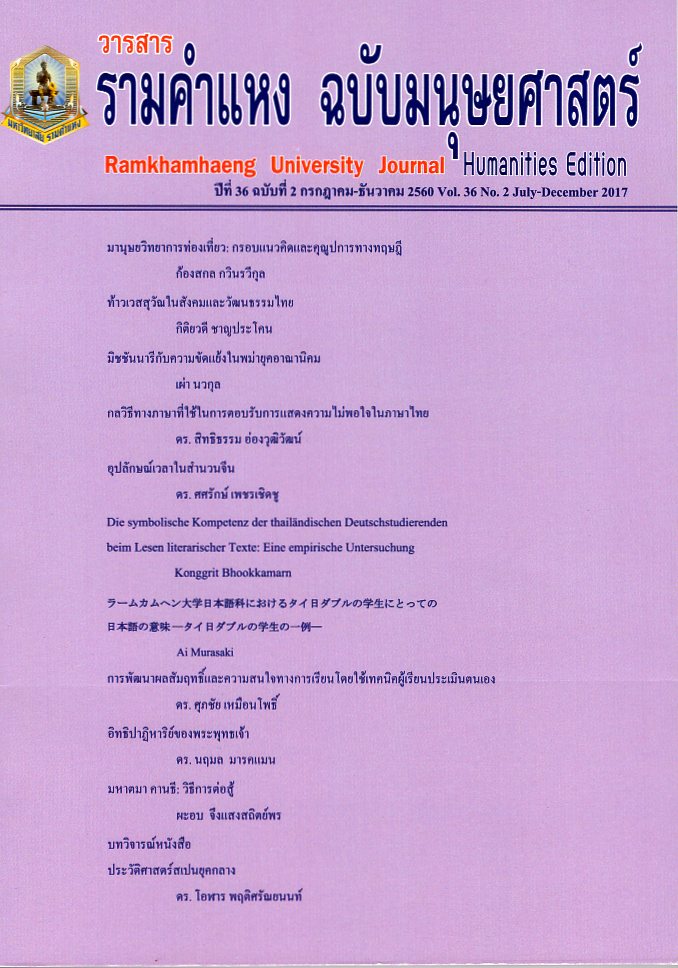
อุปลักษณ์เวลาในสำนวนจีน Time Metaphor in Chinese Idioms
Article Sidebar
Main Article Content
บทคัดย่อ
บทคัดย่อ
งานวิจัยนี้มีวัตถุประสงค์เพื่อศึกษาสำนวนจีนที่เกี่ยวกับเวลาและมโนอุปลักษณ์เวลาในสำนวนจีน จากการวิเคราะห์สำนวนที่เกี่ยวกับเวลาจำนวน 165 สำนวนพบว่า สำนวนจีนที่เกี่ยวกับเวลาสามารถแบ่งออกได้เป็นสำนวนที่มีนัยว่าระยะเวลายาวนาน ระยะเวลาสั้น เวลาผ่านไปเร็ว เวลาผ่านไปช้า ช่วงเวลาเช้าและค่ำ คุณค่าของเวลา โอกาสที่หาได้ยาก การไขว่คว้าโอกาสที่มาถึง กาลเวลาเปลี่ยนไป เวลาไม่พอเพียงและเวลาผ่านไปอย่างไร้ค่ารวมทั้งสิ้น 11 ประเภทหลัก
จากการวิเคราะห์มโนอุปลักษณ์ในสำนวนจีนที่เกี่ยวกับเวลาพบว่าสามารถแบ่งออกได้เป็น 4 มโนอุปลักษณ์ ได้แก่ [เวลาคือธรรมชาติและปรากฏการณ์ธรรมชาติ] [ เวลาคือของมีค่า] [เวลาคือมนุษย์] และ[เวลาคือสัตว์] มโนอุปลักษณ์ดังกล่าวได้สะท้อนมุมมองเกี่ยวกับเวลาว่า (1) เวลาเป็นสิ่งที่มีค่าและมีอย่างไม่จำกัด (2) เวลาไม่หยุดนิ่ง และผ่านไปอย่างรวดเร็ว และ (3) เวลาที่ผ่านแล้วไม่อาจย้อนคืนมา ดังนั้นควรไขว่คว้าโอกาสที่มาถึงไว้ให้ได้
Abstract
This research attempts to study Chinese idioms about time and to analyze TIME metaphors in Chinese idioms. By analyzing 165 Chinese idioms about time, it can be categorized them into 11 groups namely the idioms indicating a long period of time, a short period of time, a quick passage of time, a slow passage of time, the periods of morning and evening, value of time, rare opportunities, opportunities of usage, time change, insufficient time and a waste of time.
By examining conceptual metaphors in Chinese idioms about time, it can be categorized them into four namely: [Time is nature and natural phenomenon] [Time is precious] [Time is human ] and [ Time is animals]. These conceptual metaphors reflect 3 aspects of time including: (1) time is unlimited, but valuable, (2) time does not stop and pass quickly, and (3) the past time cannot come back, so be sure to get the chance to come.
Article Details

อนุญาตภายใต้เงื่อนไข Creative Commons Attribution-NonCommercial-NoDerivatives 4.0 International License.
ประกาศลิขสิทธิ์จะปรากฏในเกี่ยวกับวารสาร ควรอธิบายสำหรับผู้อ่านและผู้เขียนว่าเจ้าของลิขสิทธิ์เป็นผู้เขียนวารสารหรือบุคคลที่สาม ควรรวมถึงข้อตกลงการอนุญาตเพิ่มเติม (เช่นใบอนุญาตครีเอทีฟคอมมอนส์) ที่ให้สิทธิ์แก่ผู้อ่าน (ดูตัวอย่าง) และควรให้วิธีการรักษาความปลอดภัยหากจำเป็นสำหรับการใช้เนื้อหาของวารสาร
