
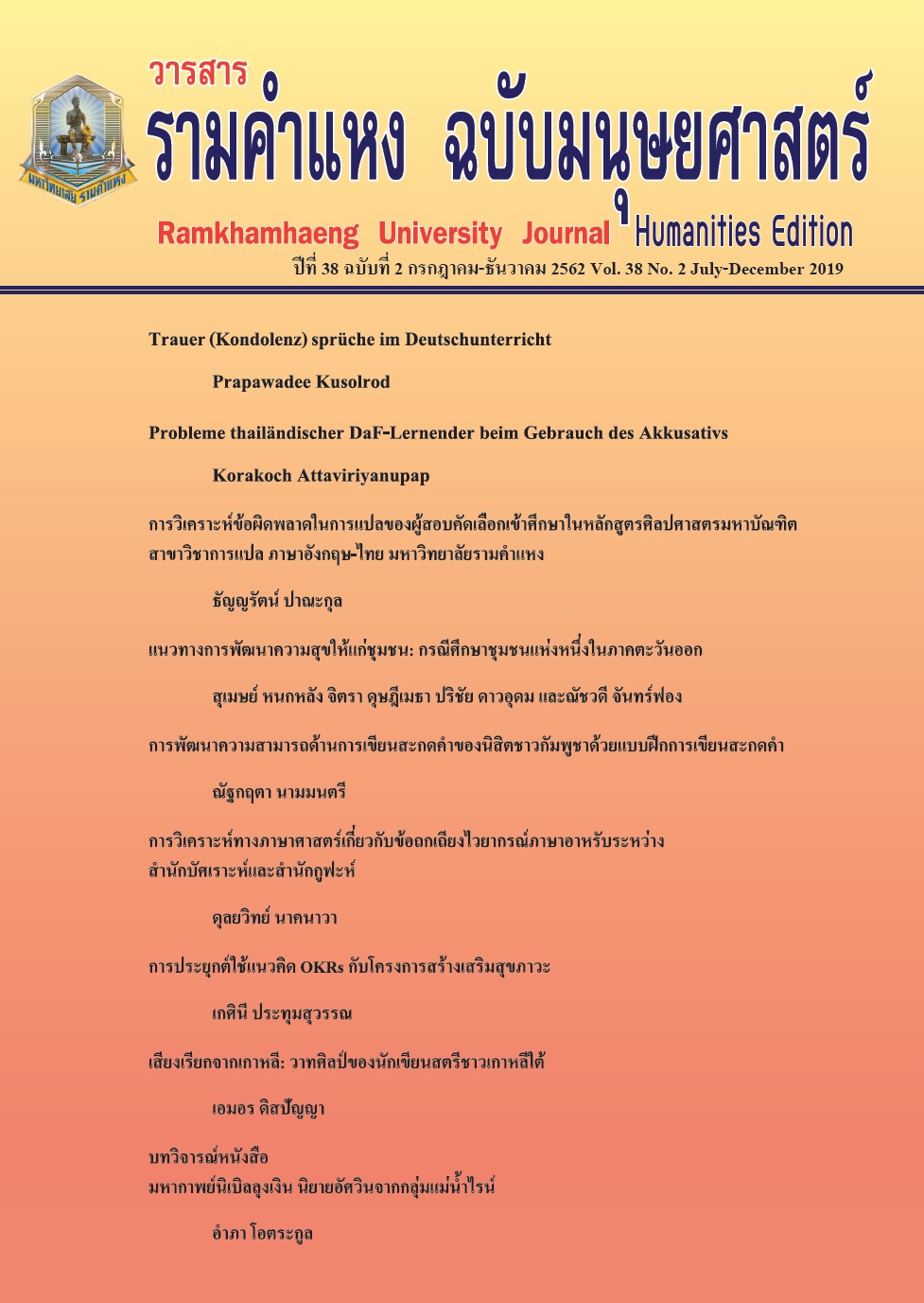
Thai GFL-Lerners’ Problems of Accusative Usage
Article Sidebar
Main Article Content
Abstract
Abstract
The use of four cases (nominative, accusative, dative and genitive) belongs to major difficulties of Thai learners of German since case does not exist as a grammatical category in Thai. Accusative errors made by Thai students of German as a Foreign Language appear most frequently. Thus, this paper focuses on the errors related to this specific case in German. 80 essays written by Thai students from two different classes (A2 and B1 levels) to retell a German short film are analyzed in two main aspects: accusative errors related to verbs and accusative errors related to prepositions. The objective of this study is to see how these errors can be categorized and which factors can influence the use of the accusative case by Thai learners. It is found that among the 190 analyzed accusative errors, the biggest group is the use of dative instead of accusative after the so-called two-way prepositions (Wechselpräpositionen) which require either accusative or dative depending on the context. Regarding verb-related errors, it is found that the overuse of nominative case instead of the accusative is the most frequent type of errors. The results of this error analysis also show that the spatial concept and the transitivity of verbs play an important role in the choice of case assigned to nouns in the perception of Thai learners of German as a Foreign Language.
Article Details

This work is licensed under a Creative Commons Attribution-NonCommercial-NoDerivatives 4.0 International License.
The Copyright Notice will appear in About the Journal. It should describe for readers and authors whether the copyright holder is the author, journal, or a third party. It should include additional licensing agreements (e.g. Creative Commons licenses) that grant rights to readers (see examples), and it should provide the means for securing permissions, if necessary, for the use of the journal's content.
