
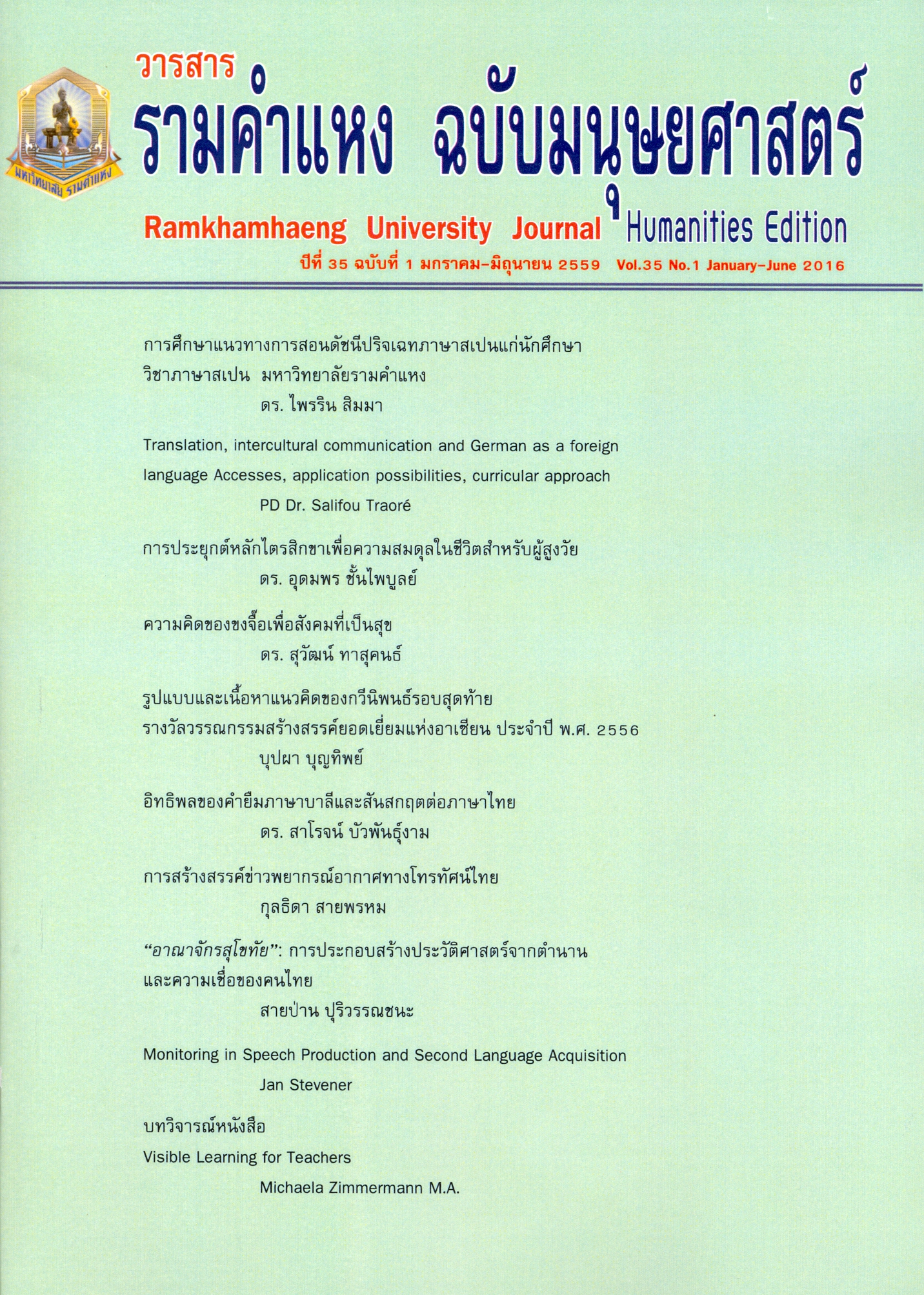
Monitoring in Speech Production and Second Language Acquisition การตรวจสอบในการผลิตคำพูดและการรับรู้ภาษาที่สอง
Article Sidebar
Main Article Content
Abstract
Abstract
This paper aims to understand the cognitive process of monitoring which is considered crucial to language production and second language acquisition. Levelt (1989), incorporating previous work from Krashen (1982) and others, made the monitor an essential part of his speech production model. His concept of the monitor saw its basic function in checking the pre-verbal and verbal language output; in case a speech error is detected the monitor would immediately stop language production processes and go back to a previous step in the language production process. Other influential models also assume monitors (MacKay, 1987; Levelt, 1989; Schade, 1999). Newer research, however, shows that the role of monitoring processes is far more complex and that in learners with more advanced language skills and a higher degree of automaticity the monitor will make more covert repairs.
บทคัดย่อ
บทความชิ้นนี้มุ่งเน้นศึกษากระบวนการทางปัญญาในการตรวจสอบ ซึ่งถือว่ามีความสำคัญอย่างยิ่งในการผลิตภาษาและการรับรู้ภาษา Levelt (1989) ซึ่งรับแนวความคิดที่ปรากฏมาก่อนของ Krashen (1982) และของนักวิจัยคนอื่น ๆ ได้ยกให้การตรวจสอบ (monitor) เป็นส่วนสำคัญส่วนหนึ่งของทฤษฎีการผลิตคำพูดของเขา หน้าที่พื้นฐานของการตรวจสอบตามแนวความคิดของ Levelt ก็คือ การตรวจสอบภาษาก่อนและระหว่างการพูด เมื่อพบข้อผิดพลาด ระบบการตรวจสอบก็จะหยุดกระบวนการการผลิตภาษาทันทีและจะกลับไปยังขั้นตอนก่อนหน้านั้นในกระบวนการการผลิตภาษา ทฤษฎีที่มีอิทธิพลอื่น ๆ ก็ยอมรับแนวความคิดเกี่ยวกับการตรวจสอบด้วยเช่นกัน (MacKay, 1987; Levelt, 1989; Schade, 1999) อย่างไรก็ตาม ผลงานวิจัยชิ้นใหม่แสดงให้เห็นว่าบทบาทของกระบวนการการตรวจสอบซับซ้อนกว่านั้นมาก และสำหรับผู้เรียนที่มีทักษะ ทางภาษาขั้นสูงและมีการผลิตคำพูดโดยอัตโนมัติอยู่ในระดับสูงขึ้นไป ระบบการตรวจสอบจะทำการแก้ไขอย่างแอบแฝงมากขึ้น
Article Details

This work is licensed under a Creative Commons Attribution-NonCommercial-NoDerivatives 4.0 International License.
The Copyright Notice will appear in About the Journal. It should describe for readers and authors whether the copyright holder is the author, journal, or a third party. It should include additional licensing agreements (e.g. Creative Commons licenses) that grant rights to readers (see examples), and it should provide the means for securing permissions, if necessary, for the use of the journal's content.
