
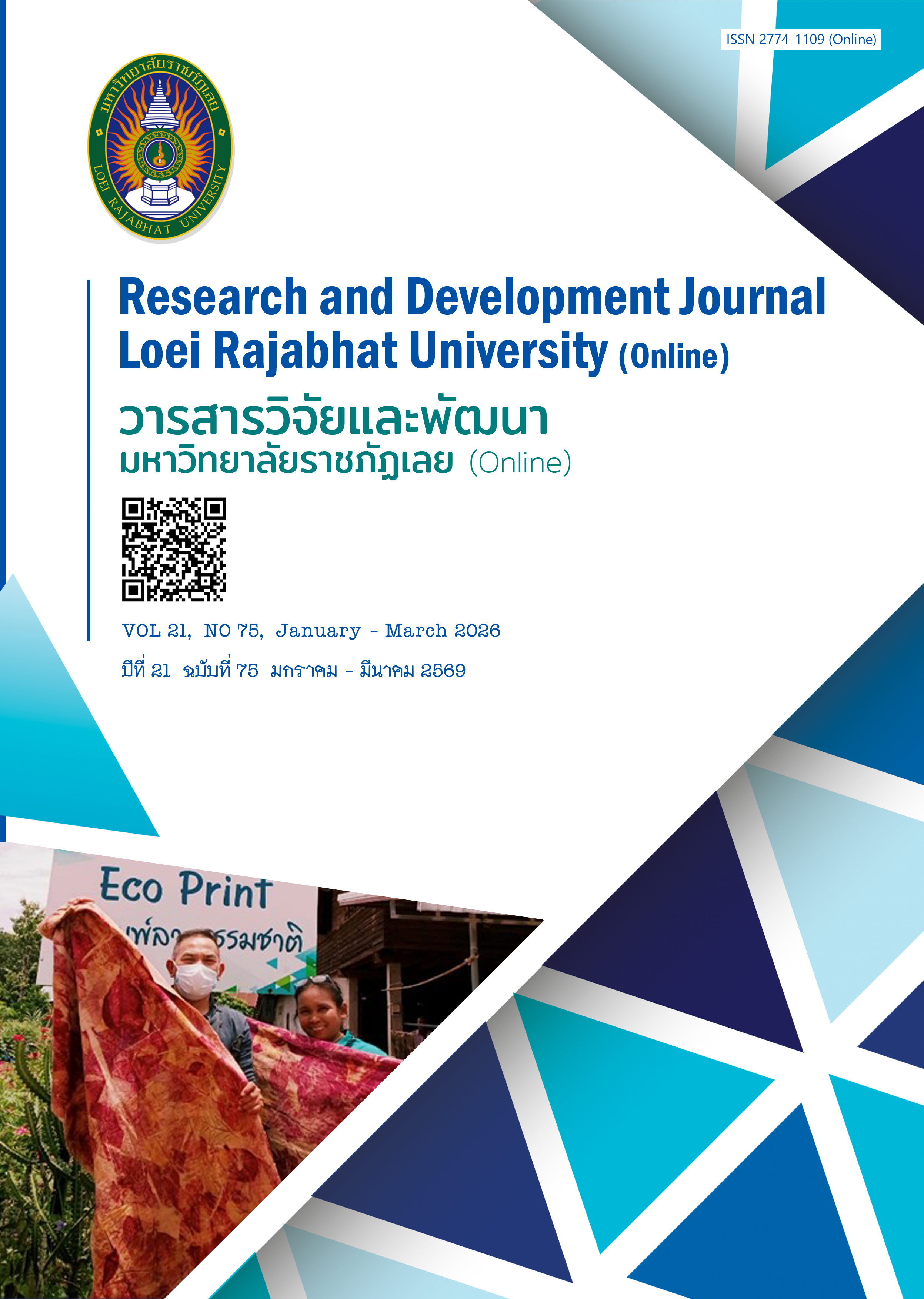
Pattern Creation from Local Plants Using Eco-printing Techniques and Product Development for the Indigenous Woven Textiles of Ban Nong Bua Community, Phu Ho Subdistrict, Phu Luang District, Loei Province
DOI:
https://doi.org/10.14456/lruj.2026.1Keywords:
pattern creation, Eco-printing technique, design and development of community productsAbstract
This academic article aimed to study pattern creation from local plants using Eco-printing techniques and the development of products from the indigenous woven textiles of Ban Nong Bua community, Phu Ho Subdistrict, Phu Luang District, Loei Province, employing document analysis and participatory action research through field-based activities, with data analyzed using content analysis. The findings revealed that pattern creation via the Eco-printing technique utilized local plants such as teak leaves, Peka leaves, Kasalong leaves, Sa-Boo Daeng leaves, and eucalyptus leaves. The pattern creation was processed through the following steps: 1) fabric preparation by soaking in a mordant; 2) laying the fabric flat on a surface, stretching it evenly, then arranging the prepared leaves in a dispersed pattern across the fabric, with small, medium, and large leaves positioned appropriately and coherently; 3) covering the leaves with a suitably sized plastic sheet, rolling the bundle tightly, and securing it with plastic wrap; 4) steaming the rolled fabric in a steamer at 90 degrees Celsius for two hours; 5) removing the bundle from the steamer, unrolling it, removing all leaves, and air-drying the fabric in shade; and 6) soaking the dried fabric in a color-fixing solution for approximately 20 minutes before shade-drying it again. Regarding the design and development of products from Eco-printed fabric, it was divided into a six-step process: 1) defining the design and development objectives; 2) studying target group needs; 3) researching relevant information; 4) drafting and developing design prototypes; 5) experimenting with prototype product processing; and 6) critiquing and evaluating the community product prototypes.
Downloads
References
Banlengloi, W., Suungthuk, K., & Ladnongkhun, P. (2022). Clothing Design from Printed Fabric with Plants. Journal of Home Economics Technology and Innovation, 1(1), 32-42. https://li02.tci-thaijo.org/index.php/JHET/article/view/290.
Chombhuphan, R., & Ruangnarong, C. (2022). Eco-printing: The Study of Color Fixing Quality from Natural Raw Material and Natural Mordant. Art and Architecture Journal Naresuan University, 14(2), 1-10. https://so01.tci-thaijo.org/index.php/ajnu/article/view/249427/175488.
Darbyshire, I., Anderson, S., Asatryan, A., Byfield, A., Cheek, M., Clubbe, C., & Radford, E. A. (2017). Important Plant Areas: Revised Selection Criteria for a Global Approach to Plant Conservation. Biodiversity and Conservation, 26, 1767-1800. https://link.springer.com/article/10.1007/s10531-017-1336-6.
Intaraprasert, J. (2025). Botanical Printing. (In Thai). Ubon Ratchathani: Janpen Intaraprasert Printing.
Kang, X. (2020). Aesthetic Product Design Combining with Rough Set Theory and Fuzzy Quality Function Deployment. Journal of Intelligent & Fuzzy Systems, 39(1), 1–16. https://www.researchgate.net/publication/342321123_Aesthetic_product_design_combining_with_rough_set_theory_and_fuzzy_quality_function_deployment.
Keawpan, T., Itsaranuwat, S., & Plangnok, J. (2020). Principles and Concepts in Product Design. Journal of Humanities and Social Sciences, Surin Rajabhat University, 22(2), 161-182. https://so03.tci-thaijo.org/index.php/jhssrru/article/view/248733.
Lawongsa, K., Sangwanna, S., & Seelarat, V. (2022). The Study of Muntingia Calabura Leaves Dyed with Sappan for Natural Color with Color Transfer Technique on Cotton Fabric. Research and Development Journal Science and Technology, 17(3), 87-96. https://so06.tci-thaijo.org/index.php/vrurdistjournal/article/view/257863.
Phannaen. S. (2023). A Study of The Results of an Integrated Experience Arrangement on The Art of Printed Cloth with Colors and Patterns from Leaves of the First Year Students. Journal of Association of Professional Development of Educational Administration of Thailand, 5(2), 53-61. https://so04.tci-thaijo.org/index.php/JAPDEAT/article/view/265971.
Phoungmanee. T., Charoensuk, K. & Jaingamdee, P. (2023). Development of Community Product Design Based on Participation of Reed Woven Mat Community Enterprise Group of Ban Huay Tard, Na Dok Kham Sub-district, Na Duang district, Loei province. DEC Journal: Art and Design, 2(2), 12-45. https://so07.tci-thaijo.org/index.php/decorativeartsJournal/article/view/1806.
Rajamangala University of Technology Lanna, Chiang Rai. (2026, January 24). ECO Printing Training Course: Fabric Printing with Leaves. (In Thai). https://e-cms.rmutl.ac.th/assets/upload/files/2021/12/20211229141451_66828.pdf.
Rakprayoon, N., Chanchay, N., Nakprasom, N., & Veerasilp, K. (2024). Development Approach of Eco Print Fabric Products to Create an Identity of Ban Mae Lan Nuea Products and Handicrafts Community Enterprise, Phrae Province. RMUTL Journal Socially of Engaged Scholarship, 8(1), 77-86. https://so07.tci-thaijo.org/index.php/JsesRMUTL/issue/view/jses-08-01/487.
Saitep, K., & Permthai, P. (2017). Guideline for The Community Product Development for Export of Artificial Flowers Community Business Group at Mae Tha Sub-Distrist, Mae Tha District, Lampang Province. Journal of Modern Management Science, 10(2), 1-11. https://so03.tci-thaijo.org/index.php/JMMS/article/view/112133.
Sukung, S., Kerdkhong, C., Phadungphol, R., & Soenghern, W. (2026, January 24). Color of Leaves: From Leaves to Printed Patterns. (In Thai). http://clgc.agri.kps.ku.ac.th/research/poster/kps65/kukps2565-05.pdf.
Suwanthada, P., & Sikka, S. (2018). Community Product Design and Development Applying The Cultural Capital and Wisdom: in The Upper Northeastern Region. Art and Architecture Journal Naresuan University, 9(2), 137-155. https://so01.tci-thaijo.org/index.php/ajnu/article/view/163918.
Tanhakorn, T., & Chantuk, T. (2018). Success Factors for Creative Entrepreneurs in The Creative Economy. Veridian E - Journal, Silpakorn University, 11(1), 396-410. https://he02.tci-thaijo.org/index.php/Veridian-E-Journal/article/view/118555.
Wongsingtong, P. (2016). History of Industrial Design. (In Thai). Bangkok: Odeonstore.
Downloads
Published
How to Cite
Issue
Section
License
Copyright (c) 2026 Research and Development Journal, Loei Rajabhat University

This work is licensed under a Creative Commons Attribution-NonCommercial-NoDerivatives 4.0 International License.
ข้อความที่ปรากฎในวารสารฉบับนี้เป็นความคิดเห็นของผู้เขียนแต่ละท่าน สถาบันวิจัยและพัฒนา มหาวิทยาลัยราชภัฏเลย และกองบรรณาธิการ ไม่จำเป็นต้องเห็นด้วยและไม่มีส่วนรับผิดชอบใดๆ
สถาบันวิจัยและพัฒนา มหาวิทยาลัยราชภัฏเลย ขอให้ผู้อ่านอ้างอิงในกรณีที่ท่านคัดลอกเนื้อหาบทความในวารสารฉบับนี้



