Cooperative Strategies of Higher Education between Beijing and Thailand under the Ideology of the “Belt and Road Initiative”
DOI:
https://doi.org/10.57260/csdj.2025.275238Keywords:
Cooperative strategies, Higher education, Belt and road initiativeAbstract
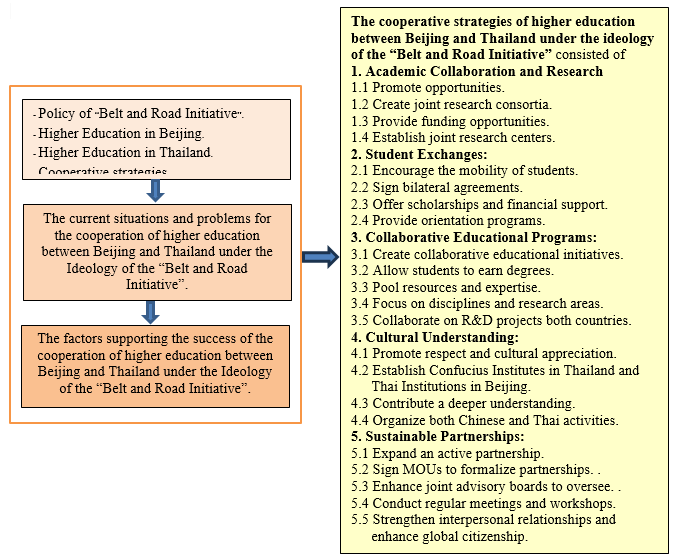
Beijing was usually greatly respected in Thailand and ensured the alliance of both countries. Thailand is one of the biggest promoters of Chinese language education in Southeast Asia. The objectives of this quality research were 1) to investigate the current situations and problems for the cooperation of higher education between Beijing and Thailand under the ideology of the “Belt and Road Initiative”; 2) to analyze factors supporting the success of the cooperation of higher education between Beijing and Thailand under the ideology of the “Belt and Road Initiative”; and 3) to develop the cooperative strategies of higher education between Beijing and Thailand under the ideology of the “Belt and Road Initiative”. The instruments used in this research were a semi-structured interview form, agenda questions for focus group discussion, and analysis issues for connoisseurship. Data were analyzed by content analysis, summarizing, and descriptive analysis. The results of the research revealed as follows: 1) The current situations and problems for the cooperation of higher education between Beijing and Thailand under the ideology of the “Belt and Road Initiative” consisted of nine issues as follows: 1.1) policy and government support; 1.2) cultural exchange and understanding; 1.3) academic collaboration and research; 1.4) student mobility and exchange programs; 1.5) quality assurance; 1.6) academic communication; 1.7) academic communication, and 1.8) sustainability of educational partnerships. 2) The factors supporting the success of the cooperation of higher education between Beijing and Thailand under the ideology of the “Belt and Road Initiative” consisted of four important agendas. 3) The cooperative strategies of higher education between Beijing and Thailand under the ideology of the “Belt and Road Initiative” consisted of one vision, five missions, one goal, and five strategies with twenty-two measures.
Downloads
References
ASEM Education Secretariat. (2023). Consult Compendium. Retrieved from https://asem-education.org/compendiums/thailand/
Chen, K. (2019). On Chinese Education in Thailand in Context of “one belt and one road”: Some Problems and Preliminary Solutions. Chinese Language and Culture Journal, 6(1), 139–153. Retrieved from https://so02.tci-thaijo.org/index.php/clcjn/article/view/219691
Fang, Y. (2018). Research on the Development of International Students Education in China against the Backdrop of ‘The Belt and Road’ initiative. Advances in Social Science, Education, and Humanities Research (ASSEHR), 248, 229-232. Retrieved from https://www.atlantis-press.com/proceedings/icsser-18/25904796
Guo, Q. (2019). “The Belt and Road” initiative leads the transformational development of Higher Education Internationalization in China. Journal of Xuzhou Institute of Technology, 3, 86–92. Retrieved from http://www.cnki.com.cn/Article/CJFDTotal-PCZD201903012.html
Krukowska, M. (2016). China’s ‘one belt, one road’ strategy and its implications for the global world order. International Business and Global Economy, 35(1),157-168. Retrieved from https://doi.org/10.4467/23539496IB.16.012.5593
Lertprakaiseang, N. (2017). Strategy of Thai team about trade and investment between Thai and Laos readiness for AEC: A case study of Thai Trade Center, Vientiane Office of Commercial Affairs, Royal Thai Embassy. Community and Social Development Journal, 17(1), 5–18. Retrieved from https://so05.tci-thaijo.org/index.php/cmruresearch/article/view/214836
Lim, S. (2022). Bilateral Cooperation in Higher Education between China and Thailand for the Belt and Road Initiative (BRI). Retrieved from https://ari.nus.edu.sg/ariscope/bilateral-cooperation-in-higher-education-between-china-and-thailand-for-the-belt-and-road-initiative-bri/
Nukitrangsan, K. (2024). Expanding the International Role of China’s Educational Soft Power. Asia Social Issues, 17(4), 1-15. Retrieved from https://so06.tci-thaijo.org/index.php/asi/article/view/263547 DOI: https://doi.org/10.48048/asi.2024.263547
Peters, M., Ogunniran, O., Green, B., Samilo, A., Lv, H., Amina, L., Wang, Y., Chunxiao, M., Chunga, J., Xu, R., Ianina, T., Hollings, S., Yousef, M., Jandric, Petar., Sturm, S., Li, J., Xue, E., Jackson, L., & Tesar, M. (2021). Education in and for the Belt and Road Initiative. Retrieved from https://doi.org/10.4324/9781003171959-17 DOI: https://doi.org/10.4324/9781003171959-17
Sakulphetaram, K., & Samerchure, C. (2021). Study and Analysis of 21st. Century Silk Road Policy, in the dimension of cultural dissemination. Publish through the Confucius Institute by New Silk Road Thailand. Academic Journal Phranakhon Rajabhat University, 5(1), 7–36. Retrieved from https://so06.tci-thaijo.org/index.php/husojournalpnru/article/view/249503
Times Higher Education. (2024). Peking University. Retrieved from https://www.timeshighereducation.com/world-university-rankings/peking-university
The People’s Government of Beijing Municipality. (2023). Report on the Work of the Government. Retrieved from https://wb.beijing.gov.cn/en/center_for_international_exchanges/headlines/202301/t20230128_2907664.html
Xinhua Silk Road Information Service. (2020). Education Action Plan for the Belt and Road Initiative. Retrieved from https://en.imsilkroad.com/p/314241.html
Yang, D. (2023). One Belt One Road Strategy Practice and Effect Evaluation in the Process of Internationalization of Higher Education. Journal of Political Science Research, Clausius Scientific Press, Canada, 4(2), 30-37. Retrieved from https://clausiuspress.com/article/8345.html DOI: https://doi.org/10.23977/polsr.2023.040204
Yodpet, W. (2023). China-Thailand International Cooperation in Higher Education in the Post COVID-19 Era: Experiences and Prospects. Panyapiwat Journal, 15(2), 284-295. Retrieved from https://so05.tci-thaijo.org/index.php/pimjournal/article/view/255486
Yue, X., Yang, S., Chen, B., Wanglee, W., & Ye, Y. (2022). A Review on Higher Education of Belt and Road Initiative: Key Findings and Emerging Themes. Higher Education Studies, 12(2), 93-111. Retrieved from https://ccsenet.org/journal/index.php/hes/article/view/0/47071 DOI: https://doi.org/10.5539/hes.v12n2p93
Zheng, W., & Katasila, S. (2021). Thailand’s Response to One Belt One Road Policy. Journal of Rangsit Graduate Studies in Business and Social Sciences, 7(1), 234-251. Retrieved from https://rsujournals.rsu.ac.th/index.php/jdbs/article/view/2126
Downloads
Published
How to Cite
Issue
Section
License
Copyright (c) 2025 Community and Social Development Journal

This work is licensed under a Creative Commons Attribution-NonCommercial-NoDerivatives 4.0 International License.