
Film-Induced Image Model for Promoting Behavioral Intention of Chinese Screen Tourists: Post Covid-19
DOI:
https://doi.org/10.57260/csdj.2025.275317Keywords:
Film-induced tourism, Chinese tourists, Behavioral intentions, Post-COVID-19 tourismAbstract
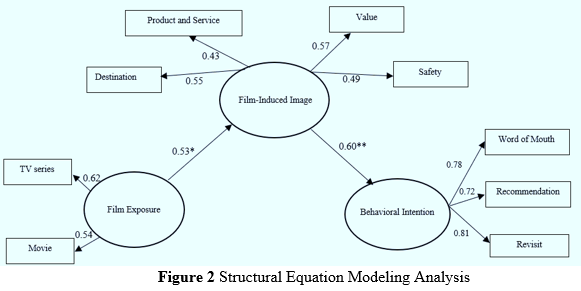
Film-induced tourism plays a growing role in shaping destination choices, yet limited studies have examined its influence on Chinese tourists in Thailand’s post-pandemic context. To fill this gap, this study investigates how exposure to Thai films and television dramas shapes the film-induced image and subsequently affects tourists’ behavioral intentions. Structural equation modeling (SEM) was applied to analyze data from 420 Chinese tourists, as it effectively tests complex causal relationships among latent variables. The results indicate that film exposure significantly enhances the film-induced image of tourist destinations, positively influencing Chinese tourists' behavioural intentions. These findings highlight the potential of leveraging film media as a strategic tool for destination marketing, particularly in reviving tourism in the post-pandemic era. Furthermore, the study contributes to academic knowledge on media-induced tourism while offering practical insights for policymakers and marketers seeking innovative approaches to attract international visitors.
Downloads
References
Ajzen, I. (1991). The theory of planned behavior. Organizational Behavior and Human Decision Processes, 50(2), 179-211. https://doi.org/10.1016/0749-5978(91)90020-T
Asian Development Bank. (2021). COVID-19 impact on tourism: A focus on Southeast Asia. https://www.adb.org
Beeton, S. (2005). Film-induced tourism. Channel View Publications.
Beeton, S. (2006). Understanding Film-induced Tourism. Tourism Analysis, 11(3), 181–188. https://doi.org/10.3727/108354206778689808
Beeton, S. (2016). Film-induced tourism. Channel View Publications.
Bolan, P., Boyd, S., & Bell, J. (2011). We’ve seen it in the Movies, let’s see if it’s true: Authenticity & displacement in film-induced tourism. Worldwide Hospitality and Tourism Themes, 3(2), 102–116. https://doi.org/10.1108/17554211111122970
China Briefing. (2023). China tourism in 2023: Outlook, trends and opportunities. https://www.china-briefing.com
China Tourism Academy. (2020). Annual report on China outbound tourism development. Beijing: China Tourism Academy.
Connell, J. (2012). Film tourism – Evolution, progress and prospects. Tourism Management, 33(5), 1007–1029. https://doi.org/10.1016/j.tourman.2012.02.008
Crompton, J. L. (1979). An assessment of the image of Mexico as a vacation destination and the influence of geographical location upon that image. Journal of Travel Research, 17(4), 18-23. https://journals.sagepub.com/doi/10.1177/004728757901700404
Croy, W. G. (2017). The Lord of the Rings, New Zealand, and tourism: Image building with film. Monash University. https://bridges.monash.edu/articles/journal_contribution/The_Lord_of_the_Rings_New_Zealand_and_tourism_image_building_with_film/5080462
Du, Y., Li, J., Pan, B., & Zhang, Y. (2019). Lost in Thailand: A case study on the impact of a film on tourist behavior. Journal of Vacation Marketing, 26(3), 365-377. https://doi.org/10.1177/1356766719886902
Etzel, M. J., & Ritchie, J. R. B. (1991). Consumer behavior in travel and tourism. In Pizam, A., & Mansfield, Y. (Eds.), Tourism marketing and destination image. (pp. 185-192). Wiley.
Frost, W. (2006). Braveheart-ed Ned Kelly: Historic films, heritage tourism, and destination image. Tourism Management, 27(2), 247-254. https://doi.org/10.1016/j.tourman.2004.09.006
Gartner, W. C. (1993). Image formation process. Journal of Travel & Tourism Marketing, 2(2-3), 191-215. https://doi.org/10.1300/J073v02n02_12
Hudson, S., & Ritchie, J. R. B. (2006). Film tourism and destination marketing: The case of Captain Corelli's Mandolin. Journal of Vacation Marketing, 12(3), 256–268. https://doi.org/10.1177/1356766706064619
Hudson, S., & Ritchie, J. R. B. (2006). Promoting destinations via film tourism: An empirical identification of supporting marketing initiatives. Journal of Travel Research, 44(4), 387-396. https://doi.org/10.1177/0047287506286720
Kim, H., & Richardson, S. L. (2003). Motion picture impacts on destination images. Annals of Tourism Research, 30(1), 216-237. https://doi.org/10.1016/S0160-7383(02)00062-2
Lei, J., & Suntrayuth, S. (2023). A study on the impact of Chinese domestic tourists’ participation on their post-travel behaviors in traditional Chinese villages. Heritage, 6(7), 5187-5201. https://doi.org/10.3390/heritage6070275
McKinsey. (2023). China’s travel recovery: Outlook and emerging trends. https://www.mckinsey.com
Ministry of Tourism and Sports, Thailand. (2020). Tourism revenue and number of tourists statistics. https://www.mots.go.th
Shi, D., & Phakdee-auksorn, P. (2024). Exploring the impact of the Thai television series on young Chinese viewers’ perceptions of Phuket, Thailand as a holiday destination and their behavioral intentions. Kasetsart Journal of Social Sciences, 45(2), 123–135. https://so04.tci-thaijo.org/index.php/kjss/article/view/272022
Tourism Authority of Thailand. (2020). Tourism statistics 2019. https://www.tat.or.th
Tourism Economics. (2020). The economic impact of tourism in Thailand. https://www.tourismeconomics.com
UNEP. (2023). Making tourism more sustainable: A guide for policy makers. United Nations Environment Programme.
UNWTO. (2021). Impact assessment of the COVID-19 outbreak on international tourism. https://www.unwto.org
UNWTO (United Nations World Tourism Organization). (2021). Global tourism trends: 2021 report. https://www.unwto.org
UNWTO. (2023). Overtourism? Understanding and managing urban tourism growth beyond perceptions: Case studies. https://www.unwto.org
Visa. (2023). Revenge travel is here to stay, Visa study reveals. https://usa.visa.com
Voice of America. (2023). Return of Chinese tourists to Thailand has pros, cons. https://www.voanews.com
Wen, H., Josiam, B. M., Spears, D. L., & Yang, Y. (2018). Influence of movies and television on Chinese Tourists perception toward international tourism destinations. Tourism Management Perspectives, 28, 211–219. https://doi.org/10.1016/j.tmp.2018.09.006
Wen, J., & Kozak, M. (Eds.). (2022). Chinese outbound tourist behaviour: An international perspective. Routledge.
World Bank. (2020). Thailand economic monitor: Thailand in the time of COVID-19. https://www.worldbank.org/en/country/thailand/publication/thailand-economic-monitor
Yao, Y., Suwannarat, P., & Sonthiprasat, R. (2020). The effects of Thailand country images on behavioral intention of Chinese tourists in Thailand. Rajapark Journal, 14(34), 118–129. https://so05.tci-thaijo.org/index.php/RJPJ/article/view/241678
Zhou, Y., Liu, L., & Sun, X. (2022). The effects of perception of video image and online word of mouth on tourists’ travel intentions: Based on the behaviors of short video platform users. Frontiers in Psychology, 13, 984240. https://doi.org/10.3389/fpsyg.2022.984240
Downloads
Published
How to Cite
Issue
Section
Categories
License
Copyright (c) 2025 Community and Social Development Journal

This work is licensed under a Creative Commons Attribution-NonCommercial-NoDerivatives 4.0 International License.