An Analysis of Social, Cultural, and Community Management Factors Contributing to the Success of the Tai Phuan Community Learning Center in Ban Klang, Loei Province, Thailand
DOI:
https://doi.org/10.57260/csdj.2026.286245Keywords:
Community learning resources, Tai Phuan people, Supporting factors, Community developmentAbstract
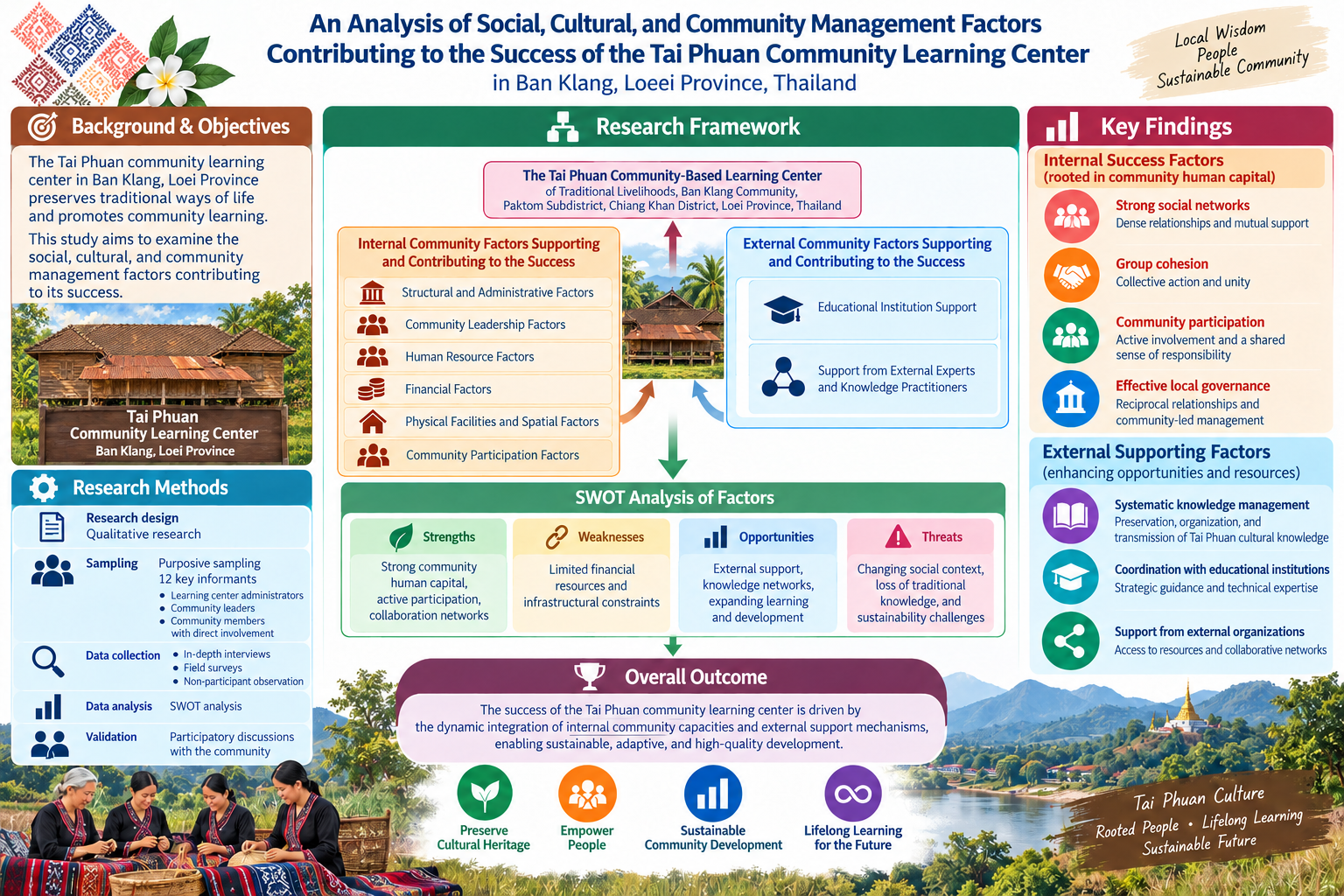
This study examines the social, cultural, and community management factors contributing to the success of the Tai Phuan community learning center in Ban Klang, Pak Tom Subdistrict, Chiang Khan District, Loei Province, Thailand. Adopting a qualitative research design, the study employed purposive sampling to recruit twelve key informants comprising community leaders, representatives of educational institutions, and community members with relevant knowledge and experience. Data were collected through documentary research, in-depth interviews, field surveys, and observation. SWOT analysis, supported by schematic mapping, was used to examine internal conditions and external influences on the center’s development. The findings were subsequently discussed with community members and local leaders in small groups to support contextual interpretation and identify development priorities.
The findings identified six internal dimensions: organizational structure and administration, community leadership, human resources, financial resources, physical facilities and learning spaces, and community participation. Community members’ cultural knowledge and active involvement emerged as central strengths, while limited financial resources constituted the principal internal constraint. Social relationships, trust, and collective decision-making supported coordination and shared ownership, whereas Tai Phuan language, traditions, beliefs, and local wisdom provided the cultural foundation for learning and intergenerational knowledge transmission. External support from educational institutions and expert practitioners complemented these capacities through academic guidance, knowledge management, and access to collaborative networks. Although no significant external threats were identified within the scope of the study, the findings underscored the importance of adaptive planning and continued resource support. Taken together, these findings suggest that the center’s development depends on the interaction of social capital, cultural capital, and participatory management, with external partnerships strengthening the community’s capacity to organize and transmit local knowledge. The study therefore recommends reinforcing participatory governance, developing local leadership, and sustaining community–academic partnerships to support the continuity of culturally grounded learning.
Downloads
References
Areekul, C. (2023). The research report on the model of development of cultural learning resources and learning networks: A multiple case study and participatory action research. Silpakorn University e-Journal (Social Sciences, Humanities, and Arts), 43(6), 106–118. https://so05.tci-thaijo.org/index.php/sujthai/article/view/262085
Bourdieu, P. (1986). The forms of capital. In J. G. Richardson (Ed.), Handbook of theory and research for the sociology of education (pp. 241–258). Greenwood Press.
Karapan, R., & Susuwan, P. (2021). Dynamics and adaptation of the Phuan ethnic group in Thailand. JATI—Journal of Southeast Asian Studies, 26(1), 141–162. https://doi.org/10.22452/jati.vol26no1.7
Nakabut, A. (2015). Community culture and development. Bangkok, Thailand.
Neak, P., & Charungkaittikul, S. (2023). Guidelines to enhance community participation in community learning centres in the Kingdom of Cambodia. Journal of Adult and Continuing Education, 29(2), 659–682. https://doi.org/10.1177/14779714221131893
Patton, M. Q. (2015). Qualitative research & evaluation methods: Integrating theory and practice. (4th ed.). SAGE Publications.
Prasithrathsint, S., & Sookasame, K. (2004). Qualitative Research Methodology: Research on Current Issues and Future-Oriented Research. Bangkok: Samlada.
Putnam, R. D. (2000). Bowling alone: The collapse and revival of American community. Simon & Schuster.
Saenkham, T., & Thongkhot, S. (2018). Bun Liang Ban ritual of the Tai Phuan in Chiang Khan District, Loei Province. https://rituals.sac.or.th/detail.php?id=121
Sarrattana, V. (2002). New paradigm mixed methodology for educational administration research. Thipyavisut.
Thongmeethip, K., Niyomratjaroon, A., Maliton, W., Phianthai, W., Khobkhet, A., & Siwicha, P. (2025). Mechanisms and community participation in learning resources management on Tai Yuan’s way of life at Ban Klang, Loei Province. Humanities and Social Sciences Nakhonsawan Rajabhat University Academic Journal, 12(2), 47–62. https://so05.tci-thaijo.org/index.php/hssnsru/article/view/283564
UNESCO. (2017). Education for sustainable development. Paris, France: UNESCO.
Waenlo, N. (2024). Ban Klang. https://wikicommunity.sac.or.th/community/1500
World Bank. (2002). Social capital implementation framework. Washington, DC: World Bank.
Downloads
Additional Files
Published
How to Cite
Issue
Section
Categories
License
Copyright (c) 2026 Community and Social Development Journal

This work is licensed under a Creative Commons Attribution-NonCommercial-NoDerivatives 4.0 International License.