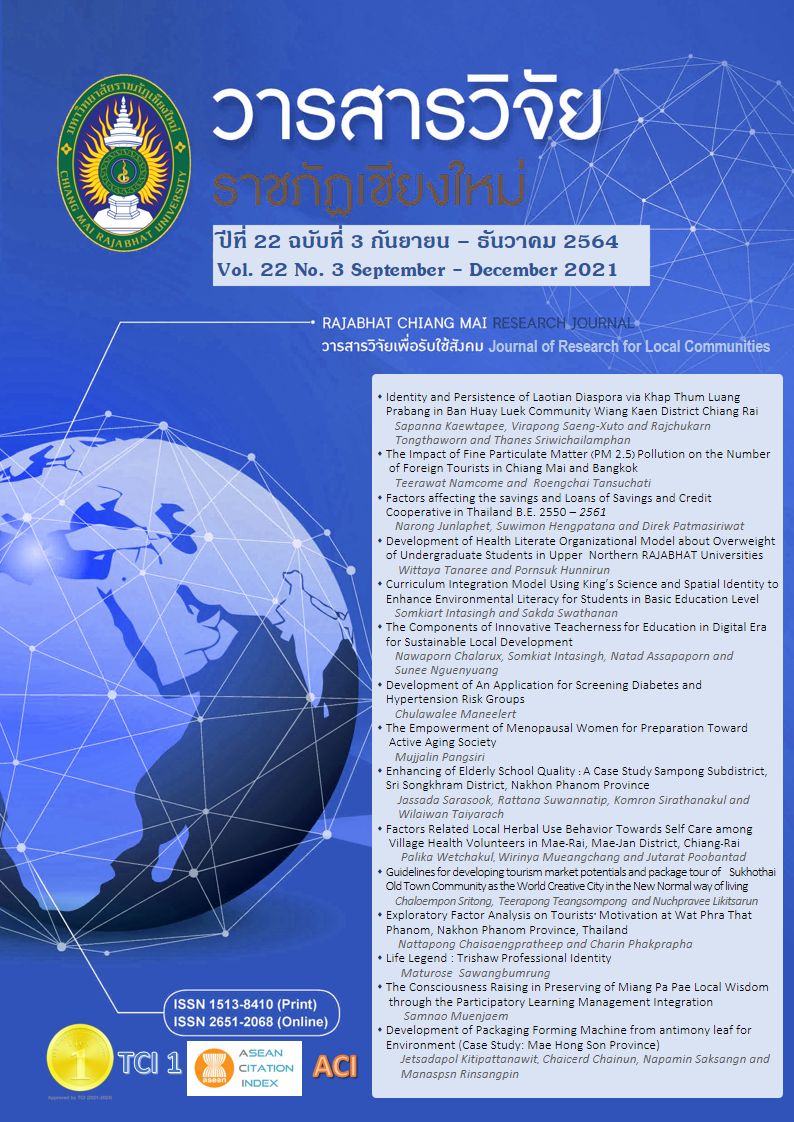
รูปแบบการบูรณาการหลักสูตรโดยน้อมนำตามศาสตร์พระราชาร่วมกับ การใช้อัตลักษณ์เชิงพื้นที่เพื่อเสริมสร้างการรู้เรื่องสิ่งแวดล้อมสำหรับ ผู้เรียนระดับการศึกษาขั้นพื้นฐาน
DOI:
https://doi.org/10.14456/rcmrj.2021.249549คำสำคัญ:
การบูรณาการหลักสูตร, ศาสตร์พระราชา, อัตลักษณ์เชิงพื้นที่, การรู้เรื่องสิ่งแวดล้อมบทคัดย่อ
ปัญหาสิ่งแวดล้อมในปัจจุบันส่งผลกระทบต่อประชาชนจำนวนมาก ซึ่งสาเหตุส่วนใหญ่เกิดจากพฤติกรรมของมนุษย์ กลไกสำคัญในการแก้ปัญหาดังกล่าวคือ การจัดการศึกษาเพื่อส่งเสริมการรู้เรื่องสิ่งแวดล้อม งานวิจัยนี้จึงมุ่งศึกษาสภาพและปัญหาในการส่งเสริมการรู้เรื่องสิ่งแวดล้อมให้กับผู้เรียนในระดับการศึกษาขั้นพื้นฐาน ออกแบบและประเมินรูปแบบการบูรณาการหลักสูตรโดยน้อมนำตามศาสตร์พระราชาร่วมกับการใช้อัตลักษณ์เชิงพื้นที่เพื่อเสริมสร้างการรู้เรื่องสิ่งแวดล้อมให้กับผู้เรียน การวิจัยมี 2 ระยะ คือ ระยะที่ 1 การศึกษาสภาพและปัญหา ตัวอย่างในการสัมภาษณ์เชิงลึก คือ ผู้บริหาร จำนวน 5 คน และครูผู้สอน จำนวน 5 คน และตัวอย่างในการตอบแบบสอบถาม คือ ครูผู้สอน จำนวน 394 คน และระยะที่ 2 การออกแบบและประเมินรูปแบบการบูรณาการหลักสูตร กลุ่มเป้าหมายในการประชุมเชิงปฏิบัติการ คือ ครูผู้สอน จำนวน 10 คน และผู้ทรงคุณวุฒิประเมินรูปแบบ จำนวน 8 คน เครื่องมือที่ใช้ในการวิจัยประกอบด้วย แบบสัมภาษณ์เชิงลึก แบบสอบถามสภาพและปัญหา แบบบันทึกการประชุมปฏิบัติการ และแบบประเมินรูปแบบ วิเคราะห์ข้อมูลโดยการหาเฉลี่ย ส่วนเบี่ยงเบนมาตรฐาน และการวิเคราะห์เนื้อหา ผลการวิจัยพบว่า 1) สภาพการส่งเสริมการรู้เรื่องสิ่งแวดล้อมในสถานศึกษาอยู่ในระดับปานกลาง และมีปัญหาในการส่งเสริมการรู้เรื่องสิ่งแวดล้อมอยู่ในระดับมาก 2) รูปแบบการบูรณาการหลักสูตรโดยน้อมนำตามศาสตร์พระราชาร่วมกับการใช้อัตลักษณ์เชิงพื้นที่เพื่อเสริมสร้างการรู้เรื่องสิ่งแวดล้อม มีทั้งหมด 7 องค์ประกอบ ได้แก่ หลักการของรูปแบบ วัตถุประสงค์ของรูปแบบ กระบวนการของรูปแบบ แนวทางการบูรณาการหลักสูตร การวัดและประเมินผล บทบาทของผู้มีส่วนเกี่ยวข้อง และเงื่อนไขความสำเร็จ และ 3) ผลการประเมินรูปแบบการบูรณาการหลักสูตรนี้ มีความเหมาะสมและความเป็นไปได้อยู่ในระดับมาก
Downloads
เอกสารอ้างอิง
Arends, R. I. (2016). Learning to Teach. (10th ed.). New York: McGraw-Hill Education.
Aumpi, S. (2015). Development of Environmental Literacy Scale for Lower Secondary Students. (M.Ed., Chulalongkorn University). (In Thai)
Benwell, B., & Stokoe, E. (2006). Spatial Identities. In Discourse and Identity (pp. 204-242). Edinburgh University Press.
Boonnen, W. (2015). Environmental Literacy, Awareness and Concepts of Global Warming Adaptation of Students at Demonstration School Mahasarakham University (Secondary Division). Bangkok: Health Fund and Global Warming Thailand Environment Institute. (In Thai)
Buosonte, R. (2019). Research and Development of Educational Innovation. Bangkok: Chulalongkorn University Press. (In Thai)
Choudhary, B. K. (2004). Formation and (Re) Formation of Spatial Identities under Globalization. Journal of Regional Development and Planning, 3(1), 35-48. https://econpapers.repec.org/article/risjrdpin/0024.htm
Creswell, J. W. (2015). A Concise Introduction to Mixed Methods Research. Thousand Oaks, CA: Sage.
Dechyotin, O., Singseevo, A., & Suksringam, P. (2017). The Development of Environmental Literacy of Mattayomsuksa 3 Students Using the Project-Based Teaching with Problem-Solving Thinking. Journal of Education Naresuan University, 19(2), 305-317. https://so06.tci-thaijo.org/index.php/edujournal_nu/article/view/89923 (In Thai)
Dick, W., Carey, L., & Carey, J. O. (2001). The Systematic Design of Instruction. New York: HarperCollins.
Erdogan, M., Kostova, Z., & Marcinkowski, T. (2009). Components of Environmental Literacy in Elementary Science Education Curriculum in Bulgaria and Turkey. Eurasia Journal of Mathematics, Sciences & Technology Education, 5(1), 15-26. DOI: https://doi.org/10.12973/ejmste/75253
Fadel, C. (2008). 21st Century Skills: How can you prepare students for the new Global Economy?. Retrieved from https://www.oecd.org/site/educeri21st/40756908.pdf
Graham, L., Berman, J., & Bellert, A. (2015). Sustainable Learning: Inclusive Practices for 21st Century Classroom. Port Melbourne: Cambridge University Press.
Hall, G. E., Quinn, L. F., & Gollnick, D. M. (2017). Introduction to Teaching: Making a Difference in Student Learning. Canada: SAGE Publication, Inc.
Jannah, M., Halim, L., Meerah, T. S. M., & Fairuz, M. (2013). Impact of Environmental Education Kit on Students’ Environmental Literacy. Asian Social Science, 9(12), 1-12. DOI: 10.5539/ass.v9n12p1
Kidman, G., & Casineder, N. (2019). Developing Teachers’ Environmental Literacy through Inquiry-Based Practices. EURASIA Journal of Mathematics, Science and Technology Education, 15(6), 1-9. DOI: https://doi.org/10.29333/ejmste/103065
Krejcie, R. V., & Morgan, D. W. (1970). Determining Sample Size for Research Activities. Educational and Psychological Measurement, 30, 607-610. DOI: https://doi.org/10.1177/001316447003000308
Nillapun, M., Phivitayasirithum, C., Vanichwatanavorachai, S., & Songserm, U. (2015). Evaluation of the Basic Education Core Curriculum 2008 in the Leading Schools for Curriculum Implementation. Silpakorn Educational Research Journal, 7(1), 26-41. https://so05.tci-thaijo.org/index.php/suedureasearchjournal/article/view/35831 (In Thai)
North American Association for Environmental Education. (2011). Developing a Framework for Assessing Environmental Literacy. Washington, D.C.: North American Association for Environmental Education.
Nopparak, S. (2018). King’s Science to Development Science of Administration. Bangkok: Amarin Printing & Publishing. (In Thai)
Office of the Education Council. (2020). Statement of Place-Based Learning in Thailand Context. Bangkok: Prikwankarnpim. (In Thai)
Office of the National Economic and Social Development Board. (2011). National Development Work Principles of His Majesty the King. Bangkok: Petchrung Printing Center. (In Thai)
Oliva, P. F., & Gordon II, W. R. (2013). Developing the Curriculum. (8th ed.). Singapore: Pearson Education South Asia Pte Ltd.
Ornstein, A. C., & Hunkins, F. P. (2018). Curriculum Foundations, Principles and Issues. (7th ed.). New Jersey: Englewood Cliffs.
Regional Education Office 15. (2020). Basic Information on Education in Government Inspectorate 15 of Academic Year 2020. Retrieved from http://www.reo15.moe.go.th/web/images/yutasan/kmps12563.pdf (In Thai)
Stevenson, K. T., Peterson, M. N., Bondell, H. D., Mertig, A. G., & Moore, S. E. (2013). Environmental, Institutional, and Demographic Predators of Environmental Literacy among Middle School Children. PLOS, 8(3), 1-11. DOI: https://doi.org/10.1371/journal.pone.0059519
Stobbelaar, D. J., & Pedroli, B. (2011). Perspectives on Landscape Identity: A Conceptual Challenge. Landscape Research, 36(3), 321–339. DOI: https://doi.org/10.1080/01426397.2011.564860
Yue, T., Long, R., & Chen, H. (2013). Factors Influencing Energy-Saving Behavior of Urban Households in Jiangsu Province. Energy Policy, 62(2013), 665-675. DOI: https://doi.org/10.1016/j.enpol.2013.07.051
ดาวน์โหลด
เผยแพร่แล้ว
รูปแบบการอ้างอิง
ฉบับ
ประเภทบทความ
สัญญาอนุญาต
1. บทความ ข้อมูล เนื้อหา รูปภาพ ฯลฯ ที่ได้รับการตีพิมพ์ใน “Community and Social Development Journal” ถือเป็นลิขสิทธิ์ของ Community and Social Development Journal มหาวิทยาลัยราชภัฏเชียงใหม่ และเพื่อให้เผยแพร่บทความได้อย่างเหมาะสมผ่านสื่อสิ่งพิมพ์และอิเล็กทรอนิกส์ ผู้เขียนยังคงถือครองลิขสิทธิ์บทความที่ตีพิมพ์ภายใต้ใบอนุญาต Creative Commons Attribution (CC BY) ซึ่งอนุญาตให้เผยแพร่บทความซ้ำในแหล่งอื่นได้ โดยอ้างอิงต้องอ้งอิงบทความในวารสาร ผู้เขียนต้องรับผิดชอบในการขออนุญาตผลิตซ้ำเนื้อหาที่มีลิขสิทธิ์จากแหล่งอื่น
2. เนื้อหาบทความที่ปรากฏในวารสารเป็นความรับผิดชอบของผู้เขียนบทความโดยตรง ซึ่งกองบรรณาธิการวารสารไม่จำเป็นต้องเห็นด้วยหรือร่วมรับผิดชอบใดๆ