
Examining the Factors Influencing Employee Retention and Loyalty in a Private Hospital in Bangkok, Thailand
DOI:
https://doi.org/10.57260/csdj.2025.279885คำสำคัญ:
Employee retention and loyalty, Structural equation modeling, Employee loyalty in hospital, Healthcare management, Employee satisfactionบทคัดย่อ
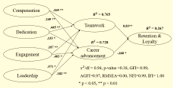
Employee retention and loyalty are critical for operational efficiency and quality patient care in hospitals. This study investigates the key factors influencing these outcomes through Structural Equation Modeling (SEM) using survey data from 332 employees of a private hospital in Bangkok. The model examined compensation, dedication, engagement, leadership, teamwork, and career advancement. Results revealed dedication (β = 0.62, p < 0.01) and teamwork (β = 0.83, p < 0.01) as the strongest positive predictors of retention and loyalty, while career advancement showed a significant negative direct effect (β = –0.66, p < 0.05) when not supported by internal opportunities. Compensation positively influenced retention (β = 0.27, p < 0.01), and leadership, though beneficial for teamwork and career growth, had a small negative direct effect (β = –0.05). These findings suggest strategic actions such as enhancing leadership development, fostering collaborative cultures, aligning career pathways with internal opportunities, and offering competitive compensation packages. By implementing these targeted strategies, hospital administrators can reduce turnover, strengthen workforce commitment, and improve healthcare service delivery.
Downloads
เอกสารอ้างอิง
Alshmemri, M., Shahwan-Akl, L., & Maude, P. (2017). Herzberg ’ s Two-Factor Theory. Life Science Journal, 14, 12-16. Retrieved from https://www.scirp.org/reference/referencespapers?referenceid=3439937
Bakker, A. B., & Demerouti, E. (2014). Job Demands–Resources Theory. In P. Y. C. a. C. L. Cooper (Ed.), Work and Wellbeing: A Complete Reference Guide (pp. 1-28). John Wiley & Sons. DOI: https://doi.org/10.1002/9781118539415.wbwell019
Becker, G. S. (1964). Human capital; a theoretical and empirical analysis, with special reference to education. New York : National Bureau of Economic Research; distributed by Columbia University Press, 1964.
Ghaleb, B. D. S. (2024). Towards A Dynamic Model of Human Needs: A Critical Analysis of Maslow's Hierarchy. International Journal of Multidisciplinary Approach Research and Science, 2(3), 1028-1046. Retrieved from https://risetpress.com/index.php/ijmars/article/view/674 DOI: https://doi.org/10.59653/ijmars.v2i03.674
Indasari, A. A., Mulyono, S., & Farhan, D. (2024). The Influence of Teamwork and Work Environment on Service Quality through Job Satisfaction. International Journal of Current Science Research and Review, 7(2), 1385-1394. Retrieved from https://ijcsrr.org/single-view/?id=15255&pid=14892 DOI: https://doi.org/10.47191/ijcsrr/V7-i2-58
Kothari, S. (2023). Role of Effective in Leadership on Employee Retention: An Empirical Study. PsychologyandEducation, 55(1), 537-544. Retrieved from https://psychologyandeducation.net/pae/index.php/pae/article/view/7837 DOI: https://doi.org/10.48047/pne.2018.55.1.66
Michael, G., & Giannis, P. (2022). Herzberg’s Motivation Theory in Workplace. Journal of Psychology Research, 12(12), 971-978. Retrieved from https://doi.org/10.17265/2159-5542/2022.12.009 DOI: https://doi.org/10.17265/2159-5542/2022.12.009
Mohamad, J. B. I., & Siti, S. (2023). The Effect of Compensation and Empowerment on Employee Loyalty Mediated by Job Satisfaction (Case Study at PT Permodalan Nasional Madani Regional Surabaya 1). Formosa Journal of Sustainable Research, 2(8), 1927-1942. Retrieved from https://doi.org/10.55927/fjsr.v2i8.5358 DOI: https://doi.org/10.55927/fjsr.v2i8.5358
Pasban, M., & Nojedeh, S. H. (2016). A Review of the Role of Human Capital in the Organization. Procedia - Social and Behavioral Sciences, 230(12), 249-253. Retrieved from https://doi.org/10.1016/j.sbspro.2016.09.032 DOI: https://doi.org/10.1016/j.sbspro.2016.09.032
Putra, A. A., Indiyati, D., & Putri, R. K. (2024). The Impact of Career Development and Job Satisfaction on Gen-Z Employee Retention in Manufacturing Companies in The Karawang Region. International Journal of Scientific and Management Research, 07(12), 92-103. Retrieved from https://doi.org/10.37502/ijsmr.2024.71207 DOI: https://doi.org/10.37502/IJSMR.2024.71207
Putri, A. R., & Renwarin, J. M. J. (2023). The Effect of Leadership and Teamwork on Employee Turnover and Team Performance. Human Capital and Organizations, 1(1), 46-54. Retrieved from https://doi.org/10.58777/hco.v1i1.121 DOI: https://doi.org/10.58777/hco.v1i1.121
Raj, R. (2024). A Conceptual Framework for Enhancing Employee Retention in the Public Healthcare Sector Using Herzberg’s Two-Factor Theory. Pakistan Journal of Life and Social Sciences (PJLSS), 22(2), 5891-5905. Retrieved from https://doi.org/10.57239/pjlss-2024-22.2.00438 DOI: https://doi.org/10.57239/PJLSS-2024-22.2.00438
Rakhab, A., Jackson, C., Nilmanat, K., Butterworth, T., & Kane, R. (2021). Factors supporting career pathway development amongst advanced practice nurses in Thailand: A cross-sectional survey. International Journal of Nursing Studies, 117, 103882. Retrieved from https://doi.org/https://doi.org/10.1016/j.ijnurstu.2021.103882 DOI: https://doi.org/10.1016/j.ijnurstu.2021.103882
Rathaba, X. M., & Naong, M. N. (2024). Interplay of human capital development and related behavioural factors as panacea for turnover intentions. SA Journal of Human Resource Management, 22, a2553. Retrieved from https://doi.org/10.4102/sajhrm.v22i0.2553 DOI: https://doi.org/10.4102/sajhrm.v22i0.2553
Sija, A. (2022). Determinants of Employee Retention in Private Healthcare. European Journal of Human Resource Management Studies, 5(4), 53-74. Retrieved from https://oapub.org/soc/index.php/EJHRMS/article/view/1220 DOI: https://doi.org/10.46827/ejhrms.v5i4.1220
Srisorn, W. (2020). Evaluation of The Relationship Between Internal Marketing and Employee Retention of Informal Elderly Laborers. PalAech's Journal of Archaeology of Egypt/Egyptology, 17(1), 90-102. Retrieved from https://archives.palarch.nl/index.php/jae/article/view/155
Talib Al Shuaili, A. S. (2025). Occupational Stress and Job Satisfaction: Unveiling Challenges in Teachers' and Doctors' Work Environments. World Journal of Education, 15(1), 37-52. Retrieved from https://www.sciedupress.com/journal/index.php/wje/article/view/27519 DOI: https://doi.org/10.5430/wje.v15n1p37
Tangthong, S., Trimetsoontorn, J., & Rojniruntikul, N. (2014). HRM Practices and Employee Retention in Thailand—A Literature Review. International Journal of Trade, Economics and Finance, 5(2), 162-166. Retrieved from https://doi.org/10.7763/IJTEF.2014.V5.362 DOI: https://doi.org/10.7763/IJTEF.2014.V5.362
Yang, Q. (2024). Research on Employee Loyalty Management Strategies in Globalized Enterprises. Open Journal of Business and Management, 12(6), 4086-4095. Retrieved from https://doi.org/10.4236/ojbm.2024.126205 DOI: https://doi.org/10.4236/ojbm.2024.126205
ดาวน์โหลด
เผยแพร่แล้ว
รูปแบบการอ้างอิง
ฉบับ
ประเภทบทความ
หมวดหมู่
สัญญาอนุญาต
ลิขสิทธิ์ (c) 2025 Community and Social Development Journal

อนุญาตภายใต้เงื่อนไข Creative Commons Attribution-NonCommercial-NoDerivatives 4.0 International License.
1. บทความ ข้อมูล เนื้อหา รูปภาพ ฯลฯ ที่ได้รับการตีพิมพ์ใน “Community and Social Development Journal” ถือเป็นลิขสิทธิ์ของ Community and Social Development Journal มหาวิทยาลัยราชภัฏเชียงใหม่ และเพื่อให้เผยแพร่บทความได้อย่างเหมาะสมผ่านสื่อสิ่งพิมพ์และอิเล็กทรอนิกส์ ผู้เขียนยังคงถือครองลิขสิทธิ์บทความที่ตีพิมพ์ภายใต้ใบอนุญาต Creative Commons Attribution (CC BY) ซึ่งอนุญาตให้เผยแพร่บทความซ้ำในแหล่งอื่นได้ โดยอ้างอิงต้องอ้งอิงบทความในวารสาร ผู้เขียนต้องรับผิดชอบในการขออนุญาตผลิตซ้ำเนื้อหาที่มีลิขสิทธิ์จากแหล่งอื่น
2. เนื้อหาบทความที่ปรากฏในวารสารเป็นความรับผิดชอบของผู้เขียนบทความโดยตรง ซึ่งกองบรรณาธิการวารสารไม่จำเป็นต้องเห็นด้วยหรือร่วมรับผิดชอบใดๆ