
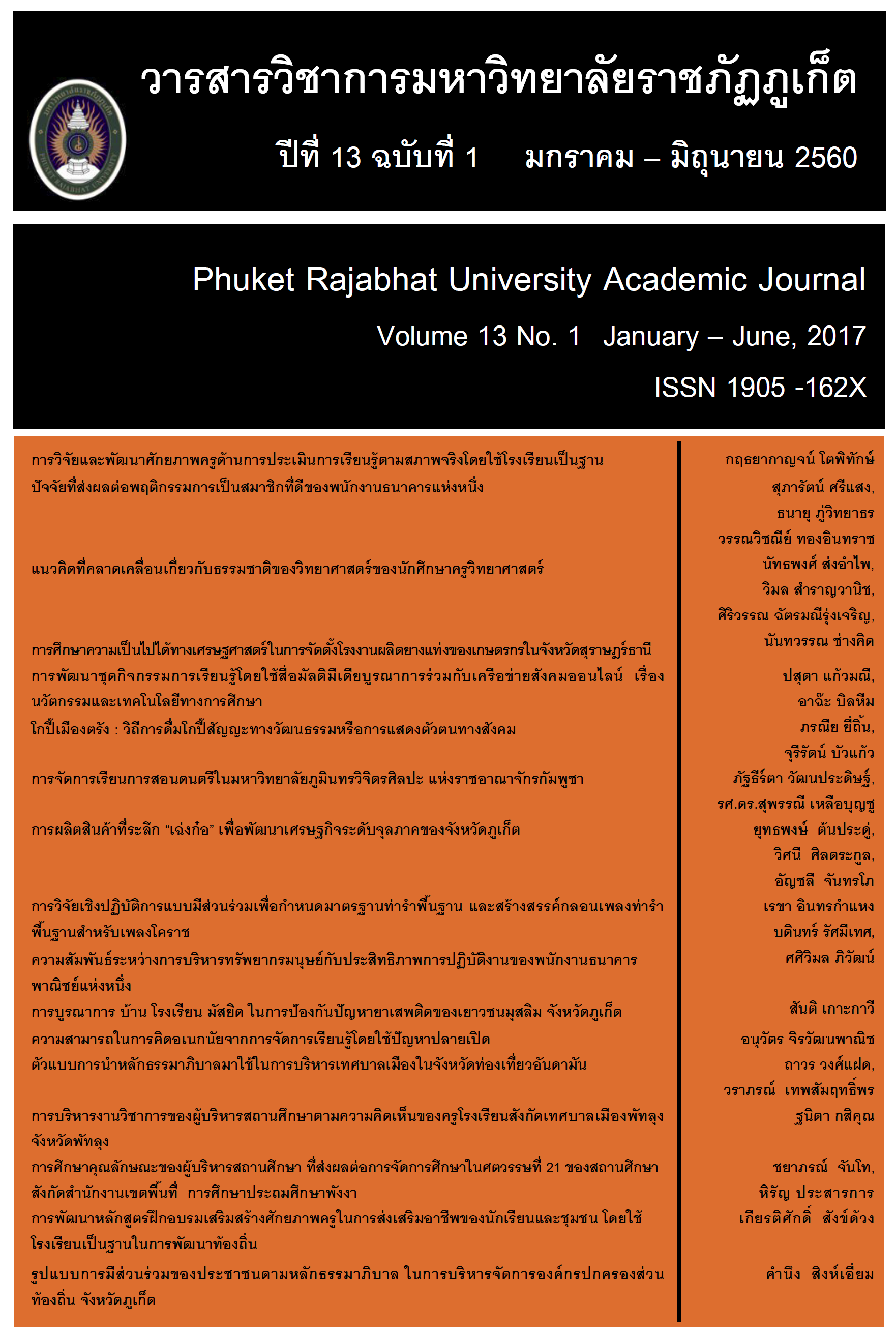
Research and Development of Teacher's Potential for Authentic Learning Assessment on School-based Training
Article Sidebar
Main Article Content
Abstract
This research aimed to develop of teacher's potential for authentic learning assessment on school-based training. The subject were 9 teachers in a case study school. The research instruments were a model for the development of teacher's potential for authentic learning assessment on school-based training model, the test of authentic learning assessment knowledge, attitude and skill, the test of the quality of authentic learning assessment, and the test of the satisfaction towards the model of development of teacher's potential for authentic learning assessment on school-based training. The data was analyzed by using mean, standard deviation and the Wilcoxon signed-rank test. The study demonstrated that (1) The model of development of teacher's potential for authentic learning assessment on school-based training is divided into 4 factors; 1. research preparation; 2. training workshop; 3. implementing and 4. monitoring. All of the following factors were relatively, effectively, possibly, and ease of using in the extremely high ranking. (2) The results of teachers' potential using for authentic learning assessment on school-based training, the knowledge of teacher after training had increased significantly and statistically at .01 level. The authentic learning assessment skill of teacher after training had higher than the criteria is 70 percent significantly. The attitude of teachers who pass the criteria is 75 percent significantly. The quality of authentic learning assessment by considering authentic learning assessment design was at the high level. The satisfaction to the model of development of teacher's potential for authentic learning assessment on school-based training was at the high level.
Article Details
The content and information published in the Phuket Rajabhat University Academic Journal represent the opinions and sole responsibility of the authors. The editorial board does not necessarily endorse or share any responsibility for these view.
Articles, data, content, images, etc., published in the Phuket Rajabhat University Academic Journal are the copyright of the Phuket Rajabhat University Academic Journal. Any individual or organization wishing to reproduce or utilize all or part of this material for any purpose must obtain prior written permission from the Phuket Rajabhat University Academic Journal.
References
กลุ่มงานคณะกรรมาธิการการศึกษา. (2552). รายงานสรุปผลการสัมมนา เรื่อง ทศวรรษที่สองของการปฏิรูปการศึกษา : ปัญหาและทางออก. กรุงเทพฯ : สานักกรรมาธิการ 3 สานักงานเลขาธิการสภาผู้แทนราษฎร.
เฉลิมชัย พันธ์เลิศ. (2549). การพัฒนากระบวนการเสริมสมรรถภาพการชี้แนะของนักวิชาการพี่เลี้ยงโดยใช้การเรียนรู้แบบเน้นประสบการณ์ในการอบรมโดยใช้โรงเรียนเป็นฐาน. วิทยานิพนธ์ปริญญาครุศาสตรดุษฎีบัณฑิต สาขาหลักสูตรและการสอน จุฬาลงกรณ์มหาวิทยาลัย.
ทรงศิลป์ ศรีธรราษฎร์. (2552). รายงานรายงานการพัฒนาหลักสูตรฝึกอบรมเรื่อง การประเมินผลตามสภาพจริงสาหรับครูผู้สอนโรงเรียนเทศบาล 4 (สิทธิไชยอุปถัมภ์) ปีการศึกษา 2552. สมุทรปราการ : เทศบาลนครสมุทรปราการ.
นงลักษณ์ วิรัชชัย. (2545). รายงานผลการดาเนินโครงการนาร่องระดับชาติ เรื่องกระบวนการปฏิรูปเพื่อพัฒนาคุณภาพการเรียนรู้ : การประเมินและ การประกัน. กรุงเทพฯ : วี.ที.ซี.คอมมิวนิเคชั่น.
นุชรี ผิวนวล. (2549). การพัฒนาบุคลากรโดยใช้โรงเรียนเป็นฐานเกี่ยวการวิจัยในชั้นเรียน. วิทยานิพนธ์ปริญญาการศึกษามหาบัณฑิต สาขาการบริหารการศึกษา มหาวิทยาลัยเชียงใหม่.
รัตนะ บัวสนธ์และคณะ (2550) การวิจัยเชิงปฏิบัติการแบบมีส่วนร่วมเพื่อพัฒนาความสามารถในการประเมินตามสภาพจริงของครูสังกัดสานักงานคณะกรรมการการศึกษาขั้นพื้นฐาน กรณีศึกษาโรงเรียนแห่งหนึ่งในจังหวัดภาคกลางตอนบน. พิษณุโลก : มหาวิทยาลัยนเรศวร.
ราเพย ภาณุสิทธิกร (2547). การศึกษาผลสัมฤทธิ์ของการฝึกอบรมโดยใช้โรงเรียนเป็นฐาน เรื่องกระบวนการเรียนการสอนโดยใช้รูปแบบการเรียนรู้แบบร่วมมือ. ปริญญาการศึกษามหาบัณฑิต มหาวิทยาลัยขอนแก่น.
วินัย บัวแดง. (2547). การพัฒนาคู่มือการประเมินผลตามสภาพจริง กลุ่มสาระการเรียนรู้ภาษาไทยสาหรับครูประถมศึกษา. วิทยานิพนธ์ปริญญาศึกษาศาสตรมหาบัณฑิต สาขาวิชาหลักสูตรและการสอน มหาวิทยาลัยศิลปากร.
ศศิธร เขียวกอ. (2548). การพัฒนาสมรรถภาพด้านการประเมินสาหรับครูโรงเรียนประถมศึกษาเปรียบเทียบผลการฝึกอบรมระหว่างการฝึกอบรมครูแบบดั้งเดิมและแบบใช้โรงเรียนเป็นฐาน. วิทยานิพนธ์ปริญญาครุศาสตรดุษฎีบัณฑิต สาขาวิชาวิธีวิทยาการวิจัยการศึกษา จุฬาลงกรณ์ มหาวิทยาลัย.
สกาวรัตน์ เชยชุ่ม. (2543). การนาเสนอรูปแบบการวิจัยปฏิบัติการสาหรับพัฒนาครูประถมศึกษาโดยใช้โรงเรียนเป็นฐาน. วิทยานิพนธ์ปริญญามหาบัณฑิต ภาควิชาวิจัยการศึกษา จุฬาลงกรณ์มหาวิทยาลัย.
สมจิต สวธนไพบูลย์ และคณะ (2548). การวิจัยและพัฒนาชุดฝึกอบรมการวิเคราะห์หลักสูตรที่ใช้โรงเรียนเป็นฐาน ภายใต้ชุดโครงการ การวิจัยและพัฒนาหลักสูตรการเรียนการสอนวิทยาศาสตร์. กรุงเทพ ฯ : มหาวิทยาลัยศรีนครินทรวิโรฒ.
สุวิมล ว่องวาณิช. (2546). การวิจัยปฏิบัติการในชั้นเรียน. กรุงเทพฯ : อักษรไทย.
สายฝน แสนใจพรม. (2554). การพัฒนาระบบการวัดประเมินผลเพื่อยกระดับผลสัมฤทธิ์ของนักเรียน. เชียงใหม่ : มหาวิทยาลัยราชภัฏเชียงใหม่.
อมรา เขียวรักษา. (2549). การพัฒนาหลักสูตรการฝึกอบรม เรื่องการประเมินผลการเรียนรู้ตามสภาพจริงโดยใช้โรงเรียนเป็นฐานสาหรับครูวิทยาศาสตร์ประถมศึกษา. ปริญญานิพนธ์การศึกษาดุษฎีบัณฑิต สาขาวิทยาศาสตร์ศึกษา มหาวิทยาลัยศรีนครินทรวิโรฒ.
Adams., T. L. (1996). Modeling authentic assessment for preservice elementary school teachers. The Teacher Educator. [Available online at :http://cdnet2.car.chula.ac.th] 32 (Au) : 75 84.
Archbald, D. A.,and Newmann, F. M. (1988). Beyond Standardized Testing: Assessing Authentic AcademicAchievement in the Secondary School. Reston, VA: National Association of School Principals.
Cardler, J. (1991). Authentic assessment: Finding the right tools. Educational Leadership. 57(5) (pp.20-26)
Fuller, D. P. (1994). The use of authentic assessment to predict success of basic skills education an program student. ED.D. BOSTON UNIVERSITY Dissertation Abstracts International Vol. 55-03 : p.0540. [Available online at : http://cdnet2.car.chula.ac.th]
Pickett, N., and Dodge, B.(2001). Rubrics for Web Lessons [Available online at: http://edweb.sdsu.edut/rubrics/ weblessons.htm]
Stufflebeam, D.L. & others (1981). Standards for Evaluations of Educational Programs, Projects and Materials. The joint committee on standards for educationalev.
