
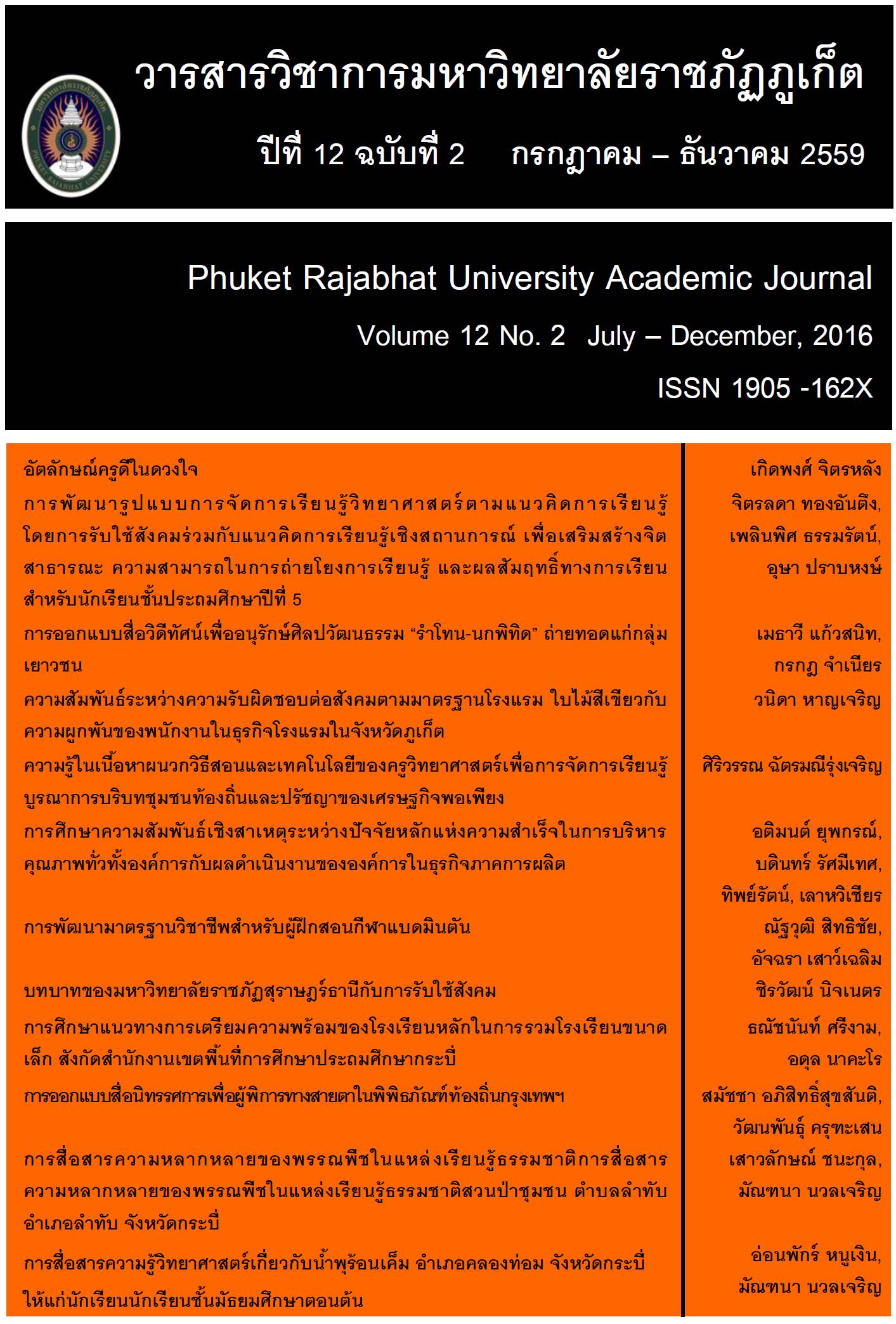
The study of casual relationships among tqm critical success factors and performance in manufacturing organizations
Article Sidebar
Main Article Content
Abstract
Even though the concept of quality management has been receiving worldwide attentions as a tool to create competitiveness for many years, companies were facing problems during the implementations, especially in defining and prioritizing their practices. The research objective of this study was to study the total quality management of ISO 9001 certified manufacturing companies by 1) studying the causal relationship among the six critical success factors of total quality management based on the national quality award criteria. 2) studying the casual relationship between the critical success factors and organizational performance.
The research sample consisted of 155 ISO 9001 certified manufacturing organizations that registered with the Thailand Industrial Standard Institute. The online questionnaires were used to collect the data from either executives or organizations’ representatives from September to December 2015. The multivariate analysis, namely, confirmatory factor analysis and structural equation modelling, were conducted by using the statistical software in order to examine the causal relationship of the latent variables of leadership, strategic planning, customer focus, measurement & analysis, workforce focus, operation focus and organizational performance.
The results confirmed the existence of nine causal relationships between 1) leadership and strategic planning 2) leadership and customer focus 3) leadership and workforce focus 4) strategic planning and measurement and analysis 5) strategic planning and workforce focus 6) customer focus, and operation focus 7) measurement & analysis and operation focus 8) workforce focus and customer focus 9) workforce focus and measurement & analysis. Additionally, the results of also confirmed the existence of the causal relationship between operation focus and organizational performance. According to the research findings, manufacturing organizations should focus on establishing operational standards of major procedures along their value chains. Quality management tools and statistical techniques should be employed in order to monitor organizational performance regularly. Leaders eventually played major roles in stimulating and monitoring for continuous improvement.
Article Details
The content and information published in the Phuket Rajabhat University Academic Journal represent the opinions and sole responsibility of the authors. The editorial board does not necessarily endorse or share any responsibility for these view.
Articles, data, content, images, etc., published in the Phuket Rajabhat University Academic Journal are the copyright of the Phuket Rajabhat University Academic Journal. Any individual or organization wishing to reproduce or utilize all or part of this material for any purpose must obtain prior written permission from the Phuket Rajabhat University Academic Journal.
References
Anderson, J. C., Rungtusanatham, M., Schroeder, R. G.. 1994. A theory of quality management underlying the Deming management method. Academy of Management. The Academy of Management Review. 19(3) : 472-509.
__________., Rungtusanatham, M., Schroeder, R. G., & Devaraj, S. 1995. A path analytic model of a theory of quality management underlying the Deming management method: preliminary empirical findings. Decision Sciences. 26(5) : 637-658.
Baird, K., Hu, K. J., & Reeve, R. (2011). The relationships between organizational culture, total quality management practices and operational performance. International Journal of Operations & Production Management. 31(7) : 789–814.
Black, S. & Porter, L. J. (1995). An empirical model for total quality management. Total Quality Management. 6(2) : 149-164.
Dale, B. G. (2003). Managing Quality. Fourth edition. Blackwell Publishing: Massachusetts.
Das, A., Paul, H., & Swierczek, F. W. (2008). Developing and validating total quality management (TQM) constructs in the context of Thailand's manufacturing industry. Benchmarking. 15(1) : 52-72.
Dean, J. W. & Bowen, D. E. (1994). Management theory and total quality: improving research and practice through theory development. The Academy of Management Journal. 19(3) : 392-418.
Dow, D., Samson, D. & Ford, S. (1999). Exploding the myth: Do all quality management practices contribute to superior quality performance? Production and Operations Management. 8(1) : 1-27.
Flynn, B., Schroeder, R. G. & Sakakibara, S. (1994). A framework for quality management research and an associated measurement instrument. Journal of Operations Management. 11(4) : 339-366.
__________., Schroeder, R. G. & Sakakibara, S. (1995). The impact of quality management practices on performance and competitive advantage. Decision Science. 26(5) : 659-691.
Fotopoulos, C. B. & Psomas, E. L. (2009). The impact of "soft" and "hard" TQM elements on quality management results. The International Journal of Quality & Reliability Management. 26(2) : 150-163.
Hair, J. F. Jr., Black, W. C., Babin, B. J. & Anderson, R. E. (2014). Multivariate Data Analysis. 7th ed. New Jersey : Pearson Education Limited.
Kaynak, H. (2003). The relationship between total quality management practices and their effects on firm performance. Journal of Operations Management. 21(4) : 405-435.
Kelley, K. (2005). The effects of nonnormal distributions on confidence intervals around the standardized mean difference: bootstrap and parametric confidence intervals. Educational and Psychological Measurement. 65(1) : 51-69
Krasachol, L. (1999). The Development of Quality Management in Thailand. Doctor of Philosophy, University of Nottingham.
Lee, S. M., Rho, B.-H. & Lee, S.-G. (2003). Impact of Malcolm Baldrige national quality award criteria on organizational quality performance. International Journal of Production Research. 41(9) : 2003-2020.
National Institute of Standards and Technology [NIST]. (2013). 2013–2014 Criteria for Performance Excellence. United States Department of Commerce. Gaithersburg.
Powell, T.C. (1995). Total quality management as competitive advantage: a review and empirical study. Strategic Management Journal. 16(1) : 15-37.
Prajogo, D. I. & Brown, A. (2004). The relationship between TQM practices and quality performance and the role of formal TQM programs: An Australian empirical study. The Quality Management Journal. 11(4) : 31-42.
. & Sohal, A. S. (2006). The integration of TQM and technology / R&D management in determining quality and innovation performance. Omega 34(3) : 296–312.
Salaheldin, S. I. (2009). Critical success factors for TQM implementation and their impact on performance of SMEs. International Journal of Productivity and Performance Management. 58(3) : 215-237.
Samson, D. & Terziovski, M. (1999). The relationship between total quality management practices and operational performance. Journal of Operations Management. 17(4) : 393-409.
Sila, I. & Ebrahimpour, M. (2003). Examination and comparison of the critical factors of total quality management (TQM) across countries. International Journal of Production Research. 41(2) : 235-268.
Siriprapawan, N. & Walsh, J. (2008). Evaluation of the Thailand Quality Award for small and medium sized enterprises. [On-line]. Available : http://dspace.siu.ac.th/bitstream/1532/226/1/SIUPSSOM-MBA-2007-02.pdf [2012, November 8].
Tamimi, N. & Sebastianelli, R. (1998). The barriers of TQM. Quality Progress. 31(6) : 57-60.
Tari, J. J., Molina, J. F., & Castejon, J. L. (2007). The relationship between quality management practices and their effects on quality outcomes. European Journal of Operational Research. 183(2) : 483–501.
Taylor, W. A. & Wright ,G. H. (2003). A longitudinal study of TQM implementation: factors influencing success and failure. Omega 31(2) : 97-111.
Venugopal, K. R. & Patnaik, L. M. (2011). Computer Networks and Intelligent Computing: 5th International Conference on Information Processing, ICIP 2011, Bangalore, India, August 5-7, 2011. Proceedings. India : Springer.
