
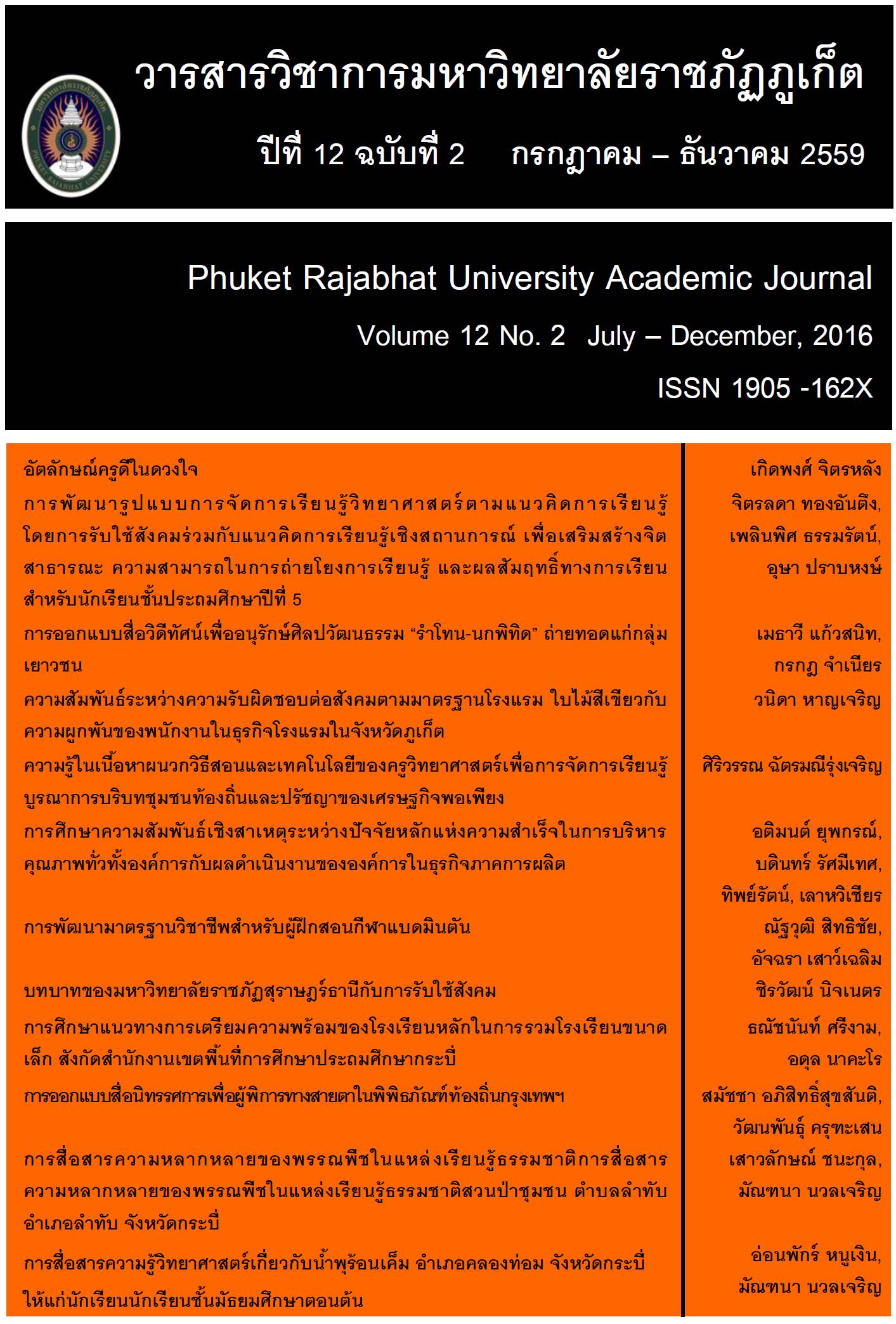
The Role of Suratthani Rajabhat University in Community Engagement
Article Sidebar
Main Article Content
Abstract
The objective of this descriptive research was to identify the role of Suratthani Rajabhat University in community engagement. The conceptual framework for monitoring university engagement performance based on 12 aspects according to the literature reviewed, namely : mission and purpose, administrative leadership, supporting structure, curriculum design (teaching and learning), staff role and reward, community-engaged research, academic extension, cultural conservation and promotion, community voice, resource allocation, public relation, and partnership. The secondary data were collected by documentary analysis of university strategic plan, annual reports, quality assessment reports and related documents while primary data were collected by using in-depth interview of key informants and focus group discussion among various stakeholders in and outside university. Data were performed through constant comparison, analytical induction of the contents. The findings were as follows :
The university had clear vision and mission in community engagement and cascaded to strategic plan of all faculties and institutions. However, the key indicators of engagement success were not quite clear both in issues and area focus. The engagement policy “one faculty, two districts” was randomly assigned to each faculty to be responsible for engagement projects in those areas. The engagement administrative structure was not quite conducive to the mission. The engagement mission was under vice president in academic service affair, academic service board and academic service division for community development as a secretariat unit. Most of curriculum and courses in programs of study in each faculty had not been designed for service learning although there were apprentice or practicum courses for students to have experiences in community work in their fields of study. Most of projects and activities delivered to the communities and organizations were academic service or extension (i.e. short-course training , seminar, lecture, exhibitions), not community engagement work which bring about change or impact on occupation, standard of living, health, environmental improvement, or sustainability development of the local people as well as most researches findings or results could not bring into practice to develop community welfare. There were just few researches that could make change in aforementioned benefits of the localities.
The findings suggested that the university should develop more potential for community engagement to enhance the welfare of local people and the benefit of targeted communities with possible and powerful action plan and active follow-up. The administrators should express of and calls for community engagement commitment from everybody in the university. The faculty staffs have to be induced and trained in a detailed treatment of community-based research, result-based academic extension, discussed in the overall context of community-university engagement and adopt service learning into most of course syllabus. The administrators also need to redesign processes of community-university engagement, including the development of structures and staffs for the support of community-based research and community-based learning (CBL). The implementation of engaged projects or activities must have been reorganized and followed up closely. Effective partnership management has to be associated with increased research on a community issue, problem, or need, improved service outcomes for clients and with increased funding for community engagement.
Article Details
The content and information published in the Phuket Rajabhat University Academic Journal represent the opinions and sole responsibility of the authors. The editorial board does not necessarily endorse or share any responsibility for these view.
Articles, data, content, images, etc., published in the Phuket Rajabhat University Academic Journal are the copyright of the Phuket Rajabhat University Academic Journal. Any individual or organization wishing to reproduce or utilize all or part of this material for any purpose must obtain prior written permission from the Phuket Rajabhat University Academic Journal.
References
ชิรวัฒน์ นิจเนตร (2557) “ความสัมพันธ์ระหว่างความฉลาดทางอารมณ์ รูปแบบการเรียนรู้ อัตราการเข้าเรียน และขนาดชั้นเรียนกับผลสัมฤทธิ์ทางการเรียนวิชาการวิจัยทางการศึกษาของนักศึกษาคณะครุศาสตร์ มหาวิทยาลัยราชภัฏภูเก็ต” ใน วารสารวิชาการมหาวิทยาลัยราชภัฏภูเก็ต ปีที่ 10 ฉบับที่ 2 กรกฎาคม-ธันวาคม 2557 หน้า 1 – 32.
นรินทร์ หิรัญสุทธิกุล (2557) จุฬาลงกรณ์มหาวิทยาลัยและพันธกิจมหาวิทยาลัยเพื่อสังคม ใน www.engagementthailand.org/images/2014conference/ppt-Narin.pptx
ปฐม มณีโรจน์. (2545) “วิวัฒนาการและความเป็นอิสระของการจัดการอุดมศึกษาของไทย” ใน อำนาจอิสระของการบริหารมหาวิทยาลัยไทย. กรุงเทพฯ : สำนักงานปลัดทบวงมหาวิทยาลัย หน้า 1-72.
รัตนวดี เศรษฐจิตร.(2558) มหาวิทยาลัยรับใช้สังคมในบริบทศตวรรษที่ 21: พะเยาโมเดล. สำนักงานกองทุนสนับสนุนงานวิจัย. สกว.สัญจร : ABC สร้างความรู้สู่โอกาสและทางเลือกของสังคมไทย เล่มที่ 8
Carnegie Foundation for the Advancement of Teaching, (n.d.). Retrieved February 22, 2008. available at http://www.carnegiefoundation.org/
Glenn Bowen, Center for Service Learning, Western Carolina University (slightly adapted) – October 11,2007Hall, Budd L. (2009) Higher Education, Community Engagement, and the Public Good :Building the Future of Continuing Education in Canada. Canadian Journal of University Continuing Education Vol. 35 No. 1, spring 2009 pp. 11–23
Hart, A., Northmore, S., and Gerhardt, C. (2009). “Briefing Paper : Auditing, Benchmarking, and Evaluating Public Engagement” available at www.publicengagement.ac.uk/sites/default/files/EvaluatingPublicEngagement_O.pdf
Holland, B. & Ramaley, J. (2008). Creating a supportive environment for community-university engagement: Conceptual frameworks. Keynote address to the HERDSA Annual Conference, Rotorua, New Zealand, July 1-4, 2008.
Hollander, Saltmarsh, & Zlotkowski, “Indicators of Engagement.” (2002). in Simon, Kenny, Brabeck, & Lerner (Eds.), Learning to Serve: Promoting Civil Society through Service-Learning . Norwell , MA : Kluwer Academic Publishers,.
Strand, K., Marullo, S., Cutforth, N., Stoecker, R. & Donohue, P. (2003). Principles of best practice for Community-based research. Michigan Journal of Community Service Learning, 9(3), 5–15.
University of Louisville, Community Engagement Glossary of Terms. Recommendation of the Community Engagement Steering Committee February 4, 2011 Acknowledgements Henry Cunningham (OCE)/Patty Payette (i2A)/Connie Shumaker (OCE/Provost) Co-Chairs: Daniel Hall, Vice President, Community Engagement, Dale Billingsley, Vice Provost for Undergraduate Affairs
The self-study process for the Carnegie Foundation Community Engagement Application 2008. available at http://louisville.edu/communityengage ment/carnegie-community-engagement-process-2008/carnegie.html
