
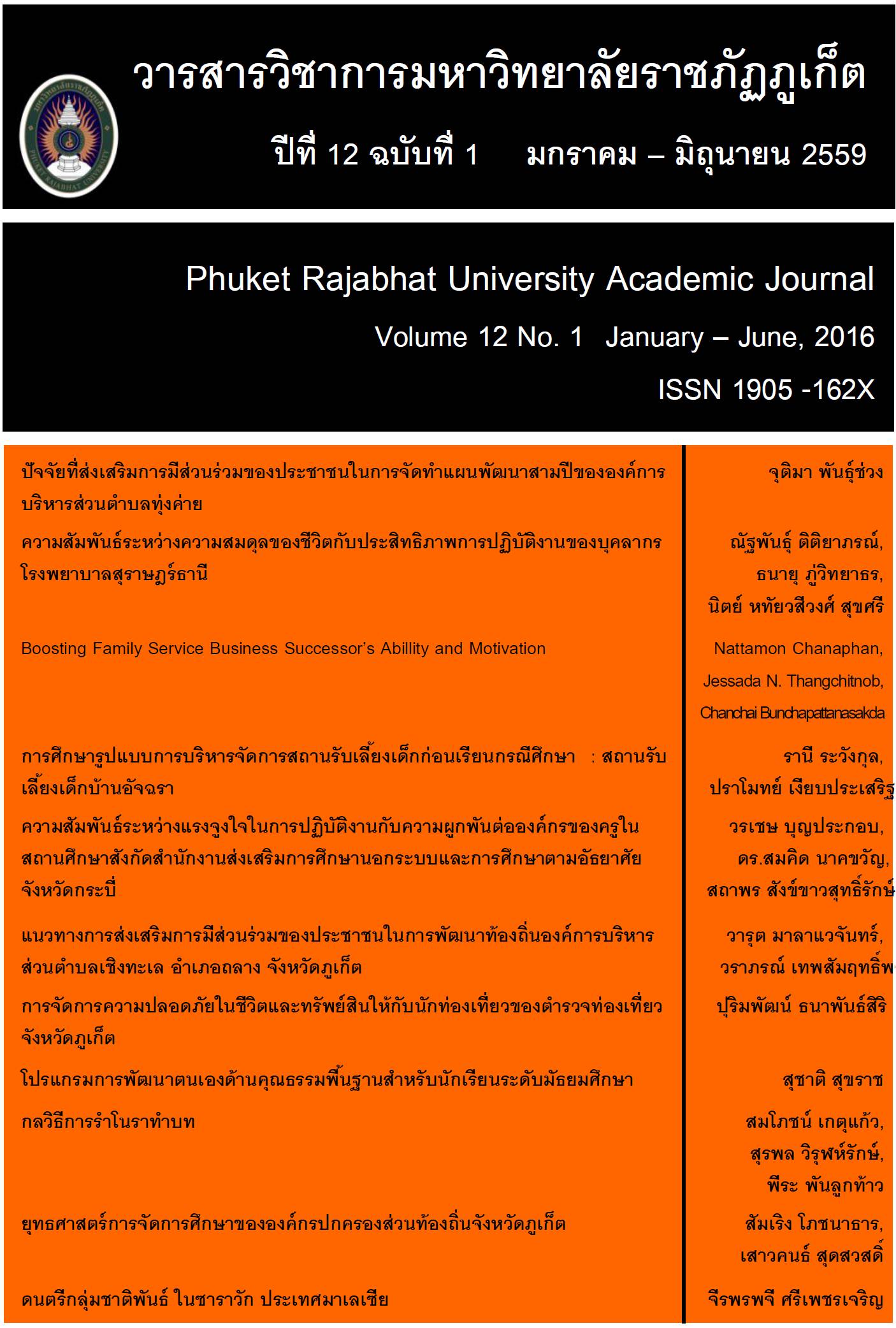
Boosting Family Service Business Successor’s Ability and Motivation
Article Sidebar
Main Article Content
Abstract
The worldwide phenomenon of third generation decline in family business could stem from diminishing entrepreneurial motivation of the successors or from imperfect conditioning of the successors by their predecessors. Given the significanceof family business to the economy, this study sought to qualitatively find out what provided the successors with more ability, more motivation, and fewer obstacles in succeeding their family business and how successful family business successions were. The research sample covered ten successors from SET listed family service businesses. Despite the supportive findings, concluding that most successions were totally successful would be naive. On factors boosting family service business successor’s ability and motivation, the study pointed out that having capable team together with five other factors were essential. Family business predecessors might consider manipulating these factors in their succession process.
Article Details
The content and information published in the Phuket Rajabhat University Academic Journal represent the opinions and sole responsibility of the authors. The editorial board does not necessarily endorse or share any responsibility for these view.
Articles, data, content, images, etc., published in the Phuket Rajabhat University Academic Journal are the copyright of the Phuket Rajabhat University Academic Journal. Any individual or organization wishing to reproduce or utilize all or part of this material for any purpose must obtain prior written permission from the Phuket Rajabhat University Academic Journal.
References
Carraher, S. M. (2005). An examination of entrepreneurial orientation : A validation study in 68 countries in Africa, Asia, Europe, and North America. International Journal of Family Business. 2(1) : 95-100.
Carraher, S. M., & Carraher, S. C. (2006). Human resource issues among SME’s in Eastern Europe : A 30 month study in Belarus, Poland, and Ukraine. International Journal of Entrepreneurship. 10 : 97-108.
De Massis, A., Chua, J. H., & Chrisman, J. J. (2008). Factors preventing intra-family succession. Family Business Review. 21(2) : 183 - 199.
Dumas, C., Dupuis, J. P., Richer, F., & St.-Cyr, L. (1995). Factors that influence the next generation’s decision to take over the family farm. Family Business Review. 8(2) : 99–120.
European Family Businesses. (2012). Family Business Statistics. Bruxelles : European Family Businesses.
Fischetti, M. (1997). The Family Business Succession Handbook. Philadelphia Family Business Publishing.
Fox, M., Nilakant, V., & Hamilton, R. T. (1996). Managing succession in family-owned Businesses. International Small Business Journal. 15(1) : 15–25.
Greenberg, J., & Baron, R. A. (1997). Behavior in organization (6th ed.). New Jersey : Prentice Hall.
Goldberg, S. D. (1996). Research note : Effective successors in family-owned businesses : Significant elements. Family Business Review. 9(2) : 185-197.
Handler, W. C. (1994). Succession in family business : A review of the research. Family Business Review. 7(2) : 133-157.
Harvey, M., & Evans, R. E. (1995). Life after succession in the family business : Is it really the end of problems? Family Business Review. 8(1) : 3-16.
Lam, L. F. (2015). Two generations’ perception of a successful business succession in small and medium-sized family business. [On-line]. Available : https://csumb.edu/sites/default/files/images/st-block-31-14281728170524009-raw-twogenerationperception of success2014.pdf. [2015, June 6].
Landes, D. S. (1965). Technological change and development in Western Europe, 1750-1914. In Habakkuk, H. J. & Postan, M. (eds.). The Cambridge Economic History of Europe (6th ed.). Cambridge : Cambridge University Press.
Lank, A. (1994). Generalizations and observations about family businesses in eastern Europe. Chicago : Loyola Press.
Matthews, C. H., Moore, T. W., & Fialko, A. S. (1999). Succession in the family firm : A cognitive categorization perspective. Family Business Review. 12(2) : 159-169.
Morris, M. H., Williams, R. W., Allen, J. A., & Avila, R. A. (1997). Correlates of success in family business transitions. Journal of Business Venturing. 12(5) : 385-401.
Neubauer, H. (2003). The dynamics of succession in family businesses in western european countries. Family Business Review. 16(4) : 269–281.
Neubauer, F., & Lank, A. G. (1998). The family business : Its governance for sustainability. London : Macmillan.
Pereira, M. F., Lisoni, J., & Serra, F. (2007). Family business : How family and ownership shapes business professionalization. Paper presented at the 2007 Business Association for Latin American Studies Annual Conference, San Jose.
Santiago, A. L. (2000). Succession experience in Philippine family businesses. Family Business Review. 8(1) : 15-40.
Sharma, P. (2004). An overview of family business studies : Current status and directions for the future. Family Business Review. 17(1) : 1-36.
Sharma, P., Chrisman, J. J., Pablo, A. L., & Chua, J. H. (2001). Determinants of initial satisfaction with the succession process in family firm : A conceptual model. Entrepreneurship Theory and Practice. 25(3) : 17-36.
Stavrou, E. (1995). The next generation’s Dilemma : To join or not to join the family business. Paper presented at the Family Firm Institute Conference, St. Louis.
Stavrou, E. (1999). Succession in family businesses : Exploring the effects of demographic factors on offspring intentions to join and take over the business. Journal of Small Business Management. 37(3) : 43–62.
Venter, E., & Boshoff, C. (2006). The influence of family-related factors on the succession process in small and medium-sized family businesses. South African Journal of Economic and Management Sciences. 9(1) : 17-32.
Venter, E., & Boshoff, C. (2007). The influence of organisaional-related factors on the succession in small and medium-sized family business. Management Dynamics. 16(1) : 42-55.
Venter, E., Boshoff, C., & Maas, G. (2005). The influence of successor-related factors on the succession in small and medium-sized family business. Family Business Review. 18(4) : 283-303.
Ward, J. L. (1988). The special role of strategic planning for family businesses. Family Business Review. 1(2) : 105-117.
Ward, J. L. (2005). Unconventional wisdom : Counterintuitive insights in family business success. Chichester : John Wiley & Sons.
