
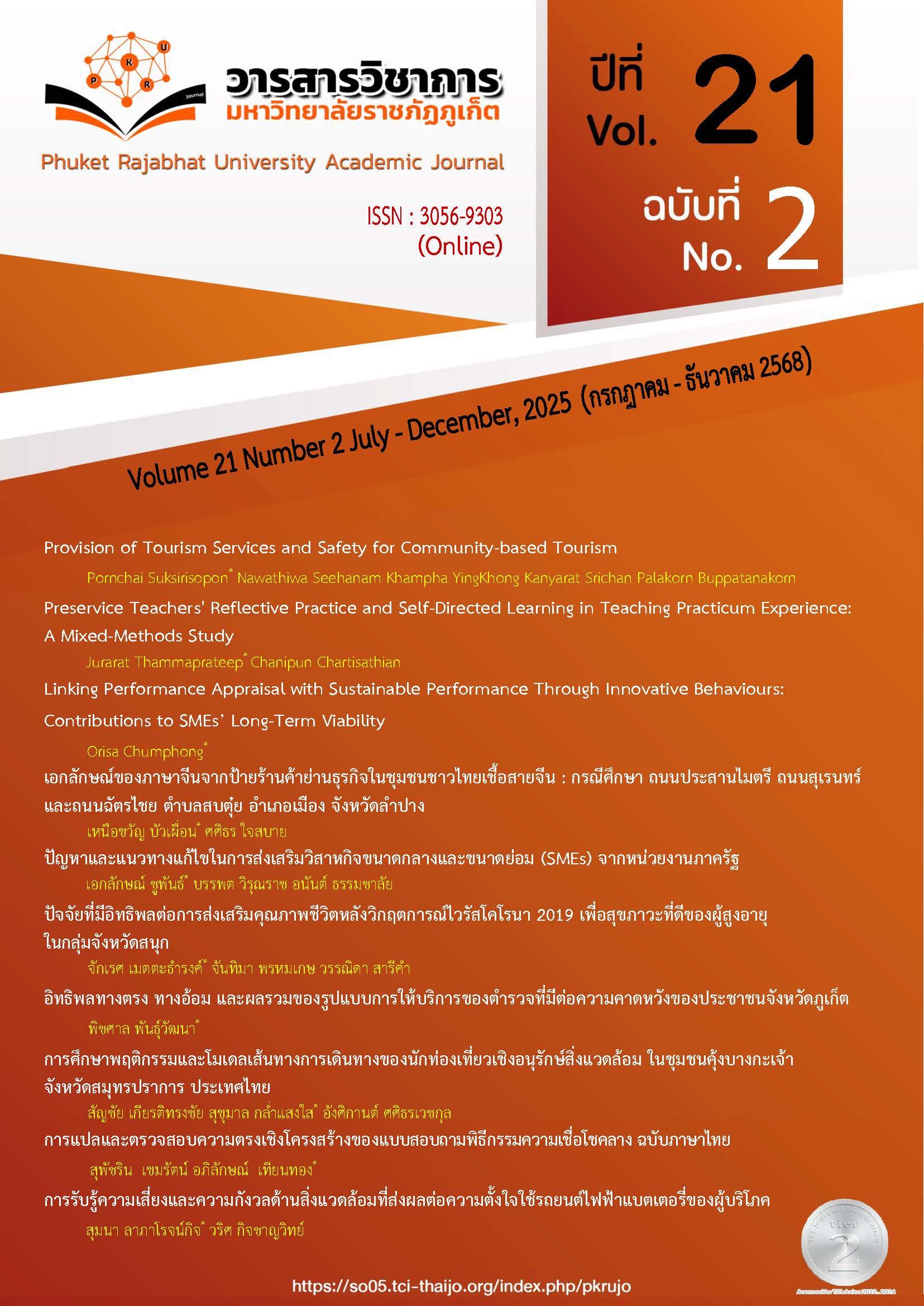
Problems and solutions in promoting small and medium-sized enterprises (SMEs) from government agencies
Article Sidebar
Main Article Content
Abstract
This academic article aims to investigate problems and solutions in promoting small and medium-sized enterprises from government agencies. The results of the study found 3 problems and solutions for supporting small and medium-sized enterprises: 1) government agencies have different missions that different people do. The business value chain system is not fully coordinated. The solution is a joint planning meeting. The upstream unit transmits information to the midstream unit and subsequently to downstream units to enhance coordination; 2) some small and medium-sized enterprises lack of access to funding sources because of incorrectly accounting systems and file tax payments. This causes financial institutions to refuse to grant loans. The solution is that government agencies should seriously campaign for small and medium-sized enterprises to register into the tax system and reach out to help guarantee loans for strong small and medium-sized enterprises lacking sufficient collateral; and 3) Small and medium-sized enterprises are still unable to adapt or use innovative technology to develop in time with the conditions of products from abroad. The solution is that government agencies taking proactive measures to offer services, guidance, and support for technological innovation aimed at fostering product development within small and medium-sized enterprises.
Article Details

This work is licensed under a Creative Commons Attribution-NonCommercial-NoDerivatives 4.0 International License.
The content and information published in the Phuket Rajabhat University Academic Journal represent the opinions and sole responsibility of the authors. The editorial board does not necessarily endorse or share any responsibility for these view.
Articles, data, content, images, etc., published in the Phuket Rajabhat University Academic Journal are the copyright of the Phuket Rajabhat University Academic Journal. Any individual or organization wishing to reproduce or utilize all or part of this material for any purpose must obtain prior written permission from the Phuket Rajabhat University Academic Journal.
References
Allen, K. R. (2006). Launching new ventures: An entrepreneurial approach (4th ed.). Houghton Mifflin.
Amnatwipavee, S. (2020). Government policy to promote small and medium enterprises to be sustainable. Journal of Administrative and Management Innovation, 8(3), 56-66.
Amnatwipavee, S. (2023). The integration of government policy implementation in sustainability of small and medium-sized enterprises development. Ph.D. in Social Sciences Journal, 13(1), 271-282.
Awae, K. (2017). Problems of business operation and needs for government supports among small and medium enterprises of gemstones in Chanthaburi Province [Master's thesis, Burapha University].
Boontanasub, T. (2024, June 24). Director of SME Knowledge and Service System Department [Personal interview].
Department of Business Development. (2023, November 8). Statistics of business going out of business. https://www.dbd.go.th/news/184261266
Heure, A., & Liñán, F. (2013). Testing alternative measures of subjective norms in entrepreneurial intention models. International Journal of Entrepreneurship and Small Business, 19(1), 35-50.
Kasikorn Research Center. (2020). Economic analysis. https://www.kasikornresearch.com/th/analysis/k-social-media/Pages/Challenges-SME-Businesses.aspx
Lekmat, L., & Intaragasam, P. (2019). Potential development guidelines of SMEs. University of the Thai Chamber of Commerce Journal Humanities and Social Sciences, 39(2), 104-122.
Maireang, K. (2020). Administration innovation model for small and medium enterprises. Journal of Social Science and Buddhistic Anthropology, 5(2), 255-269.
Office of Small and Medium Enterprise Promotion. (2017). Report the situation of SMEs. http://www.sme.go.th/
Office of Small and Medium Enterprise Promotion. (2020). Report the situation of SMEs. http://www.sme.go.th/
Office of Small and Medium Enterprise Promotion. (2021). Report the situation of SMEs. http://www.sme.go.th/
Office of Small and Medium Enterprise Promotion. (2022). Report the situation of SMEs. http://www.sme.go.th/
Pattarabanjird, S. (2016). Financial liquidity management for SMEs entrepreneurs in world economic crisis. MBA-KKU Journal, 9(1), 281-303.
Pickel, H. B., & Abrahamson, R. L. (1989). Small business management (4th ed.). John Wiley & Sons.
Pongnairat, K., & Wiroonrath, B. (2019). A model of Chinese government promotion towards business investment of Chinese investors in Thailand. Journal of Politics, Administration and Law, 12(3), 280-294.
Prasanpanid, V. (2024, June 24). Assistant director [Personal interview].
Rojanapanich, A. (2024). Qualitative characteristics of useful financial information increasing competitive advantages in small and medium enterprises (SMEs) in Bangkok. Journal of Innovation and Management SSRU, 9(1), 23-36.
Sareebut, S., Likitapiwat, T., & Thawesaengskulthai, N. (2018). The recovery of SME business among the group of entrepreneurs with declining growth (turnaround). RMUTT Global Business and Economics Review, 13(2), 79-99.
Surintaraseree, D., Kaewkuekool, S., & Vejpas, S. (2020). Taxation rights and benefits for small and medium enterprises. Academic Journal of Buriram Rajabhat University, 12(2), 115-129.
Thailand Development Research Institute. (2021). https://tdri.or.th/en/
Tunsri, K., Wiriyakitja, A., & Jangkrajarng, V. (2014). Financial access for small and medium enterprises (SMEs) in the northeastern region. University of the Thai Chamber of Commerce Journal, 34(3), 1-19.
Vatinchai, S., & Charoenporn, C. (2023). The condition affected accessibility of e-bidding between government sector and state enterprises (SME) in category of manufacturing business. Journal of Educational Innovation and Research, 7(2), 513-526.
Wongwijit, W., & Porananond, D. (2022). Problems and obstacles of small and medium enterprises (SMEs) promotion projects in the textile and garment industry. Journal for Strategy and Enterprise Competitiveness, 1(3), 66-77.
