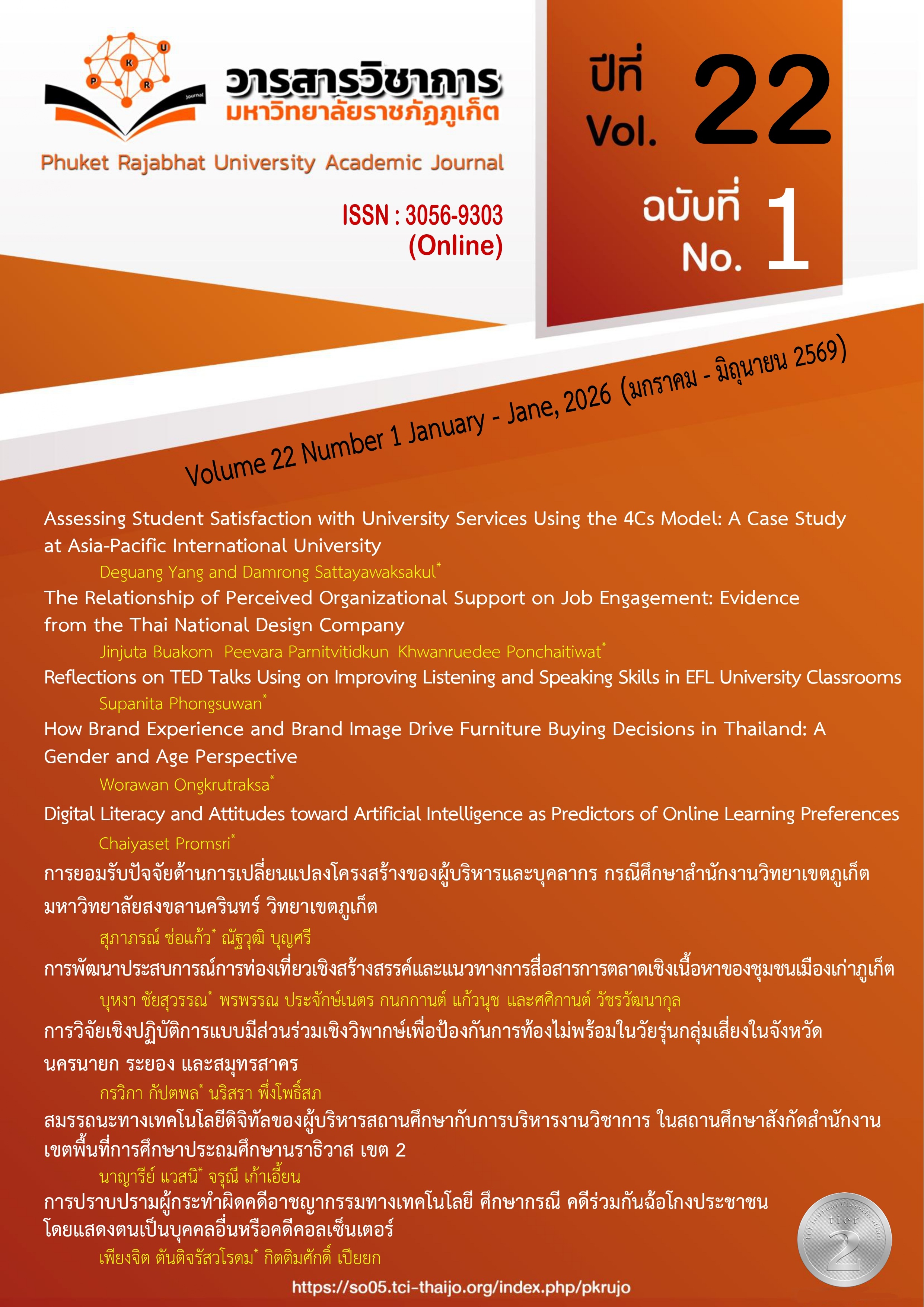
Digital Literacy and Attitudes toward Artificial Intelligence as Predictors of Online Learning Preferences
Article Sidebar
Main Article Content
Abstract
This study examined the influence of digital literacy and attitudes toward artificial intelligence (AI) on students’ online learning preferences. A quantitative research design was employed, with data collected from 177 undergraduate management students at a public university in Thailand using a structured questionnaire. The instruments included scales measuring digital literacy, AI attitudes, and online learning preferences, all of which demonstrated good reliability. Descriptive statistics showed that students reported high levels of digital literacy, positive attitudes toward AI, and strong preferences for online learning. Pearson’s correlation analysis revealed significant positive relationships among the three variables. Furthermore, multiple regression analysis confirmed that both digital literacy and AI attitudes significantly predicted students’ online learning preferences, with digital literacy emerging as the stronger predictor. These findings extended previous research by jointly analyzing skills and attitudes within a single model, demonstrating that technical competencies and perceptions toward AI collectively shaped students’ engagement in online learning. The study contributes to the literature by providing empirical evidence on the combined role of digital literacy and AI attitudes, offering implications for curriculum design, AI integration, and online learning strategies in higher education.
Article Details

This work is licensed under a Creative Commons Attribution-NonCommercial-NoDerivatives 4.0 International License.
The content and information published in the Phuket Rajabhat University Academic Journal represent the opinions and sole responsibility of the authors. The editorial board does not necessarily endorse or share any responsibility for these view.
Articles, data, content, images, etc., published in the Phuket Rajabhat University Academic Journal are the copyright of the Phuket Rajabhat University Academic Journal. Any individual or organization wishing to reproduce or utilize all or part of this material for any purpose must obtain prior written permission from the Phuket Rajabhat University Academic Journal.
References
Acosta-Enriquez, B. G., Arbulú Pérez Vargas, C. G., Huamaní Jordan, O., Arbulú Ballesteros, M. A., & Paredes Morales, A. E. (2024). Exploring attitudes toward ChatGPT among college students: An empirical analysis of cognitive, affective, and behavioral components
using path analysis. Computers and Education: Artificial Intelligence, 7, 100320. https://doi.org/10.1016/j.caeai.2024.100320
Aktay, S., Gök, S., & Yıldırım, A. (2024). Artificial intelligence attitude scale. International Technology and Education Journal, 8(2), 14–24. https://itejournal.com/articles/artificial-intelligence-attitude-scale.pdf
Alanoglu, M., Karabatak, S., & Yang, H. (2026). Understanding university students’ self-directed online learning in the context of emergency remote teaching: The role of online learning readiness and digital literacy. Journal of Computing in Higher Education, 38, 651–677. https://doi.org/10.1007/s12528-025-09458-0
American Psychological Association. (2020). Publication manual of the American Psychological Association (7th ed.). American Psychological Association.
Anderson, T. D., Ogruk-Maz, G., & Bell, T. J., III. (2024). Enhancing digital literacy in higher education: A comprehensive analysis of digital skill development among college students. Journal of Higher Education Theory and Practice, 25(3), 63–81. https://doi.org/10.33423/jhetp.v25i3.7631
Best, J. W. (1977). Research in education (3rd ed.). Prentice-Hall.
British Educational Research Association. (2018). Ethical guidelines for educational research (4th ed.). https://www.bera.ac.uk/publication/ethical-guidelines-for-educational-research-2018-online
Chen, F. (2025). The relationship between digital literacy and college students’ academic achievement: The chain mediating role of learning adaptation and online self-regulated learning. Frontiers in Psychology, 16, 1590649. https://doi.org/10.3389/fpsyg.2025.1590649
Cohen, J. (1988). Statistical power analysis for the behavioral sciences (2nd ed.). Lawrence Erlbaum Associates.
Davis, F. D. (1989). Perceived usefulness, perceived ease of use, and user acceptance of information technology. MIS Quarterly, 13(3), 319–340. https://doi.org/10.2307/249008
Deci, E. L., & Ryan, R. M. (2000). The “what” and “why” of goal pursuits: Human needs and the self-determination of behavior. Psychological Inquiry, 11(4), 227–268. https://doi.org/10.1207/S15327965PLI1104_01
Demirel, S. (2022). Developing students’ attitude scale for the online education. International Journal of Modern Education Studies, 6(2), 448–469. https://doi.org/10.51383/ijonmes.2022.239
El-Shara’, I. A., Saeed, A. S., & Arouri, Y. M. (2025). University students’ awareness and attitudes toward the use of artificial intelligence applications (AIAs) in learning: A descriptive study. International Journal of Information and Education Technology,
(3), 539–548. https://doi.org/10.18178/ijiet.2025.15.3.2264
Erdfelder, E., Faul, F., & Buchner, A. (1996). G-POWER: A general power analysis program. Behavior Research Methods, Instruments, & Computers, 28(1), 1–11. https://doi.org/10.3758/BF03203630
Etikan, I., & Bala, K. (2017). Sampling and sampling methods. Biometrics & Biostatistics International Journal, 5(6), 00149. https://doi.org/10.15406/bbij.2017.05.00149
Gautam, P. (2022, October 10). Advantages and disadvantages of online learning. eLearning Industry. https://elearningindustry.com/advantages-and-disadvantages-online-learning
Hair, J. F., Black, W. C., Babin, B. J., & Anderson, R. E. (2019). Multivariate data analysis (8th ed.). Cengage Learning.
Hermosura, L. (2025). Analysis of college students' attitude towards using AI in their academic works. World Journal of Advanced Research and Reviews, 26(1), 3634–3639. https://doi.org/10.30574/wjarr.2025.26.1.1527
Irpan, R. M., Roesminingsih, M. V., & Jacky, M. (2023). The influence of digital literacy in online learning on student learning outcomes. Studies in Philosophy of Science and Education, 4(2), 88–93. https://doi.org/10.46627/sipose.v4i2.285
Katsantonis, A., & Katsantonis, I. G. (2024). University students’ attitudes toward artificial intelligence: An exploratory study of the cognitive, emotional, and behavioural dimensions of AI attitudes. Education Sciences, 14(9), 988. https://doi.org/10.3390/educsci14090988
Kayyali, M. (2024). Digital literacy in higher education: Preparing students for the workforce of the future. International Journal of Information Science and Computing, 11(1), 53–73. https://doi.org/10.30954/2348-7437.1.2024.6
Liu, X., Wu, J., Li, B., Guo, L., & Ye, B. (2024). Digital literacy and online learning satisfaction among junior high school students: A moderated mediation model. South African Journal of Education, 44(4), 1–10. https://doi.org/10.15700/saje.v44n4a2562
Ng, W. (2012). Can we teach digital natives digital literacy? Computers & Education, 59(3), 1065–1078. https://doi.org/10.1016/j.compedu.2012.04.016
Nunnally, J. C., & Bernstein, I. H. (1994). Psychometric theory (3rd ed.). McGraw-Hill.
Nurteti, L., Pardosi, V. B. A., Maq, M. M., Hanim, S., & Tampubolon, J. (2024). Analysis of factors that influence student preferences for online learning. Journal Emerging Technologies in Education, 2(1), 61–71. https://doi.org/10.70177/jete.v2i1.745
Padohinog, E., & Balsicas, N. (2023). College students’ preferences and perceptions of online learning activities in a private school in Cavite. Journal of Science and Education (JSE), 3(3), 264–273. https://doi.org/10.56003/jse.v3i3.233
Promsri, C. (2019). The association between digital literacy and social intelligence. International Journal of English, Literature and Social Science (IJELS), 4(8), 1674–1678. https://ijels.com/detail/the-association-between-digital-literacy-and-social-intelligence
Rovinelli, R. J., & Hambleton, R. K. (1977). On the use of content specialists in the assessment of criterion-referenced test item validity. Dutch Journal of Educational Research, 2(2), 49–60.
Sun, A., & Chen, X. (2016). Online education and its effective practice: A research review. Journal of Information Technology Education: Research, 15, 157–190. https://doi.org/10.28945/3502
Tabachnick, B. G., & Fidell, L. S. (2019). Using multivariate statistics (7th ed.). Pearson.
UNESCO Institute for Statistics. (2021). Digital literacy (Glossary definition). https://uis.unesco.org/en/glossary-term/digital-literacy
Vaněček, D., Dobrovská, D., & Yorulmaz, I. (2024). Students' attitudes towards AI in teaching and learning. International Journal of Engineering Pedagogy, 14(8), 52731. https://doi.org/10.3991/ijep.v14i8.52731
Vaszkun, B., & Szakács, K. M. (2025). Looking for student success factors outside of the educators’ scope: The effect of digital literacy, personal skills, and learning habits and conditions on self-evaluated online learning effectiveness in management education. International Journal of Management Education, 23(2), 101188. https://doi.org/10.1016/j.ijme.2025.101188
Venkatesh, V., Morris, M. G., Davis, G. B., & Davis, F. D. (2003). User acceptance of information technology: Toward a unified view. MIS Quarterly, 27(3), 425–478. https://doi.org/10.2307/30036540
Vieriu, A. M., & Petrea, G. (2025). The impact of artificial intelligence (AI) on students’ academic development. Education Sciences, 15(3), 343. https://doi.org/10.3390/educsci15030343
Wang, H., & Song, Y. (2024). Portrait of college students’ online learning behavior based on artificial intelligence technology. IEEE Access, 12, 6318–6328. https://doi.org/10.1109/access.2024.3349448
Xu, Y., Chen, C., Feng, D., & Luo, Z. (2022). A survey of college students on the preference for online teaching videos of variable durations in online flipped classroom. Frontiers in Public Health, 10, 838106. https://doi.org/10.3389/fpubh.2022.838106
Zimmerman, B. J. (2002). Becoming a self-regulated learner: An overview. Theory Into Practice, 41(2), 64–70. https://doi.org/10.1207/s15430421tip4102_2
