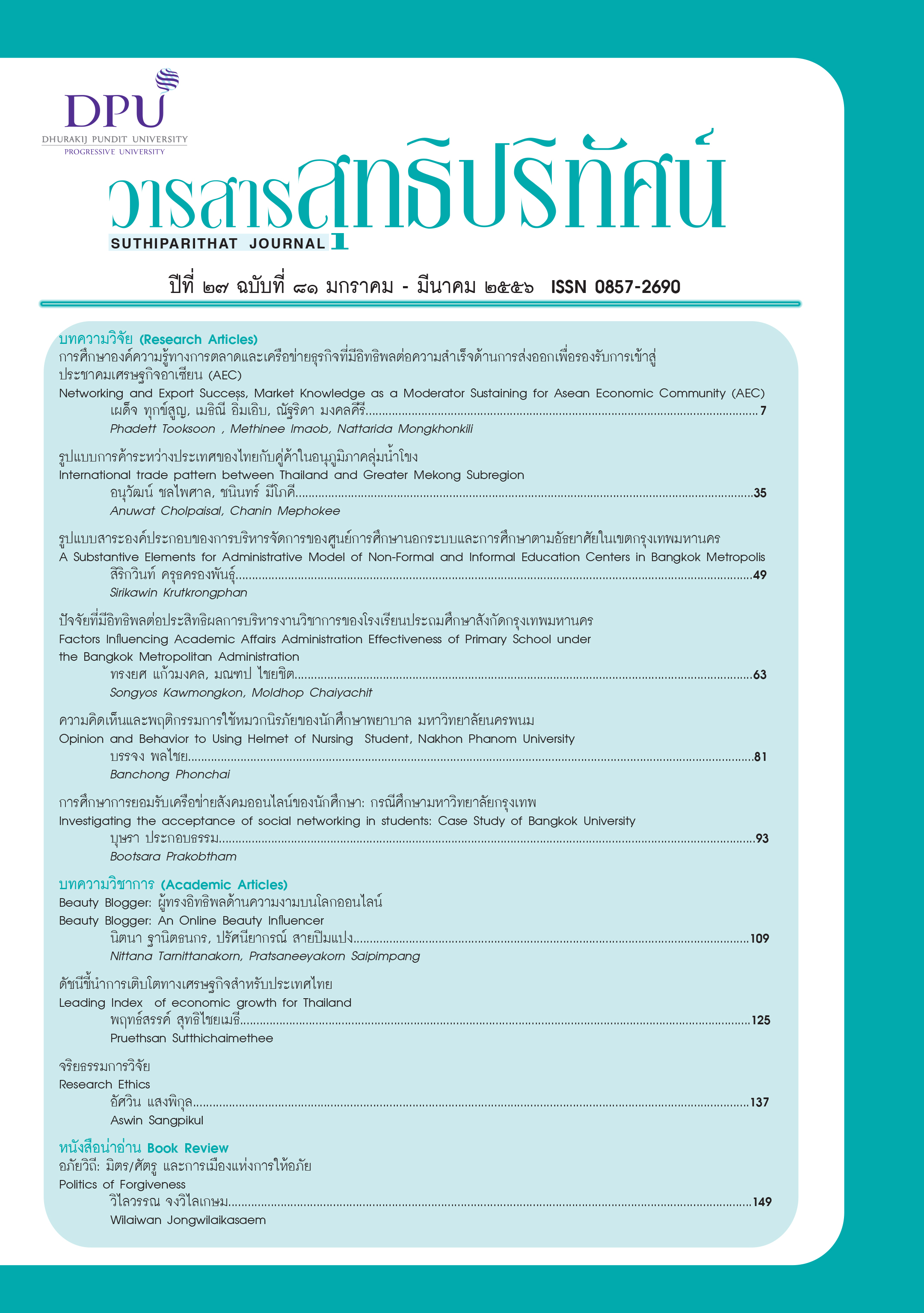
รูปแบบการค้าระหว่างประเทศของไทยกับคู่ค้าในอนุภูมิภาคลุ่มน้ำโขง
คำสำคัญ:
การค้าระหว่างประเทศ, อนุภูมิภาคลุ่มน้ำโขงบทคัดย่อ
บทความนี้ศึกษารูปแบบการค้าระหว่างประเทศของไทยกับคู่ค้าในอนุภูมิภาคลุ่มน้ำโขง ในช่วงปี พ.ศ. 2524-2553 โดยกรอบแนวคิดภูมิเศรษฐศาสตร์การค้าระหว่างประเทศ ข้อมูลที่ใช้มีลักษณะ Panel data ผลการประมาณการด้วยวิธี Generalized Least Square พบว่า นอกเหนือจากตัวแปรทางเศรษฐกิจ อาทิ ผลิตภัณฑ์มวลรวมภายในประเทศอัตราภาษี และความสามารถเชิงนโยบายในการอำนวยความสะดวกด้านการค้า ตัวแปรระยะทาง (Distance) ซึ่งในแบบจำลองหมายถึง ต้นทุนธุรกรรมเป็นตัวแปรที่สามารถอธิบายรูปแบบของการค้าของไทยกับกลุ่มประเทศคู่ค้าในช่วงเวลาดังกล่าวได้ดี
นัยเชิงนโยบายคือ การปรับปรุงโครงสร้างการผลิตควบคู่กับการพัฒนาประสิทธิผล ด้านการผลิต (Productivity) นโยบายด้านการค้าของไทยควรมีจุดยืนในลักษณะการร่วมมือมากกว่าการเป็นคู่แข่งขัน นอกจากนี้ผลการศึกษายังยืนยันถึงประโยชน์ร่วมกันของการลดต้นทุนธุรกรรมระหว่างประเทศในภูมิภาคนี้
Downloads
เอกสารอ้างอิง
จุฬาลงกรณ์มหาวิทยาลัย. คณะเศรษฐศาสตร์. (2548). โครงการศึกษาผลกระทบที่เกิดจากการเปิดเสรีการค้าอาเซียน- จีน. กรุงเทพฯ: ผู้แต่ง.
ชนินทร์ มีโภคี, และอนุวัฒน์ ชลไพศาล. (2555). การพัฒนาความร่วมมือด้านการค้าการลงทุนในอนุภูมิภาคลุ่มแม่น้ำโขง (รายงานผลการวิจัย). กรุงเทพฯ: มหาวิทยาลัยธรรมศาสตร์และคณะกรรมการวิจัยร่วม สกอ.-วช.
มนิสา นวลเต็ม. (2553). บทประยุกต์ Gravity Model: การค้าไทยกับประเทศในภูมิภาคเอเชียตะวันออก. (วิทยานิพนธ์ปริญญามหาบัณฑิต). กรุงเทพฯ: มหาวิทยาลัยธรรมศาสตร์.
Aderson, J. (1979). A Theoretical foundation for the gravity equation. American Economic Review, 69, 106-116.
Baltagi, B. (1995). Econometric analysis of panel data. N.P.: John Wiley and Son.
Bergstrand H. (1985). The Gravity equation in international trade: some microeconomic foundations and empirical evidence. Review Economic Statistics, 67(3), 474-481.
Fujimura, M., & C. Edmonds. (2006). Impact of cross-border transport infrastructure on trade and investment in the GMS. ADB Discussion Paper No. 48.
Kepaptsoglou K., et al. (2009). Analyzing free trade agreements effects in the Mediterranean region: a sure gravity model based approach. Transportation Research Record, 2097, 88-96.
Kepaptsoglou, K., et al. (2010). The Gravity model specification for modeling international trade flows and Free Trade Agreement effects: A 10-year review of empirical studies. The Open Economics Journal, 3, 1-13.
Lampe M. (2008). Bilateral trade flows in Europe, 1857-1875: a new dataset. Research in Economic History, 26(1), 81–155.
Lee H., & Park I. (2007). In search of optimized regional trade agreements and applications to East Asia. World Economy, 30(5), 783-806.
Qiu, H., Yang, J., Huang, J. & Chen, R. (2007). Impact of China–ASEAN Free Trade Area on China’s international agricultural trade and its regional development. China & World Economy, 15(4), 77-90.
ดาวน์โหลด
เผยแพร่แล้ว
รูปแบบการอ้างอิง
ฉบับ
ประเภทบทความ
สัญญาอนุญาต
เนื้อหาและข้อมูลในบทความที่ลงตีพิมพ์ในวารสารสุทธิปริทัศน์ ถือเป็นข้อคิดเห็นและความรับผิดชอบของผู้เขียนบทความโดยตรงซึ่งกองบรรณาธิการวารสาร ไม่จำเป็นต้องเห็นด้วย หรือร่วมรับผิดชอบใด ๆ
บทความ ข้อมูล เนื้อหา รูปภาพ ฯลฯ ที่ได้รับการตีพิมพ์ในวารสารสุทธิปริทัศน์ ถือเป็นลิขสิทธิ์ของวารสารสุทธิปริทัศน์หากบุคคลหรือหน่วยงานใดต้องการนำทั้งหมดหรือส่วนหนึ่งส่วนใดไปเผยแพร่ต่อหรือเพื่อกระทำการใด ๆ จะต้องได้รับอนุญาตเป็นลายลักษณ์อักษรจากวารสารสุทธิปริทัศน์ก่อนเท่านั้น