
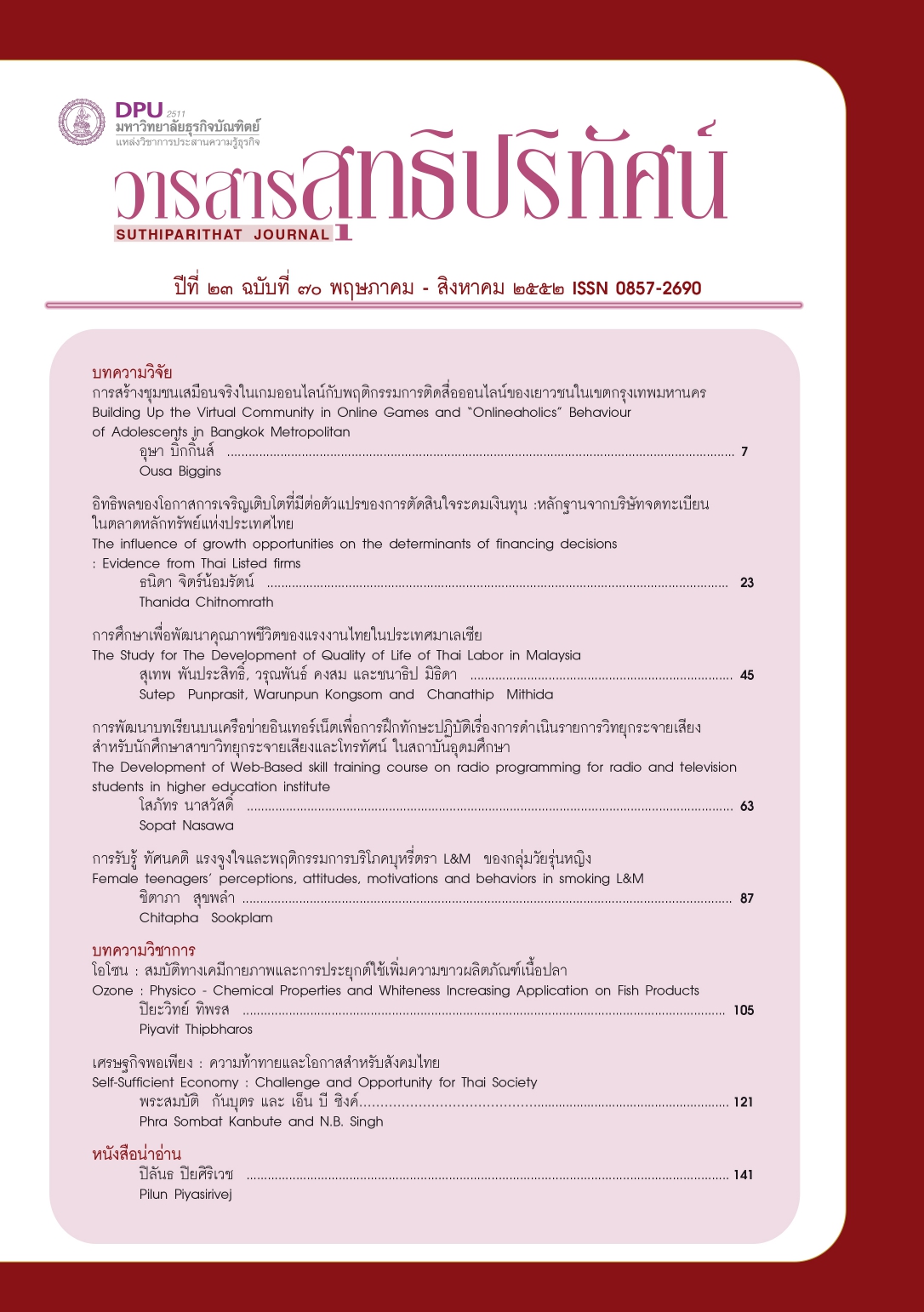
Ozone : Physico - Chemical Properties and Whiteness Increasing Application on Fish Products
Keywords:
ozone, physico-chemical properties, whiteness, fish productsAbstract
Ozone is the substance which is produced from oxygen in the air and electric energy or ultraviolet ray by changing oxygen’s chemical structure from O2 to O3 in 1 molecule. In 1840, ozone was first found by the German Scientist, C. F. Schonbein. Its qualification is water soluble at low temperature and can be applied as ozone solution which has the sanitizing property in water. According to this principle, there is a development of ozone generator for business which lets oxygen gas flows through electric stream in the discharge gap which is the result of produced electrical stream from the dielectric surface. The breakdown of ozone depends on pH value, temperature, and ultraviolet ray. There are 2 types of chemical breakdown reaction of ozone namely indirect and direct. Currently, there are many ways of using ozone namely 1) damaging toxin or biotoxic agents, 2) using as oxidized organic compounds, 3) damaging pathogenic microorganism, 4) eliminating unwanted odours, and 5) bleaching. In 1997, Dee Graham certified that ozone could be used for cleaning tools, machines, and grounds of the food processing factory. He also motivated the United States Department of Agriculture (USDA) to certify ozone by specifying the standard of “generally recognized as safe” (GRAS). Moreover, the United States for Food and Drug Administration (USFDA) officially accepted ozone in both gaseous and aqueous phases on June 26, 2001. In terms of ozone’s mechanism of “revised whiteness”, the previous research found that washing fish by ozone water could increase more lubricity value and whiteness than other ways. Because of the losing of myoglobin and bleaching, ozone would destroy the structure of porphylin in myoglobin and haemoglobin, but ozone would cause the gelation. In addition, the previous research related to the test of ozone for producing mackerel surimi found that ozone oxidized the free sulfhydryl group on protein molecule which caused the disulfide bond. Ozone could also oxidized the disulfide and led to the cysteic acid. In other words, ozone could destroy disulfide bond which led to sulfonic acid. This process caused the protein denaturation that caused the reduced capacity of gelation. As for the using of ozone for revised whiteness of horse mackerel fish, it was washed by using ozone in distilled water , and was controlled by washed water temperature lower than 5 ํC. It was found that this process could revised whiteness for 10-20 minutes because ozone was the strong oxidizing agent which could destroy the structure of porphylin. Besides, it could increase the proficiency of various composition separated by floating with bubble. Therefore, “soluble pigment” might be destroyed by this floating. As for the test of using the cooled water and washing with alkaline solution, it was found that it took long time or had to wash many times in order to revised. Moreover, it was found that ozone could revised whiteness and reduce the quantity of myoglobin and total pigment content for producing surimi by washing mackerel meat with 0.04 M ozone in citrate buffer at pH 3 for 30 minutes. In conclusion, washing fish by using of ozone must consider the residual ozone in water because if there is no residual ozone, it will be ineffective.
Downloads
References
ณัฐพล ฟ้าภิญโญ (2550). คุณภาพและการยืดอายุการเก็บรักษาปูนิ่ม (Scylla serrata Forskal) โดยใช้โอโซน กรดแอซีติก กรดแล็กติก กรดแอสคอร์บิก และการเก็บรักษาภายใต้สภาวะปรับบรรยากาศ. บัณฑิตวิทยาลัย วิทยานิพนธ์ปริญญาเอก สาขาวิชาผลิตภัณฑ์ประมง ภาควิชาผลิตภัณฑ์ คณะประมง
มหาวิทยาลัยเกษตรศาสตร์ : กรุงเทพฯ, 137 หน้า.
ยุวันดา นะหีม (2545). อิทธิพลของโอโซน ไข่ขาวผง และซีสเตอีนต่อคุณภาพเจลของซูริมิที่ทำจากปลาทูแขก (Decapterus maruadsi) แช่เยือกแข็ง. บัณฑิตวิทยาลัยปริญญาโท สาขาวิชาผลิตภัณฑ์ประมง ภาควิชาผลิตภัณฑ์ประมง คณะประมง มหาวิทยาลัยเกษตรศาสตร์. : กรุงเทพฯ, 109 หน้า.
สุทธวัฒน์ เบญจกุล (2549). การปรับปรุงสีของซูริมิจากปลาที่มีไขมันสูง. ซูริมิ : วิทยาศาสตร์และเทคโนโลยีเนื้อปลาบด. กรุงเทพฯ. สำนักพิมพ์โอเดียนสโตร์, หน้า 65.
ภาษาอังกฤษ
H. H. Chen, E. M. Chiu., and J. R. Huang (1997). Color and Gel Forming Properties of Horse Mackerel(Trachurus japonicus) as Related to Washing conditions. J. Food Sci. 62 : pp. 985 - 991.
T. L. Dew (2005). Ozone Degradation of Off - Flavors in Catfish. A Thesis Submitted to the Graduate Faculty of The Louisiana State University and Agricultural and Mechanical College. In The Department of Food Science, 69 p.
J. A. Gottschalk, M. A. Libra, and K. M. Saupe (2000). Ozonation of Water and Waste Water. Weinheim. New York, 189 p.
D. M. Graham (1997). Use of Ozone for Food Processing. Food Technology, 51(6) ; pp. 72 - 75.
J. Hoigne.1982. Mechanism, Rates and Selectivities of Oxidations of Organic Compounds Initiated by Ozonation of Water, pp.341 - 379. In Rice, R. G., and Netzer, A. (eds). Handbook of Ozone Technology and Applications. Ann. Arbor. Sci. Publ, Ann Arbor MI.
Jiang, Shan - Tzang, H.O. Ming - Lang, Sheng - H. O. Jiang, and Hsing - Chen Chen (1998). Purified NADPH - Sulfite Reductase from Saccharomyces cerevisiae Effects on Quality of Ozoned Mackerel Surimi. J. Food Sci. 63 (5) : pp. 777 - 781.
J. C., Kaminski, and P. W. Prendiville. (1996). Milwaukee,s Ozone Upgrade, Civil Engineering, September : pp. 62 - 67.
J. G. Kim, S. Daves, and A. E. Yousef (1999). Application of Ozone for Enhancing the Microbiological Safety and Quality of Foods. Journal Food Protection. 62 : pp. 1071 - 1087.
J. F. Martin, L. W. Bennett, and W. H. Graham (1988). Off - Flavor in the Channel Catfish (Icatlurus punctatus) due to 2 - methylisoborneol and its Dehydration Products. Water Sci. Technol. 29 (8/9) : pp. 65 - 99.
J. B. Mudd, L. Leavith, A. Ongun, and T. T. McManas (1989). Reaction of Ozone with Amino Acid and Protein. Atoms Environ. 23 : pp. 669 - 674.
G. R. Rip (1984). Soft Drinking Water. Lewis Publishers, Inc., United States of America. 275 p.
H. H. Tomiyasu, S. A. Fukutomi, and G. Godon (1985). Kinetics and Mechanisms of Ozone Decomposition in Basic Aqueous Solutions. Inorganic Chem. 24 : pp. 2962 – 2985.
http://www.ozoneapplications.com/info/cd_vs_uv.htm) (2008) สืบค้นเมื่อวันที่ 20 ธันวาคม 2551 จาก www.google.com
http://www.ozonesolutions.com/Ozone_Formation.html (2008) สืบค้นเมื่อวันที่ 5 ธันวาคม 2551 จาก www.google.com
http://www.ozone.meteo.be/meteo/view/en/1547746-Formatio (2008) สืบค้นเมื่อวันที่ 18 ตุลาคม 2551 จาก www.google.com
www.silvermedicine.org (2008) สืบค้นเมื่อวันที่ 20 ธันวาคม 2551 จาก www.google.com
Downloads
Published
How to Cite
Issue
Section
License
Content and information of the article published at Suthiparithat Journal are based on the sole opinions and responsibility of author(s) only. Neither the editorial board involve in......



