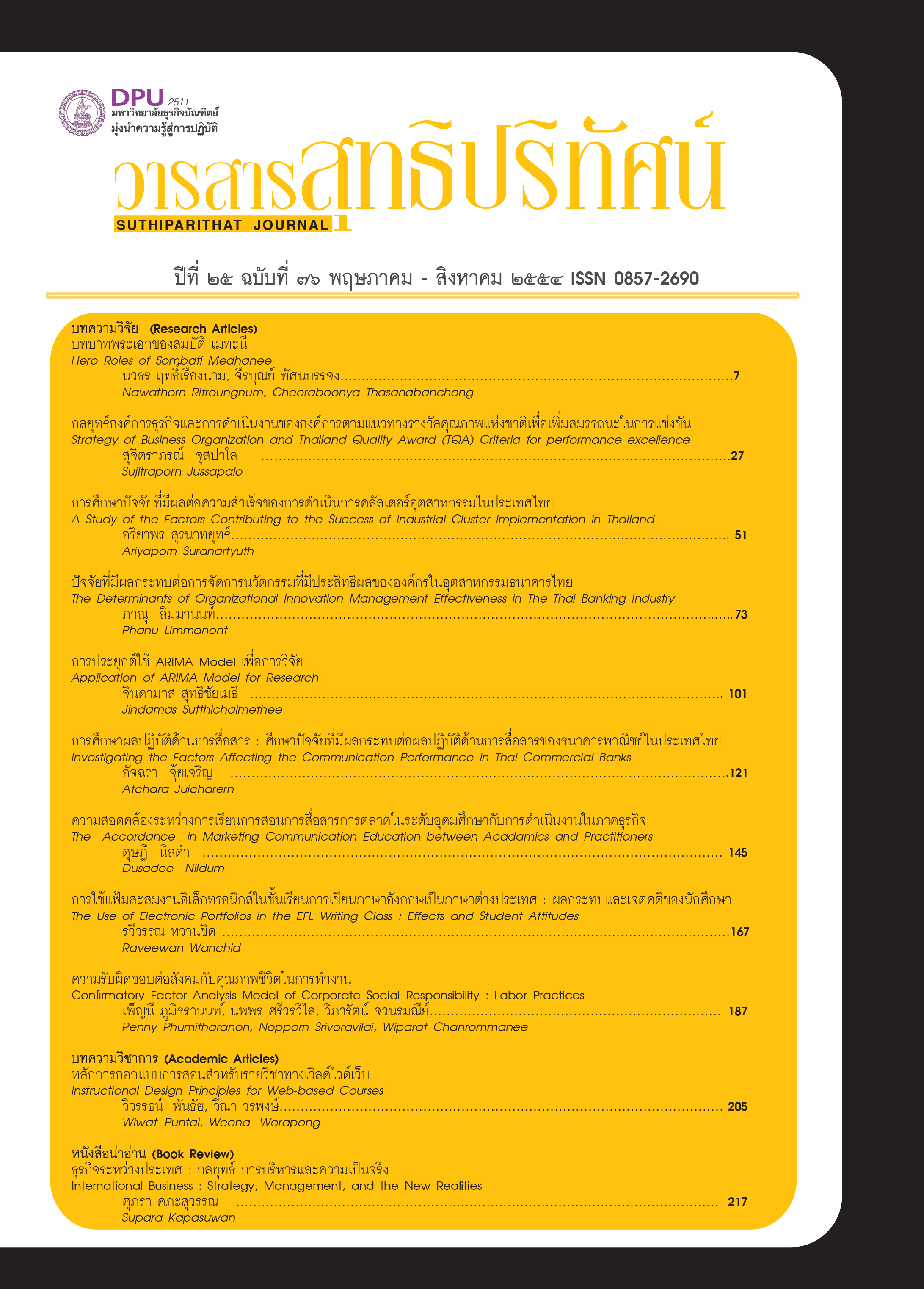
ความรับผิดชอบต่อสังคมกับคุณภาพชีวิตในการทำงาน
คำสำคัญ:
ความรับผิดชอบต่อสังคม, คุณภาพชีวิตในการทำงานบทคัดย่อ
ปัจจุบันความรับผิดชอบต่อสังคมขององค์การธุรกิจได้ถูกกล่าวถึงอย่างกว้างขวาง และขอบเขตของความรับผิดชอบต่อสังคมขององค์การธุรกิจได้ขยายขอบเขตกว้างขึ้นกว่าเดิมที่จำกัดอยู่เพียงเรื่องทางสังคมและปัญหาสิ่งแวดล้อมเท่านั้น โดยได้ขยายขอบเขตไปถึงเรื่องการพัฒนาคุณภาพมนุษย์โดยเฉพาะคุณภาพชีวิตในการทำงาน ซึ่งประเด็นการปฏิบัติด้านแรงงานได้ถูกระบุไว้ในข้อตกลงของ UN Global Compact 2000 (United Nations Global Compact, 2009) ดังนั้นการปรับปรุงคุณภาพชีวิตในการทำงานของบุคลากรจึงถือเป็นว่าเป็นประเด็นที่สำคัญในการดำเนินกิจกรรม ความรับผิดชอบต่อสังคมขององค์การธุรกิจ การวิจัยครั้งนี้จึงมีวัตถุประสงค์เพื่อศึกษาแนวคิดและแนวทางการปฏิบัติกิจกรรมความรับผิดชอบต่อสังคมขององค์การธุรกิจ ประเด็นการปฏิบัติด้านแรงงานในประเทศไทยว่ามีความสัมพันธ์กับคุณภาพชีวิตในการทำงานของบุคลากรในองค์การธุรกิจ ซึ่งผู้วิจัยได้พัฒนาแบบสอบถาม จากมาตรฐานความรับผิดชอบของผู้ประกอบการอุตสาหกรรมต่อสังคม (Standard of Corporate Social Responsibility: CSR-DIW) ของกรมโรงงาน กระทรวงอุตสาหกรรม และหลักการปฏิบัติของมาตรฐานสากล ISO26000 (ISO/DIS 26000, 2009) ขององค์การมาตรฐานสากล ISO เพื่อเป็นเครื่องมือในการวิจัย และกระจายเก็บข้อมูลจากพนักงานจากบริษัทที่ได้รับการรับรองมาตรฐานความรับผิดชอบของผู้ประกอบการอุตสาหกรรมต่อสังคม (Standard of Corporate Social Responsibility: CSR-DIW) โดยผลการวิเคราะห์ด้วยโปรแกรม LISREL พบว่าความสัมพันธ์ของการดำเนินกิจกรรม ความรับผิดชอบต่อสังคมประเด็นการปฏิบัติด้านแรงงานขององค์การ (Corporate Social Responsibility) กับคุณภาพชีวิตการทำงานของบุคลากร (Quality of Work Life) มีความสัมพันธ์กันและเป็นไปในทิศทางเดียวกัน โดยองค์ประกอบที่สำคัญที่สุดของกิจกรรมความรับผิดชอบต่อสังคมขององค์การธุรกิจประเด็นการปฏิบัติด้านแรงงานนั้น คือประเด็นการสานเสวนาทางสังคม และองค์ประกอบที่สำคัญรองลงมาคือการพัฒนาและฝึกอบรมทรัพยากรมนุษย์
Downloads
เอกสารอ้างอิง
หนังสือ
กระทรวงอุตสาหกรรม. 2552. มาตรฐานความรับผิดชอบของผู้ประกอบการอุตสาหกรรมต่อสังคม.
จินตนา บุญบงการ. 2547. จริยธรรมทางธุรกิจ. พิมพ์ครั้งที่ 3. สำนักพิมพ์แห่งจุฬาลงกรณ์มหาวิทยาลัย.
สุวิมล ติรกานันท์. 2551. การสร้างเครืองมือวัดตัวแปรในการวิจัยทางสังคมศาสตร์ : แนวทางสู่การปฏิบัติ. พิมพ์ครั้งที่ 2. กรุงเทพฯ : โรงพิมพ์แห่งจุฬาลงกรณ์มหาวิทยาลัย.
อุทุมพร(ทองอุไทย) จามรมาน. การเลือกใช้เทคนิคทางสถิติเพื่อวิเคราะห์ข้อมูลทางสังคมศาสตร์. กรุงเทพฯ : ห้างหุ้นส่วนจำกัด พันนี่พับบลิชชิ่ง. 2531.
วารสาร
กัลยาณี คูณมี และบุษยา วีรกูล (2550). “จริยธรรม คุณภาพชีวิตในการทำงาน และผลลัพธ์ที่เกี่ยวข้องกับงานของพนักงาน: การสำรวจจากผู้จัดการด้านทรัพยากรมนุษย์แลพผู้จัดการด้านการตลาดขององค์การไทย”. วารสารพัฒนบริหารศาสตร์. ปีที่ 47 ฉบับที่ 4/2550
กวี วงศ์พุฒิ พันตรี. 2550. “คุณภาพชีวิตของคนไทยในภาวะเศรษฐกิจพอเพียง”. สยามรัฐ. 22 ธันวาคม 2550
ทัศนา แสวงศักดิ์. (2549, มิถุนายน-ตุลาคม). “คุณลักษณะที่ส่งผลต่อคุณภาพชีวิตการทำงานของผู้บริหารสถานศึกษา สังกัดสำนักงานเขตพื้นที่การศึกษาปทุมธานี”. วารสารศึกษาศาสตร์. ปีที่ 18 ฉบับที่ 1. หน้า 45-60
อนันตชัย ยูรประถม. 2550. “The Myth of CSR (จบ): ความสัมพันธ์ของการพัฒนาอย่างยั่งยืนและ CSR”. ประชาชาติธุรกิจ. 9 กรกฎาคม 2550. ปีที่ 31 ฉบับที่ 3912 (3112). 42
อมราพร ปวะบุตร, ปพฤกษ์ อุตสาหะวาณิชกิจ และจิระทัศน์ ชิดทรงสวัสดิ์. (2550). “ความสัมพันธ์ระหว่างความโปร่งใส ความรับผิดชอบต่อสังคมและภาพลักษณ์องค์การของธุรกิจที่ได้รับการส่งเสริมการลงทุน”. วารสารมนุษยศาสตร์และสังคมศาสตร์ มหาวิทยาลัยมหาสารคาม. ปีที่ 26 ฉบับที่ 2 เม.ย.-มิ.ย. 2550 หน้าที่ 99-109
Bala Ramasamy and Hung Woan Ting. 2004. “A Comparative Analysis of Corporate Social Responsibility Awareness”. The Journal of Corporate Citizenship. Spring 13. 109-123
Bhattacharya C.B., Sankar Sen and Daniel Korschun. (2008). “Using Corporate Social Responsibility to Win the War for Talent”. MIT Sloan Management Review, Vol. 49, No. 2. p. 37-44.
Browning, E.S. 2002. “Investor Confidence Remains Fickle-Dow Barly Above Post – Sept. 11 Low as S&P, NASDAQ Still Languish, Terrorism is Discounted as Factor”. The Wall Street Journal. Sept 9
Carroll Archie B. (1979). “A Three-Dimensional Conceptual Model of Corporate Performance”. Academy of Management Review, Vol. 4 No.4. pp. 497-505.
Carroll Archie B. (2001). “The Pyramid of Corporate Social Responsibility: Toward the Moral Management of Organizational Stakeholder”. Business Horizons. Vol. 39. Jul-Aug 1991.
Deborah E. Rupp, Jyoti Ganapathi, Ruth V. Aguilera and Cynthia A. Williams. (2006). “Employee Reactions to Corporate Social Responsibility: An Organizational Justice Framework”. Journal of Organizational Behavior. Vol. 27 .p. 537-543.
Gibbs, N. 2002. “Summer of Mistrust”. Time. 160 (4). 16-20.
Gillian, Considine and Ron, Callus. (2001). “The Quality of Work Life of Australian Employee - The Development of an Index.” University of Sydney.
Huse E.F. and Cumming T.G. (1985). “Organization Development and Change”, Minnesota: West Publishing, pp. 198-199
Lewin, A.Y., Sakano, T., Stephens, C.U., and Victor, B. 1995. “Corporate Citizenship in Japan: Survey Results from Japanese Firms”. Journal of Business Ethics 14(2). 83-101
Maignan I., Ralston, D. 2002. “Corporate Social Responsibility in European and LJS: Insights from Business’ Self Presentaton”. Journal of International Business studies. Vol.33 (3). 497-514.
Mary Campbell. 1997. “The Family as Stakeholders”. Business Strategy Review. Vol. 8 (2). 29-37.
Snider J., Hill R.P. and Martine D. 2003. “Corporate Social Responsibility in the 21st Century: A View from the World’s most Successful Firms”. Journal of Business Ethics. Vol.24 (2). (December).175-187.
Walton R.E. (1974). “Critiria for Quality of Work Life”. The Quality of Work Life. New York : Free Press.
Yin, R. 1989. “Case Study Research: Design and Methods”. Californaia: Sage Publications.
Zikmund, W. 2003. Essentials of Marketing Research. USA: Thompson South-Western.
ข้อมูลออนไลน์
Hae-Ryong Kim, Moonkyu Lee, Hyoung-Tark Lee and Na-Min Kim. (2010). “Corporate Social Responsibility and Employee - Company Identification”. Journal of Business Ethics, Springer 2010. Published online: 13 February 2010.
Leif Jackson. (2008). “Corporate Social Responsibility (CSR) What it is, Why you Should Care, and What you Need to Do”. Chicago Business. http://www.chibus,com. Retrieved on May 25, 2008
Raynard P., Forstater M. “Corporate Social Responsibility: Implications for Small and Medium Enterprises in Developing Countries”. Available from http://www.unido.org/userfiles/BethkeK/csr.pdf (Access date: 2 March 2008).
http://www.iso.org/. (Access date: 2 April 2009).
http://www.unglobalcompact.org/ (Access date: 2 April 2009).
ดาวน์โหลด
เผยแพร่แล้ว
รูปแบบการอ้างอิง
ฉบับ
ประเภทบทความ
สัญญาอนุญาต
เนื้อหาและข้อมูลในบทความที่ลงตีพิมพ์ในวารสารสุทธิปริทัศน์ ถือเป็นข้อคิดเห็นและความรับผิดชอบของผู้เขียนบทความโดยตรงซึ่งกองบรรณาธิการวารสาร ไม่จำเป็นต้องเห็นด้วย หรือร่วมรับผิดชอบใด ๆ
บทความ ข้อมูล เนื้อหา รูปภาพ ฯลฯ ที่ได้รับการตีพิมพ์ในวารสารสุทธิปริทัศน์ ถือเป็นลิขสิทธิ์ของวารสารสุทธิปริทัศน์หากบุคคลหรือหน่วยงานใดต้องการนำทั้งหมดหรือส่วนหนึ่งส่วนใดไปเผยแพร่ต่อหรือเพื่อกระทำการใด ๆ จะต้องได้รับอนุญาตเป็นลายลักษณ์อักษรจากวารสารสุทธิปริทัศน์ก่อนเท่านั้น