
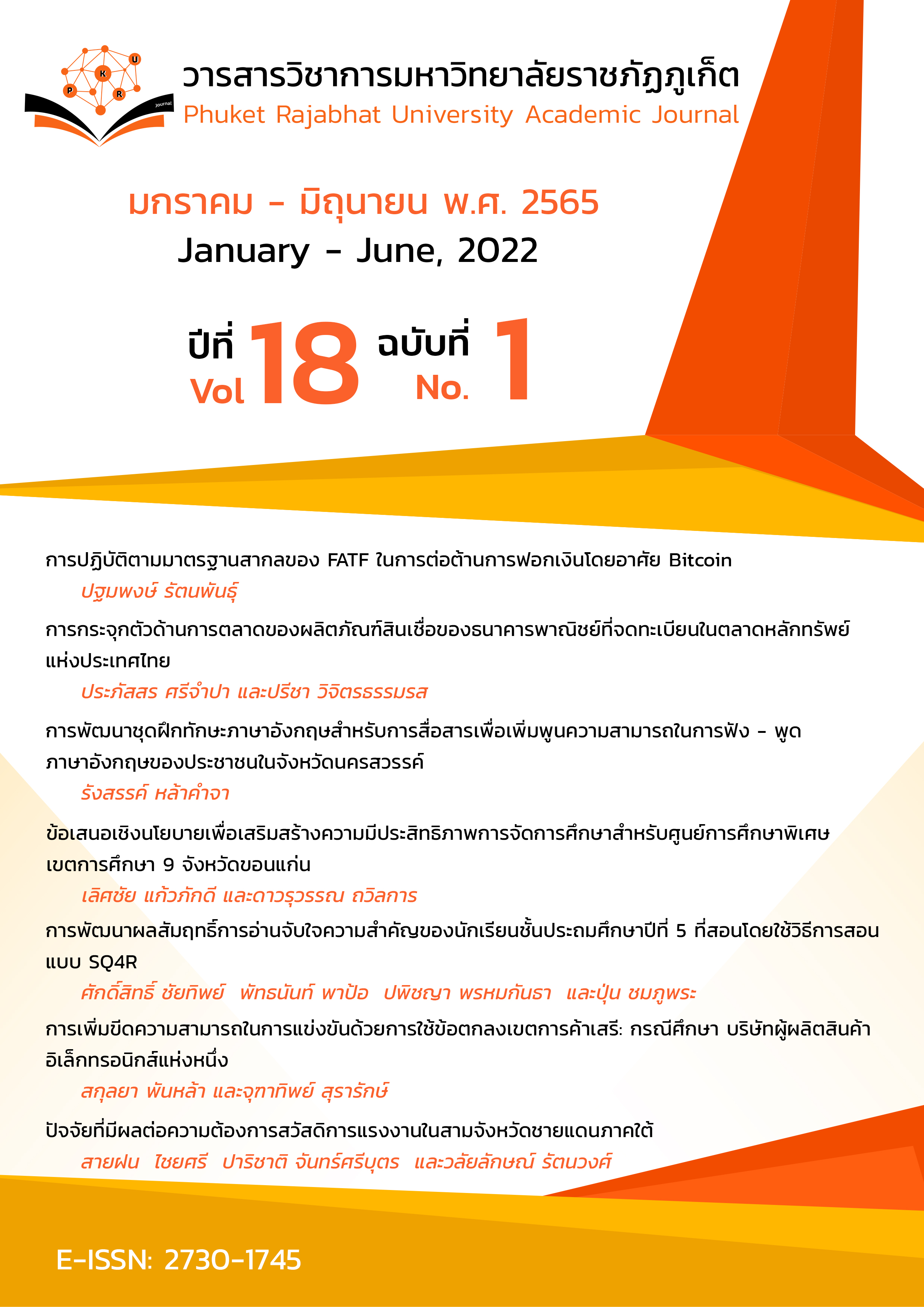
The development of communicative english packages to enhance english listening-speaking abilities among people in nakhon sawan province
Article Sidebar
Main Article Content
Abstract
This research aimed to 1) study the need for content in the development of English listening-speaking skills for communication among people in Nakhon Sawan Province; 2) develop English listening-speaking skills for communication among people in Nakhon Sawan to enhance work potential; and 3) study the satisfaction of training packages to improve English listening-speaking skills for communication among people in Nakhon Sawan province as well as enhance work potential. The experimental group consisted of working people in public and private organizations and independent professionals in Nakhon Sawan province, ready to develop English listening and speaking skills to communicate with 30 people using systematic random sampling with frequent probability. The training took place for 30 hours, six hours each time, five times. The tools used in the experiment were 1) structured and unstructured interviews. 2) English listening and speaking skills communication training packages 3) Pre- and post-testing 4) a satisfaction questionnaire, and a 5) an observation form. The statistics used for data analysis were 1) frequency, 2) percentage, 3) mean, and 4) standard deviation.
The study indicated that 1) After the samples were trained using the English listening-speaking skills training packages, the participants had enhanced listening-speaking abilities with statistical significance at the level of 0.05. 2) The results of observations of people's listening-speaking behavior while attending the training and using language skills for communication. It was found that people's ability to listen to and speak English for communication increased, respectively, as follows: Level 1 was in the low range. Level 2 was moderate, with an average of 2.48. Level 3 and 4 were at a high level with an average of 3.12 and mean values of 3.63 and 4.20, respectively. The last level, the fifth level, was the highest level. with an average of 4.61. 3) The satisfaction assessment results in the development of the English for Communication Skills Development Training Package. It was found that the satisfaction assessment results in all 4 aspects were at a high level. When considering each aspect, it was found that the average score of the speakers was 4.56, followed by the duration, location, and various facilities. The mean score was 4.46, the knowledge application aspect, the mean score was 4.36, and the content of the training course, the mean score was 4.07.
Article Details

This work is licensed under a Creative Commons Attribution-NonCommercial-NoDerivatives 4.0 International License.
The content and information published in the Phuket Rajabhat University Academic Journal represent the opinions and sole responsibility of the authors. The editorial board does not necessarily endorse or share any responsibility for these view.
Articles, data, content, images, etc., published in the Phuket Rajabhat University Academic Journal are the copyright of the Phuket Rajabhat University Academic Journal. Any individual or organization wishing to reproduce or utilize all or part of this material for any purpose must obtain prior written permission from the Phuket Rajabhat University Academic Journal.
References
Hutchinson, T., & Waters, A. (1987). English for Specific Purposes: A Learning – centered Approach. Cambridge University Press.
Jamjaroen, S. (2016). English Listening and Speaking Skill Development by English Language Activities. Academic Journal Phranakhon Rajabhat University, 7(1), 85-91.
Klein, S.B. (1991). Learning. McGraw –Hill.
Knowles, M.S. (1980). The Modern Practice of Adult Education: From Pedagogy to Andragogy. Cambridge University Press.
Kowtrakul, S. (1996). Education Psychology. Chulalongkorn University Press.
Lertvattrakan, W. (2013). The development of instructional package to practice listening and speaking in English communication with emphasis work for primary 5 Mareewittaya School. [Master’s thesis, Silpakorn University]. Silpakorn University Central Library. Retrieved December 21st, 2021, from http://www.sure.su.ac.th/xmlui/handle/12345 6789/7933
Phuliamkam, N., Worakham, P. & Chanthachum, N. (2019). The Development of Listening and Speaking Skills in English for the 3rd Year of Vocation Certificate students at Northeastern Vocational Institute of Agricultural. Journal of Roi Et Rajabhat University. 13(1), 162 – 173.
Richards, J. & Rodgers, T. (1986). Approaches and Methods in Language Teaching. Cambridge University Press.
Rovinelli, R.J. & Hambletan, R.K. (1977). On In Use of Content Specialists in The Assessment of Criterion-Reference Test Item Validity. Dutch Journal of Educational Research, 2(2), 49-60.
Rujichom, K. (2018.) English Communication Life Skills of Thailand People in the 21st Century. Journal of Arts Management, 2(3), 199-210.
Thanakong, K. & Adipattaranan, N. (2017). Using Communicative Language Teaching Activities to Enhance English Listening-Speaking Abilities and Grammatical Knowledge among Undergraduate Students. Journal of Education Naresuan University, 19(4), 51-64.
Viriyachitra et al. (2012). Looking back and moving: Forward of English learning. Bangkok: Window on the world publishing.
Wikipedia. (2019). Learning Theory. Retrieved December 21st, 2021, from https://th.wikipedia. org/wiki/learningtheory
