
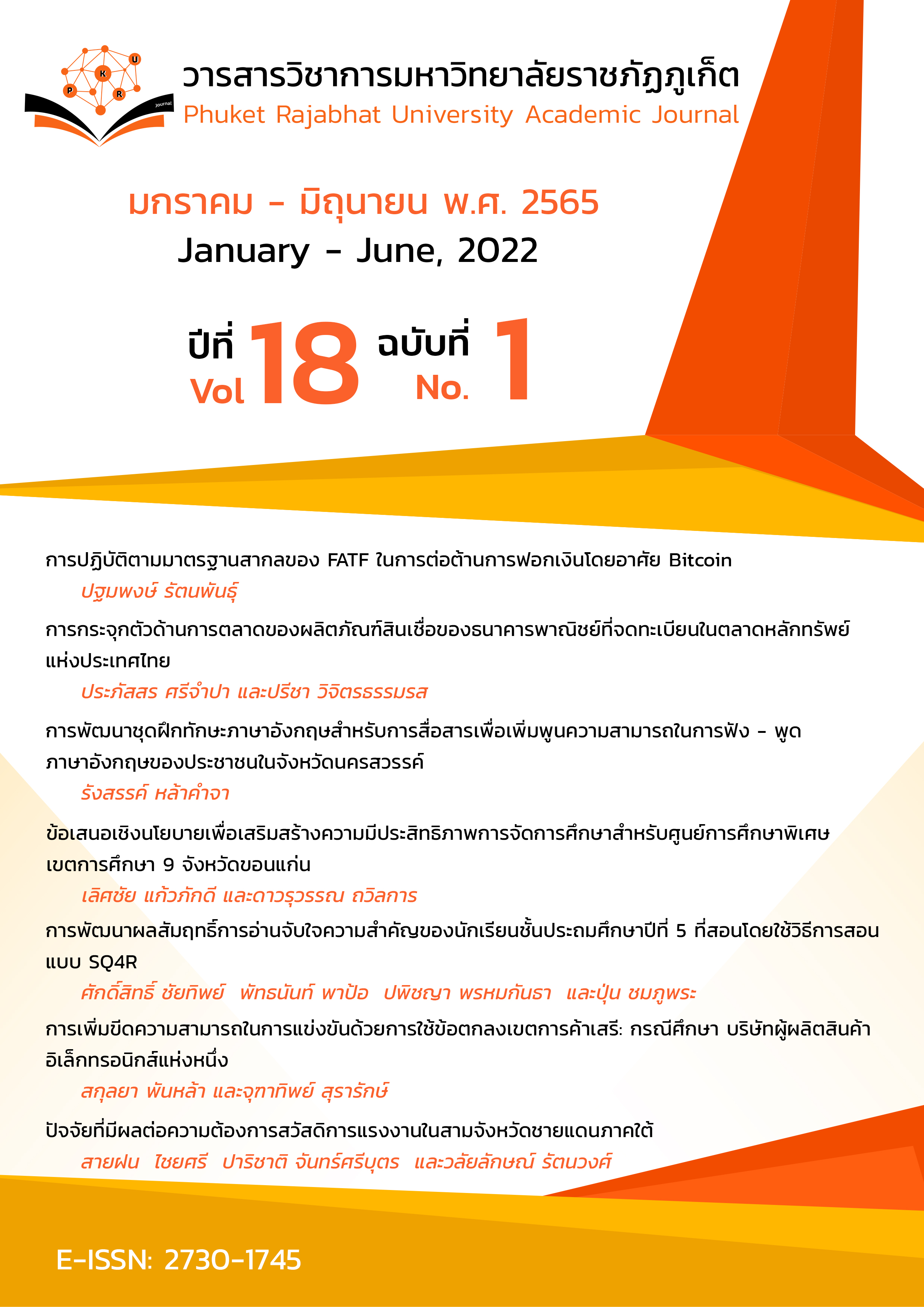
Thailand’s Obligations of The FATF’s International Standards Concerning on Anti-Money Laundering by Using Bitcoin
Article Sidebar
Main Article Content
Abstract
Money laundering is the problem affects the global economy which all states in the international community must focus and create measures to achieve the objectives of mutual prevention and suppression of money laundering. It is the good image of those state about the efficiency of capital protection which is the important factor in investor's investment decision. The result is both of internal and international economic system continue growing up. Nowadays, financial technology has evolved into the digital age, Blockchain and Bitcoin is the most interesting. Anti-money laundering laws need to be dynamic and to be adapted to situations which Bitcoin is used as a money laundering. The content of this paper is to study and compare about international law and international standard against anti-money laundering with Thailand Emergency Decree on Digital Asset Business Operation, B.E. 2561 (2018), To present the importance of the problem and analyze Thailand's obligations to such international rules, And assessing of Thailand's compliance level with international standards. Moreover, the examples of practical problem which may arise from the creation of anti-money laundering measures by using Cryptocurrencies are also explained. According to the results of the research, Thailand is one of the first countries in the Southeast Asian region to have a digital asset regulation which is responsible for regulating and protecting cryptocurrencies investments. However, there are some issues which are not compliance with the international standards on money laundering, Financial Action Task Force (FATF). Therefore, the research proposes additional legislation which based on the United States' Uniform Regulation of Virtual-Currency Businesses Act (URVCBA) as the basis.
Article Details

This work is licensed under a Creative Commons Attribution-NonCommercial-NoDerivatives 4.0 International License.
The content and information published in the Phuket Rajabhat University Academic Journal represent the opinions and sole responsibility of the authors. The editorial board does not necessarily endorse or share any responsibility for these view.
Articles, data, content, images, etc., published in the Phuket Rajabhat University Academic Journal are the copyright of the Phuket Rajabhat University Academic Journal. Any individual or organization wishing to reproduce or utilize all or part of this material for any purpose must obtain prior written permission from the Phuket Rajabhat University Academic Journal.
References
Anning, P., Hoegner, S., & Brito, J. (2015). The Law of Bitcoin. iUniverse.
Apaiyanukorn, P. (2015). Anti-Money Laundering Against Virtual Currency in Case of Using Bitcoin. [Master’s thesis, Thammasat University]. Thammasat University.
Bit Investment. (2021). EP501 Many ways to own Bitcoin, how do you find it? Let's share. Retrieved May 17th, 2019, from https://www.youtube.com/watch?v=NpmXRcyQVXM
Boonborwornrattanakul, P. (2018). The Study of "Form" and "Control" of The Utilization of Cryptocurrency For Money Laundering Protection. [Master’s thesis, Thammasat University]. Thammasat University.
Bowtakul, K. (2001). Measures to Prevent and Combat Money Laundering Derived from Corruption Offenses. [Master’s thesis, Chulalongkorn University]. Chulalongkorn University.
Financial Action Task Force (FATF). (2014). Virtual Currencies: Key Definitions and Potential AML/CFT Risks. (n.p.).
Financial Action Task Force (FATF). (2019). Guidance for a Risk-Based Approach Virtual Assets and Virtual Asset Service Providers. (n.p.).
Inland Revenue Authority of Singapore. (2020). Income Tax Treatment of Virtual Currencies. Retrieved May 17th, 2019, from https://www.iras.gov.sg/irashome/uploadedFiles/IRASHome /e-Tax_Guides/etaxguide_CIT_Income%20Tax%20Treatment%20of%20Digital%20Tokens.pdf
Japan’s Payment Services Act (PSA). (2016). (n.p.).
Kawachart, P. (2014). Decentralized Virtual Currency on The Internet. [Master’s thesis, Thammasat University]. Thammasat University.
Kharpal, A. (2019). Bitcoin value rises over $1 billion as Japan, Russia move to legitimize cryptocurrency. Retrieved May 17th, 2019, from https://www.cnbc.com/2017/04/12/ bitcoin-price-rises-japan-russia-regulation.html.
Kowpatanakit, P., Bunaramrueang, P., Eiamchamroonlarp, P., Chaidejsuriya, J., & Mongkolvitt, P. (2018). The Project on Digital Assets Law Enforcement. Chulalongkorn University.
Nakamoto, S. (2008). Bitcoin: A Peer-to-Peer Electronic Cash System. Retrieved May 17th, 2019, from https://bitcoin.org/bitcoin.pdf
Reuters. (n.d.). ADVISORY-References to bitcoin as ‘legal tender’ in Japan. Retrieved May 17th, 2019, from https://www.reuters.com/article/idUKL3N1OD35L?edition-redirect=uk
Sakkosol, C. (2001). Money Laundering : A Case Study Comparing Between The Thai Laws and United Nations Convention Against Transnational Organized Crime. [Master’s thesis, Chulalongkorn University]. Chulalongkorn University.
Sooksena, N. (2017). Digital Currency Regulatory Measures and Thai Laws Applicable to Cryptocurrency: Bitcoin. [Master’s thesis, National Institute of Development Administration]. National Institute of Development Administration.
Srisanit, P. (2018). Advanced Criminal Law. (2nd ed). Winyuchon.
Thai Government. (2020). Summary of important works of the Anti-Money Laundering Office (Anti-Money Laundering Office) on prevention troubleshooting Providing services to people in various fields and improving and developing the country. Retrieved February 16th, 2019, from https://media.thaigov.go.th/uploads/public_img/source/สำนักงานป้องกันและปราบปรามการฟอกเงิน.pdf
Thailand Emergency Decree on Digital Asset Business Operation. (2018). (n.p.).
Umeda, S. (2019). Regulation of Cryptocurrency: Japan. Retrieved May 17th, 2019, from https://www.loc.gov/law/help/cryptocurrency/japan.php
Watcharaprida, R. (2004). United Nations Convention against Transnational Organized Crime. [Master’s thesis, Thammasat University]. Thammasat University.
