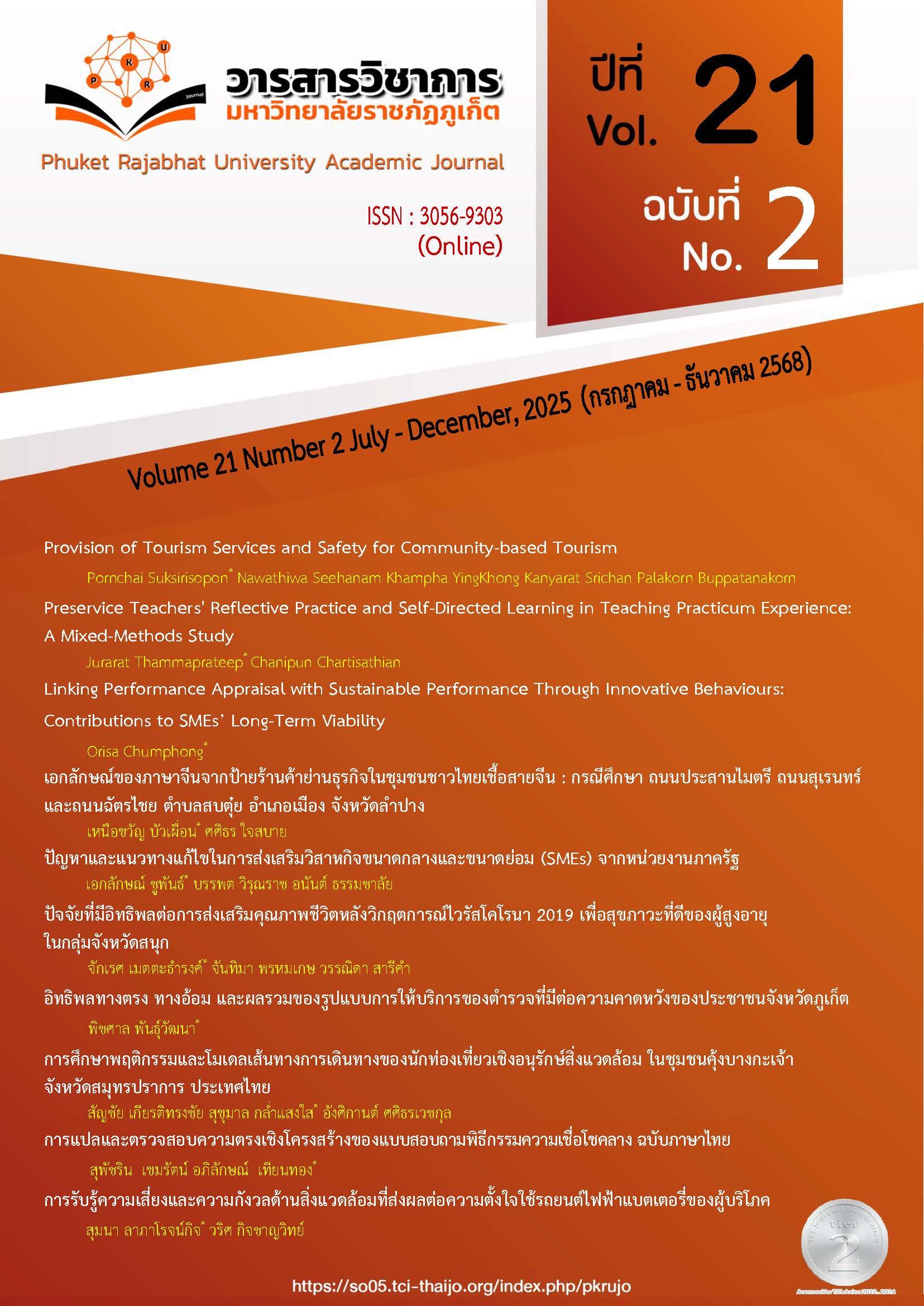
Preservice Teachers' Reflective Practice and Self-Directed Learning in Teaching Practicum Experience: A Mixed-Methods Study
Article Sidebar
Main Article Content
Abstract
This mixed-methods study explores the role of reflective practice in fostering self-directed learning (SDL) among preservice teachers during their fully online teaching practicum experience. The study involved 230 students enrolled in the Graduate Diploma Program in Curriculum and Instruction at Sukhothai Thammathirat Open University. Data were collected through the Self-Directed Learning Questionnaire (pre-test and post-test), reflective journals (n=187), and semi-structured interviews (n=12). Quantitative results showed a consistent increase in motivation, self-monitoring, and self-management after the practicum. Thematic analysis revealed that structured reflection through teaching videos, mentor feedback, and peer interaction contributed significantly to SDL development. Teaching practicum contextual factors such as digital supervision platforms and structured self-assessment frameworks were also found to enhance engagement and personal growth. The findings emphasized the importance of integrating reflective practice into teacher education programs to build autonomy, metacognition, and professional identity aligned with lifelong learning.
Article Details

This work is licensed under a Creative Commons Attribution-NonCommercial-NoDerivatives 4.0 International License.
The content and information published in the Phuket Rajabhat University Academic Journal represent the opinions and sole responsibility of the authors. The editorial board does not necessarily endorse or share any responsibility for these view.
Articles, data, content, images, etc., published in the Phuket Rajabhat University Academic Journal are the copyright of the Phuket Rajabhat University Academic Journal. Any individual or organization wishing to reproduce or utilize all or part of this material for any purpose must obtain prior written permission from the Phuket Rajabhat University Academic Journal.
References
Ambreen, M., & Arif, A. (2022). Self-directed professional development approach: A challenge for secondary school teachers. International Research Journal of Education and Innovation, 3(1), 300–309.
Brookfield, S. D. (2017). Becoming a critically reflective teacher (2nd ed.). Jossey-Bass.
Chinnapong, U., & Pulsuwan, S. (2012). The development of self-directed learning model for community college students. Journal of Research and Curriculum Development, 2(1), 53–54.
Choy, S. C., Dinham, J., Yim, J. S., & Williams, P. (2021). Reflective thinking practices among pre-service teachers: Comparison between Malaysia and Australia. Australian Journal of Teacher Education, 46(2), Article 1. https://doi.org/10.14221/ajte.2021v46n2.1
Dewey, J. (1933). How we think: A restatement of the relation of reflective thinking to the educative process. D.C. Heath & Co.
Du Toit-Brits, C., Blignaut, J. H., & Vos, E. (Eds.). (2024). Self-directed learning: Curriculum implementation, praxis and scholarship in context (Vol. 14). AOSIS Books.
Etscheidt, S., Curran, C. M., & Sawyer, C. M. (2012). Promoting reflection in teacher preparation programs: A multilevel model. Teacher Education and Special Education, 35(1), 7–26. https://doi.org/10.1177/0888406411420887
Farrell, T. S. C., & Kennedy, B. (2019). Reflective practice framework for TESOL teachers: One teacher's reflective journey. Reflective Practice, 20(1), 1–12. https://doi.org/10.1080/14623943.2018.1539657
Garrison, D. R. (1997). Self-directed learning: Toward a comprehensive model. Adult Education Quarterly, 48(1), 18–33.
Gencel, I., & Saracaloğlu, A. S. (2018). The effect of layered curriculum on reflective thinking and on self-directed learning readiness of prospective teachers. International Journal of Progressive Education, 14(1), 8–20. https://doi.org/10.29329/ijpe.2018.129.2
Knowles, M. (1975). Self-directed learning: A guide for learners and teachers. Association Press.
Larrivee, B. (2000). Transforming teaching practice: Becoming the critically reflective teacher. Reflective Practice, 1(3), 293–307. https://doi.org/10.1080/713693162
Li, Z., Wang, C., & Bonk, C. J. (2024). Exploring the utility of ChatGPT for self-directed online language learning. Online Learning, 28(3), 157–180. https://doi.org/10.24059/olj.v28i3.4497
Loyens, S. M. M., Magda, J., & Rikers, R. M. J. P. (2008). Self-directed learning in problem-based learning and its relationships with self-regulated learning. Educational Psychology Review, 20(4), 411–427. https://doi.org/10.1007/s10648-008-9082-7
Mushayikwa, E., & Lubben, F. (2009). Self-directed professional development: Hope for teachers working in deprived environments? Teaching and Teacher Education, 25(3), 375–382. https://doi.org/10.1016/j.tate.2008.12.003
Schön, D. A. (1983). The reflective practitioner: How professionals think in action. Basic Books.
Suphasri, P., & Chinokul, S. (2021). Reflective practice in teacher education: Issues, challenges, and considerations. Journal of Language Teaching and Learning in Thailand, 62, 236–264.
Thabane, R. W. (2022). Mentoring student teachers for self-directed professional learning through the use of e-portfolios during teaching practice [Doctoral dissertation, Central University of Technology, Free State]. Institutional Repository.
Van Lier, L. (2004). The ecology and semiotics of language learning: A sociocultural perspective. Springer. https://doi.org/10.1007/1-4020-7912-5
Vygotsky, L. S. (1978). Mind in society: The development of higher psychological processes. Harvard University Press.
Weaver, J. C., Bertelsen, C., & Othman, K. (2022). Reflection impacts preservice teachers' instruction and planning. Journal on Empowering Teaching Excellence, 6(2), Article 3. https://doi.org/10.26077/b2e1-0829
Zhang, X. (2020). Assessment for learning in constrained contexts: How does the teacher's self-directed development play out? Studies in Educational Evaluation, 66, Article 100909. https://doi.org/10.1016/j.stueduc.2020.100909
Zhao, W., & Lertlit, S. (2023). The enhancements of self-directed learning on tertiary level students' English reading skills: A Thai private university context. LEARN Journal: Language Education and Acquisition Research Network, 16(2), 588–602. https://so04.tci-thaijo.org/index.php/LEARN/article/view/266973
